
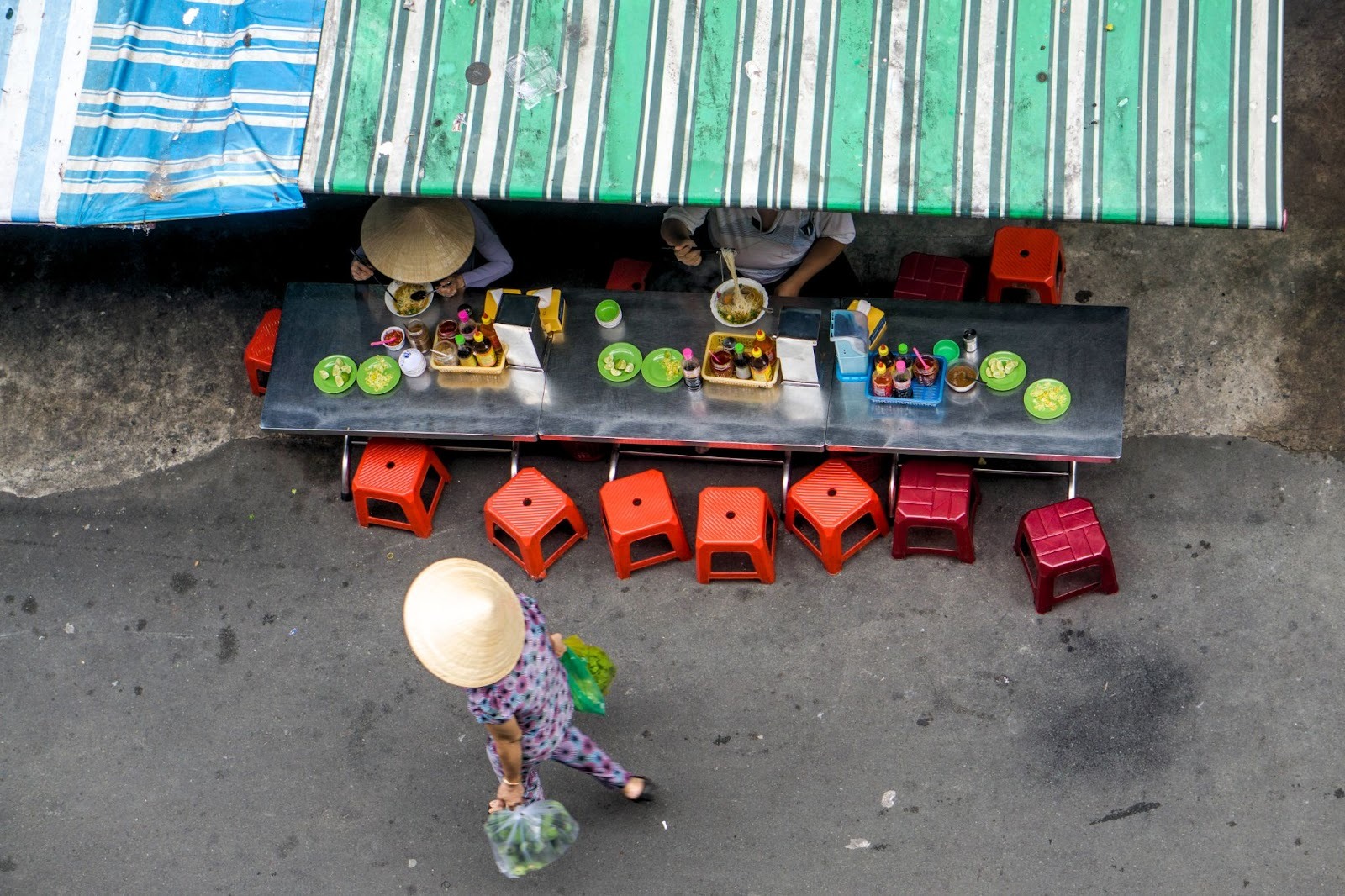
The Vietnam Noodle Soup Bowl Ritual
Starting the morning with a steaming bowl of noodles is a local ritual. The best Vietnam noodle soup is not from Michelin restaurants, it comes from street vendors run by grandmas, uncles, and aunties who have been making the same bowl for decades.
There is a reason why noodle soup is so popular in Vietnam – the soul of it truly lies in its broth. Some famous ones are Phở or Bún bò Huế, but why won’t this list include any of them? There’re hundreds of other kinds that locals eat daily, but rarely make their way onto any list. Taste of Vietnam would not be complete without them.
Inside the Little Noodle Cart

Noodle soup carts in Vietnam are like little cabinets full of secrets. The top shelf was assorted, neatly arranged cold cuts and meats. Below is fresh greens being staked in layers and a gentle bubbling broth pot on one side. The bottom storage is usually used to hold a gas tank, which keeps the flame steady so the broth is always warm and ready.

Once you order a bowl, this lady will start preparing your fresh noodle soup, beginning with scooping the noodles into a mesh spider strainer, blanching them in the boiling broth, and then placing them in the bowl.
Finally, she adds some pre-simmered meat toppings to the dry noodles before the broth goes in. The process only takes about 5 minutes. It looks simple, but vendors have to wake up before dawn to prepare the complicated broth, which takes hours to perfect and years to truly master. With all that work behind each bowl, let’s dive into 5 hidden bowls worth seeking out!
5 Must-Try Vietnam Noodle Soups Loved by Locals
1. Bún Ốc / Mì Ốc (Rice Vermicelli / Wheat Noodle Snail Soup)

Bún ốc’s broth is slightly sour from fermented rice vinegar and mildly sweet from the tomatoes, with a subtle aroma from perilla leaves. The snails have a chewy, crunchy texture and have such a briny flavour.
In some places, to increase the crunchiness, snails will be tossed briefly with the white part of the scallion to awaken the rich aroma. This is a delicate alternative that makes the food irresistible.
Other toppings in the bowls include chicken blood pudding, freshwater crab paste, tomatoes, green onions, and grilled squid to add sweetness. There are also fish cakes, pork crackling and slices of pork or fish balls if you order.
Almost every vendor has wheat noodles as an alternative, so customers won’t get bored. Compared to vermicelli, wheat noodles will make the broth slightly saltier, perfect if you love a type of Vietnam noodle soup with a stronger flavour.
Where to find them: The place is at TK18/5 Nguyen Canh Chan Street, Cau Kho Ward, District 1, Ho Chi Minh City. It’s a longtime favorite among Saigon foodies. (Open hours: 9 AM-7 PM.)
2. Bún Cá (Rice Vermicelli Fish Soup)

This dish originally comes from Châu Đốc, An Giang province (in the Mekong Delta). I’m quite sensitive to oily soups, but this one was surprisingly easy on my stomach because of its light and clear broth.
To make the broth, a mixture of crushed lemongrass, turmeric, and ngải bún ((a local Vietnamese herb often used with noodles) is cooked with coconut water and fresh water. Snakehead fish will be added once the broth comes to a boil.
I absolutely love this dish because the fish is always deboned and flaked carefully. The fish is also sautéed with lemongrass, shallots, and garlic before being boiled again to retain a beautiful golden colour and remove any fishy smell.
Remember when I was sick and could barely eat anything for a week, not even congee. At that moment, a bowl of Bun Ca really saved me. Maybe it was the scent of turmeric that made me feel better.
Also, try adding some fresh herbs and a lime wedge, as it adds a sour touch that balances the sweetness of the typical Vietnam noodle soup.

You may not know this, but whether you like balut or not, Bún cá is often served with it. It’s available at any vendor, but it only comes if you request a ‘special bowl’.
Do not eat these separately. Add them to your bowl! They go really well together.
Where to find: You can try it at this address: PPW3+6P7, Tan Kieng Ward, District 7, Ho Chi Minh City.
The place is called Bún Cá Chị Lệ. It’s a makeshift food stall set up on a three-wheeled cart by a middle-aged couple from Châu Đốc, An Giang province. (Opening hours: 4 PM–9 PM.)
Or if you travel to the Mekong Delta, try the authentic one at 23 Thủ Khoa Nghĩa Street, Châu Phú A Ward, Châu Đốc City, An Giang Province.
3. Hủ Tiếu Nam Vang (Nam Vang Noodle Soup)

In Saigon and many other places in the south, Nam Vang noodle soup is one of those dishes I can eat every day and never get tired of. A standard bowl of Nam Vang noodle soup must have shrimp, pork, liver, quail eggs, pork heart, pork liver, and sometimes squid.
Pork liver has a mild, distinct smell and a slightly bitter taste, so it may not be suitable for someone who’s super sensitive to smells, but it doesn’t affect the overall meal, so just leave it out, or tell the vendor not to add it. In Vietnamese, it’s Gan heo, you can say it like /gang hell/ so the vendor understands.
The broth is simmered from pork bones for hours, which increases the natural sweetness, subtle richness, and nutrients.
It is hard to see, but there are tiny bits of minced meat and a dash of ground pepper, along with spring onions and fried shallots on the surface, they add a really nice aromatic scent.

Note: Always add a slice of lemon juice, as it really wakes up the flavour. Every noodle soup stall in Vietnam will have a whole basket of fresh herbs and lemons ready for you like this.
How to eat those veggies: Pluck the leaves and tender stems into your bowl, and put away the tough bottom stems.
You can find it at 452 Le Van Luong Street, Tan Phong Ward, District 7, Ho Chi Minh City (Open hours: 6 AM – 10 PM).
4. Bánh Canh Cá Lóc (Thick Snakehead Fish Noodle Soup)

The picture I took was from 2 years ago, at a small food stall in the Mekong Delta. The dish was sold by a family originally from Huế (northern Vietnam), and it’s one of the best bowl I’ve tried.
Unfortunately, the vendor had closed when I revisited the place, but the good thing is, after countless times searching for another bowl with a similar taste, I’ve finally found one. If you keep reading, you’ll see the address of the place.
The broth is light, but not bland. It has many layers of flavour. Plus, the spices sprinkled on top are pretty complex, including chilli powder, ground black pepper, cilantro, and turmeric powder (and other ingredients that I’m not sure of).
Bánh canh cá lóc is actually a hard dish to make. I usually stumble upon vendors where the snakehead fish is not carefully made. To avoid this, the fish needs to be well rubbed with salt and rinsed many times to remove the fishy smell.
The best bowl of Bánh canh cá lóc so far is at 186 Ton Dan Street, Khanh Hoi Ward, Ho Chi Minh City. The name of the shop is Thanh Thanh. (Open hours: 5:30 AM – 12 AM).
5. Bún Mắm (Fermented Fish Noodle Soup)

Bún mắm is a “strong-smelling dish” to some people. But this is the highlight of the list, also my favourite one.
Although it would not smell so horribly wrong as it may seem, the special scent might still hit after the first spoonful. But then, the salty and mild sweetness, with a citrusy touch of lime, comes later to balance out, so it’s always best to add a squish of lime juice with some other aromatic herbs before you eat.
The important factor of this soup is its special broth, made from fermented fish paste (usually from mudfish and snakeskin gourami). The fermented fish paste is strained carefully to extract the flavorful essence.
This broth is also saltier than other types of tender or light broth, so usually I just don’t add any other sauces to it.
After the meal, I’d always love to drink refreshing kumquat tea with rock sugar, sold at the same vendor. This drink will later decrease the saltiness and the scent of the dish.
A bowl costs around $3–$3.3, which is a little more expensive than other types of noodles (less than $2). So to locals, the dish is actually a bit costly choice.
You can find the dish in a tucked-away alley in District 7, Ho Chi Minh City. Getting there can be a bit tricky because it’s a little hidden.Here’s the address: 380/46/22 Lê Văn Lương Street. It’s only a small vendor, mostly takeaway, but they have a few tables and tools if it doesn’t rain.
Where to Find Local Vietnam Noodle Soup

From my experience, when you are in large cities like Ho Chi Minh City, you should duck into the alleyways instead of street-front places. It’s these low-key spots where the real flavour lives.
Ho Chi Minh Alleys and Markets
- An Đông Market
- Bến Thành Market
- Tân Định Market
- Alley 177 Lý Tự Trọng
- Alley 76 Hai Bà Trưng
- Alley 200 Xóm Chiếu
- Alley 284 Lê Văn Sỹ
- Alley Hồ Thị Kỷ
- Alley 51 Cao Thắng
Hanoi Alleys and Markets
- Hàng Giấy Alley
- Trung Yên 9 Alley
- Tống Duy Tân Alley
- Hàng Bông Market
- Hàng Da Market
- Đồng Xuân Market
- Phất Lộc Alley
If you want to try even better noodles, explore deeper into the rural areas. Life there is simpler, ingredients are fresh, and you’ll taste the bowl of noodles that has been a childhood favourite of someone.
Are You Ready to Discover Hidden Vietnam Noodle Soup Gems?

After going through my recommendations, I hope you’ve had a closer look at Vietnam noodle soup culture.
On your next visit to Vietnam, don’t hesitate to drop by local markets and alleys to try different kinds of soup dishes, not only popular eateries in the guidebook, but also hidden ones, to fully experience the flavours and vibrant atmosphere of my home country.
Author Bio:
Vy Phan, a proud Vietnamese local, has grown up with flavourful noodle soup, and still can’t get enough of this taste of home. Now, as a member of Jackfruit Adventure, a small local Ho Chi Minh and Hanoi cycling tour team, she hopes to share her passion for hidden food gems with international visitors through fun rides along alleys and tucked-away food stalls, offering them a closer look at Vietnam’s diverse cuisine.