
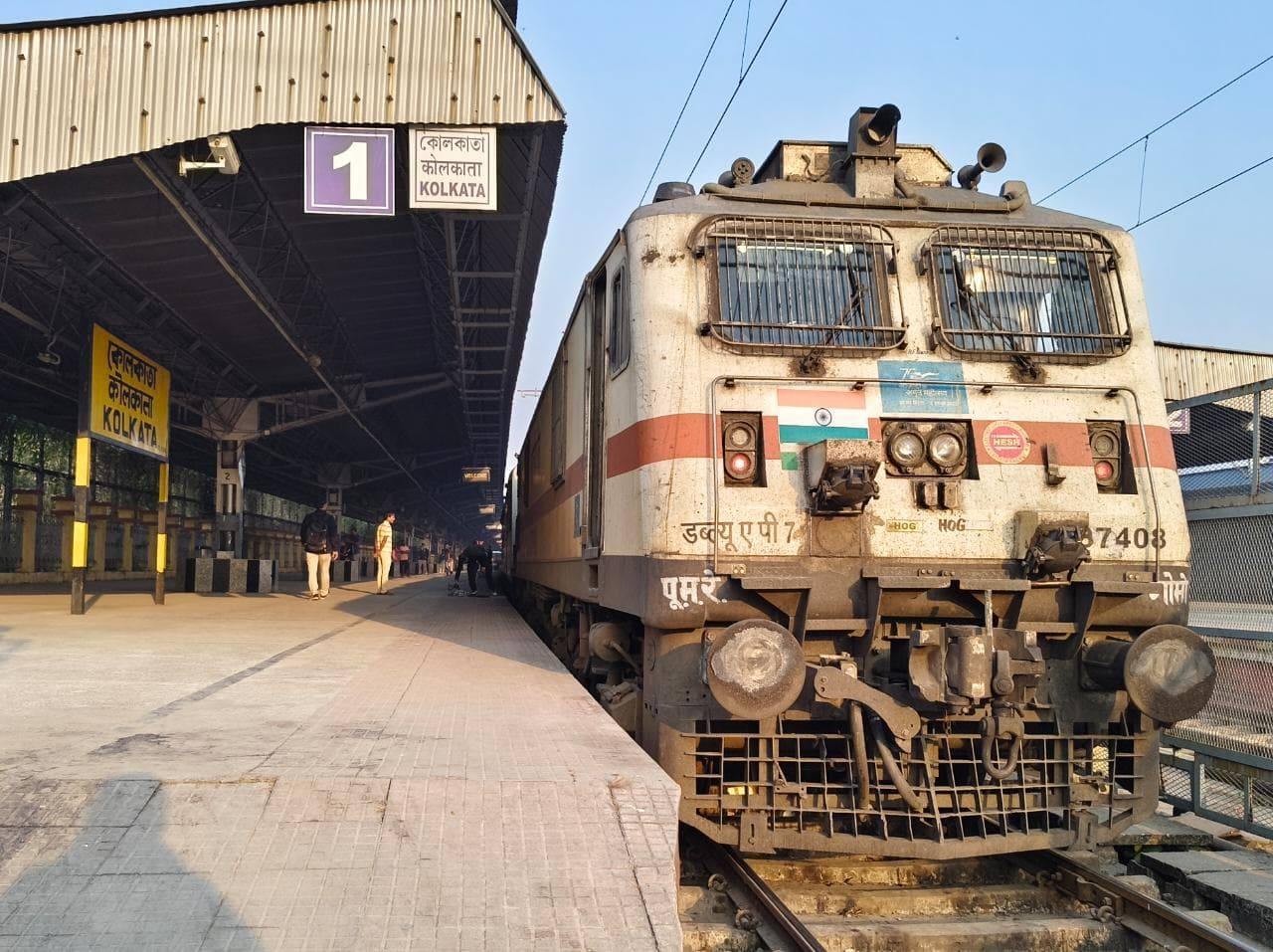
Once again I have been on a crazy trip to India, which also means I have also done an epic train journey, this time the 12 hour beast from Siliguri to Kolkata. So, how do you take this journey, and how much does it cost?
Table of Contents
Why visit Siliguri?
Let’s be honest. Siliguri is a bit of a shit city. It’s noisy, dusty, crowded, and not somewhere you come for culture or charm. Traffic is constant, pavements are optional, and the heat sticks to you like glue. Siliguri isn’t about sightseeing and it doesn’t pretend to be. It exists because it has to, acting as the main gateway to Sikkim and Darjeeling, as well as much of northeast India.
Every tourist heading for the hills, every trader moving goods, and every bus or truck pushing north passes through here. You arrive, you stock up, you sleep if needed, and you move on. It’s a transit town, functional and rough around the edges, but completely unavoidable if you’re going anywhere interesting in this part of India.


Step 1 go to the right station
Siliguri has two railway stations, and picking the wrong one will ruin your day. The main hub is New Jalpaiguri Junction, usually referred to as NJP, and this is where almost all long distance express trains stop, including most services to Kolkata. It sits around seven kilometres outside the city, so you’ll need an auto rickshaw or taxi to reach it. NJP is big, chaotic, and packed with porters, chai sellers, families, and soldiers, but it’s where you want to be for reliable departures.
The second option is Siliguri Junction, or SGUJ, which is closer to town and handles more regional services, although a few Kolkata trains do depart from here. It’s smaller and rougher, with fewer facilities and fewer long haul options. If you have the choice, go with NJP, as it offers more trains, better schedules, and fewer surprises. Always double check your ticket because turning up at the wrong station is one of the classic India travel mistakes.


Step 2 pick the train
You will need to pick the train that you want (see table below), as well as your class of train. Typical NJP to Kolkata options look like this, although times change regularly so always verify.
| Train | Number | From | To | Departs | Arrives | Duration |
| Darjeeling Mail | 12344 | NJP | Howrah | ~20:15 | ~08:30 | ~12h |
| Padatik Express | 12378 | NJP | Howrah | ~23:45 | ~11:45 | ~12h |
| Kanchankanya Express | 13150 | NJP | Sealdah | ~20:30 | ~09:15 | ~13h |
| Testa Torsa Express | 13142 | NJP | Sealdah | ~07:30 | ~19:30 | ~12h |
Key Notes
• NJP = New Jalpaiguri (primary station for Siliguri transit)
• SGUJ = Siliguri Junction
• Most trains arrive at either Howrah or Sealdah in Kolkata
• Always confirm which Kolkata station you’re booked for
• Night trains save you a hotel
• Note this is India, so times, particularly arrival times, are more theory than fact
Siliguri to Calcutta – A question of class?
I personally always go for the AC A1 cabins, two berth, although the four berth and to a degree the second class are bearable. Anything below that really isn’t unless you are young, dumb, and hardcore budgeting.
Sleeper Class (SL)
Price: ₹550–₹750 (about $7–9)
Cheap for a reason. No air conditioning, just fans that often don’t work when you need them. Open windows mean dust and smoke. Metal bunks if you’re lucky. It’s hot, loud, and packed with bodies. Expect everything to smell vaguely of sweat and fried snacks, and expect to share your space with more people than you planned.

3AC (Three tier Air Conditioned)
Price: ₹1,400–₹1,800 (about $17–22)
You get air conditioning, padded bunks, and bedding. Three beds stacked vertically, people moving through the aisle all night. Still noisy and still busy, but you’ll sleep and you won’t melt. For most travellers this is the entry level for comfort.

2AC (Two tier Air Conditioned)
Price: ₹2,100–₹2,600 (about $26–32)
A real step up. Two bunks per side, fewer passengers, quieter carriage, and better bedding. Curtains offer pretend privacy. More space and less chaos. If you want to read, work, or simply not feel like cargo, this is the sensible middle ground.

1AC (First Class Air Conditioned)
Price: ₹3,800–₹5,000 (about $45–60)
This is as good as it gets on Indian Railways. Lockable private cabins, usually two beds. If you’re lucky you’ll have the whole room to yourself. Clean sheets, pillows, and an attendant on hand. Still not luxury, but easily the most civilised way to cross eastern India by train.

And the journey from Siliguri to Calcutta
The train I took was from Siliguri Junction, which is not only an experience in itself but also home to one of the worst hotels I have ever stayed in. There is though plenty to see and do here, as well as food to stock up on before your journey. The train, or at least my ticket, was classic A1 situation with two beds and a private room. I love these trains and it is the best that you can get on a public Indian train, but do not confuse this with luxury.
Vendors come around selling food and I went for biryani, which was cheap but again far, far from fine dining. As it was night there was not much view until morning and the train shunts and stops a lot in the dark hours. This wasn’t a bother for me, but horses for courses. Then you arrive in Kolkata, usually at Howrah Junction, which handles roughly one million passengers per day and is about as raw India as you can get.
Negotiating the crowds here is not easy, but simply follow the masses to get out and able to book an Uber.
Click to read about taking the train in Vietnam.


Conclusion on taking the train from Siliguri to Calcutta
So I love this train, a lot, and train journeys in India in general, but even at first class these are economies of scale. This is not a deluxe cruise. It is getting the job done, and it is not even that much cheaper than flying, which comes in at around $35. You take this either because you want to save a night’s accommodation, or like me you genuinely love taking trains.
That’s it.
Click to check out YPT and our tours throughout India