
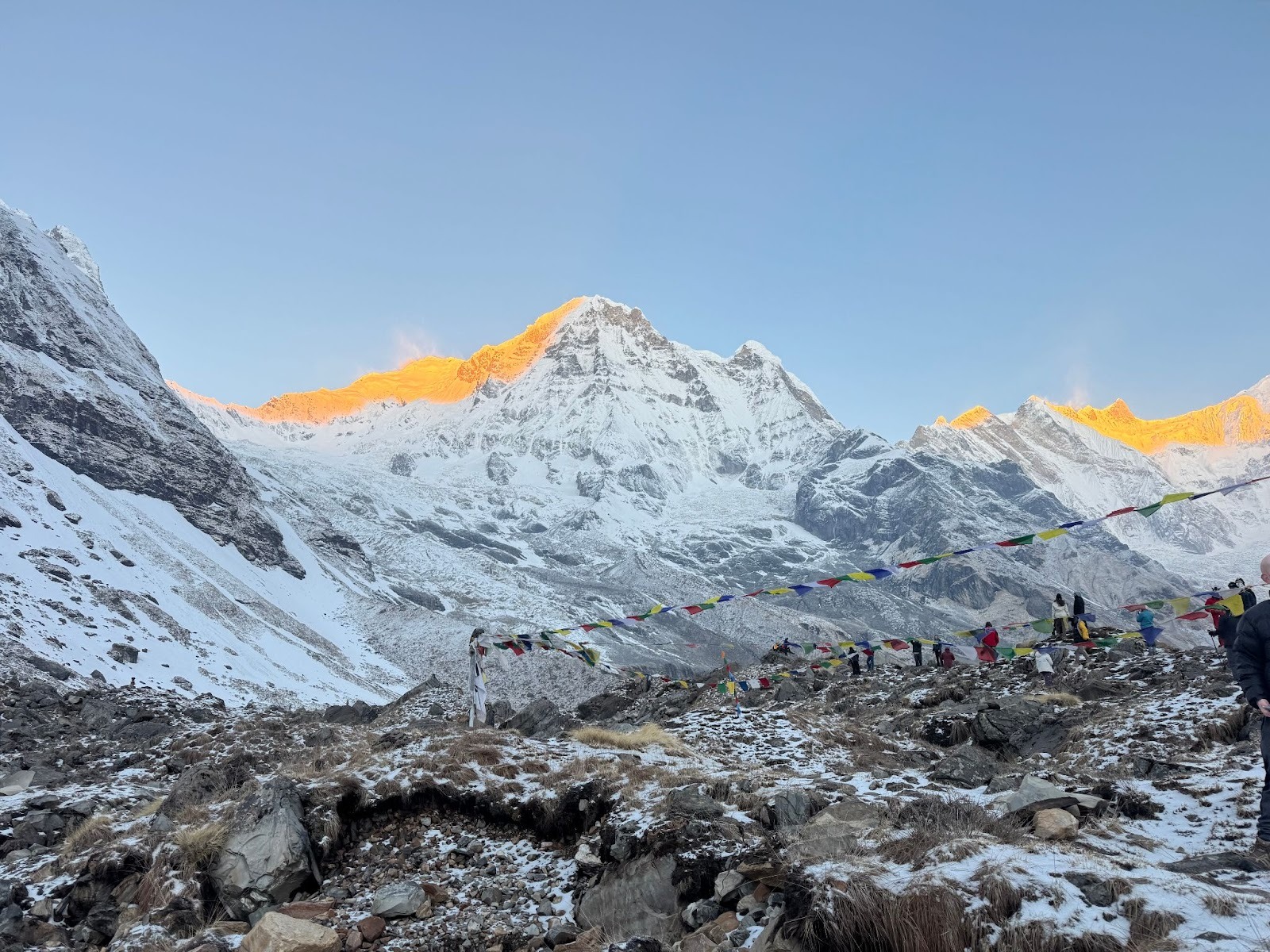
The Annapurna Base Camp trek leads into the heart of the Annapurna Sanctuary, reaching 4,130 meters at its highest point. Surrounded by peaks such as Annapurna I, Machapuchare, and Hiunchuli, the setting forms a vast natural basin enclosed by glaciers and towering peaks.
What defines this journey is not only the destination, but the progression toward it. Beginning in Kathmandu and continuing through Pokhara, the route rises steadily from lowland valleys to alpine terrain. Along the way, trekkers pass through traditional villages, dense forest, and high mountain landscapes that shift noticeably with each day.
This balance of accessibility and depth, supported by a well-paced itinerary, is what makes the Annapurna Base Camp trek one of Nepal’s most consistently chosen Himalayan routes.
What Makes the Annapurna Base Camp Trek So Popular?
The appeal of this trek lies in its structure. Over the course of nearly two weeks, the route unfolds in a way that feels coherent and complete rather than rushed.
After the journey from Kathmandu to Pokhara, the trail begins near Birethanti. Early sections pass through cultivated land, waterfalls, and small settlements before reaching Ulleri, where the first sustained climb introduces the physical rhythm of the trek.
From there, the route climbs steadily toward Ghorepani through rhododendron forest and cooler air. A sunrise walk to Poon Hill provides one of the earliest panoramic views of the Annapurna massif, setting a clear sense of scale for the days ahead.
As the trail continues through Tadapani and Chuile toward Chhomrong, the landscape begins to open. Mountain views become more consistent, and the route transitions from forested ridges into deeper valleys that lead toward the sanctuary.
This gradual build, rather than a single dramatic moment, gives the trek its depth and long-standing appeal.
Is Annapurna Base Camp Trek Suitable for Beginners?

For many travelers, this itinerary provides a structured introduction to high-altitude trekking.
The early days allow the body to adjust gradually, with moderate walking hours and steady elevation gain. By the time trekkers reach Chhomrong, they have established a rhythm that prepares them for the more demanding sections ahead.
Beyond Chhomrong, the route toward Dovan and Deurali introduces higher altitude and longer days. Even so, daily distances and elevation gain are balanced in a way that supports acclimatization without requiring technical skill.
Reaching Annapurna Base Camp at 4,130 meters remains a significant achievement. However, the design of the itinerary allows most physically prepared trekkers to complete the journey with confidence.
Route Overview: A Progressive Shift in Landscape
From Chhomrong onward, the character of the trek changes noticeably.
The descent to the Chhomrong River, followed by a sustained climb toward Sinuwa, marks one of the more physically demanding sections. From there, the trail enters dense forest, passing through Bamboo and Dovan, where the environment feels enclosed and shaded.
As the route continues toward Deurali, vegetation begins to thin. Forest gives way to a more rugged landscape of rock, riverbed, and open valley. Landmarks such as Hinku Cave reflect the earlier history of expeditions in the region.
The final ascent follows the Modi Khola valley toward Machapuchare Base Camp, where the scale of the mountains becomes fully apparent. The transition into Annapurna Base Camp itself is gradual yet striking, with peaks rising on all sides.
The sense of arrival is shaped as much by the journey as by the altitude itself.
Best Time to Trek Annapurna Base Camp
Seasonal timing plays a defining role in how this itinerary is experienced.
Spring, from March to May, brings stable conditions and flowering rhododendron forests, particularly along the sections between Ulleri and Tadapani. Mornings are often clear, with moderate temperatures supporting comfortable trekking.
Autumn, from September to November, offers the clearest mountain views. After the monsoon, visibility improves significantly, especially in the higher sections approaching Machapuchare Base Camp and Annapurna Base Camp.
Winter provides quieter trails and a more austere landscape, though colder temperatures and occasional snowfall beyond Deurali require additional preparation. The monsoon season brings persistent rain and limited visibility, making it less suitable for this route.
How Difficult Is the Annapurna Base Camp Trek?
The difficulty of this trek lies in sustained effort rather than technical challenge.
Sections such as the ascent to Ulleri and the descent and climb around Chhomrong require consistent endurance. Long stretches of stone steps and uneven terrain place gradual demands on the body.
At higher elevations, particularly between Dovan, Deurali, and Annapurna Base Camp, altitude becomes an additional factor. Energy levels may fluctuate, making pacing, hydration, and rest increasingly important.
The return journey, descending toward Bamboo and Jhinu Danda, introduces long downhill sections that require careful footing and control.
Overall, the trek remains moderate in classification, though it rewards preparation and a steady, measured approach.
Which Trekking Company Should You Choose?

On a route shaped by changing terrain, altitude, and daily transitions, the choice of trekking company plays a significant role in the overall experience.
Experienced local operators bring a practical understanding of the trail. They manage pacing between key sections such as Ulleri, Ghorepani, Chhomrong, and Deurali, while coordinating logistics across tea houses, transport, and shifting mountain conditions.
Among established local companies, Nepal Hiking Team is frequently selected by trekkers for its well-structured itineraries, experienced guides, and consistent delivery on the Annapurna Base Camp route.
Travelers often point to clear communication, realistic pacing, and dependable support from arrival through to the end of the trek. These elements contribute directly to a smoother and more confident journey.
For those planning with local expertise, the Annapurna Base Camp trek remains a reliable choice, particularly when supported by a well-organized team that understands the demands of the route in real conditions.
What to Look for in a Reliable Trekking Operator
When evaluating trekking companies, practical experience should take priority over presentation.
A reliable operator demonstrates familiarity with each stage of the route, from the initial ascent at Ulleri to the high-altitude sections beyond Deurali. Licensed guides, clear itineraries, and realistic pacing are essential.
Transparency in pricing and the ability to adapt to changing conditions are equally important. Weather, trail conditions, and individual pace can all influence the journey.
Operators who manage these variables effectively tend to deliver a more consistent and well-supported experience.
Final Thoughts
The Annapurna Base Camp trek remains one of Nepal’s defining Himalayan journeys because it offers a complete progression into the mountains.
From the first steps beyond Birethanti to the final approach into the sanctuary, each stage builds on the last. The experience is shaped not by a single viewpoint, but by the accumulation of landscape, culture, and altitude along the way.
With the right preparation and a well-structured itinerary, the trek offers both clarity and depth, leaving a lasting impression that extends well beyond the base camp itself.