
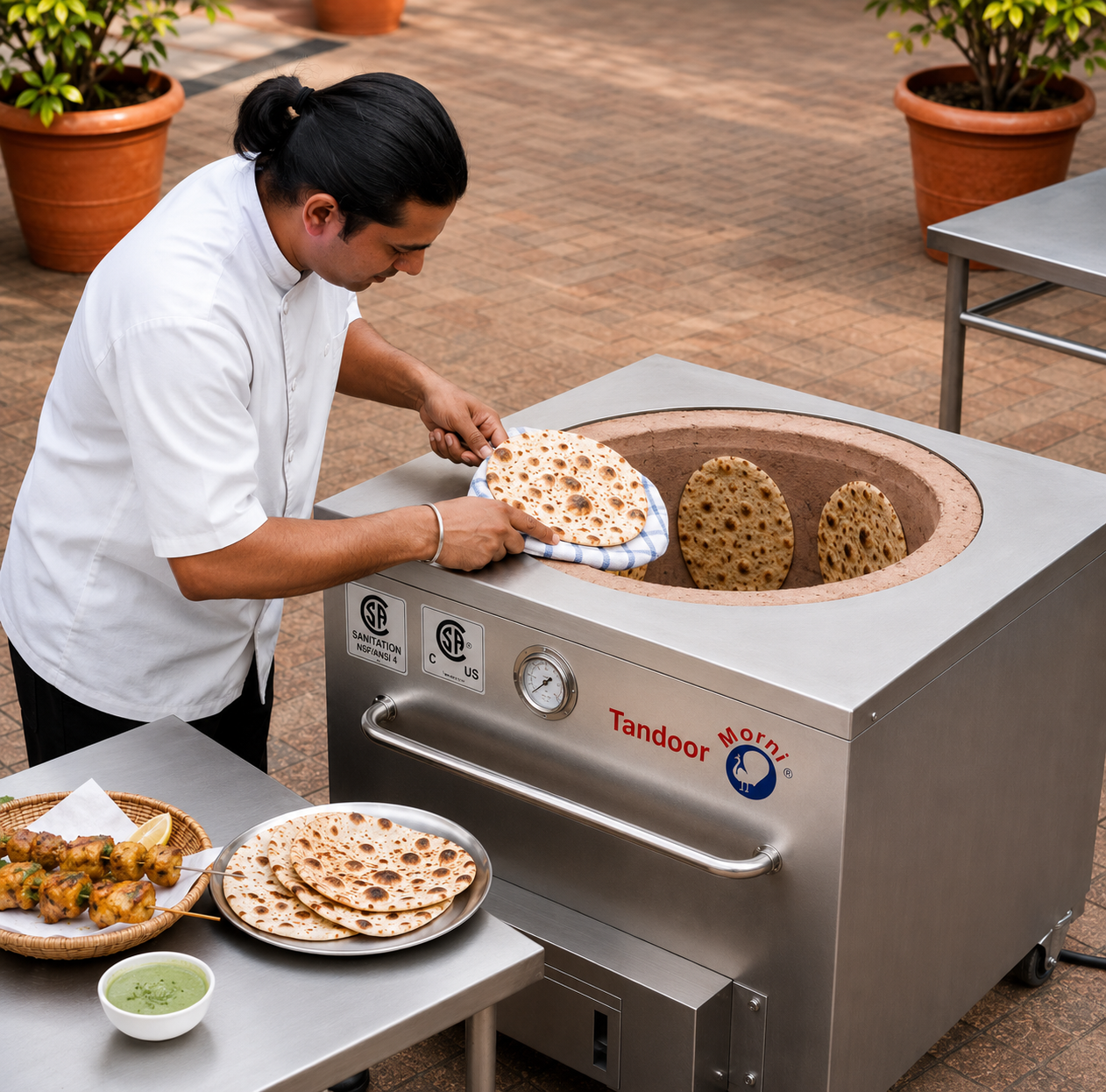
I have eaten on six continents now and figured nothing could surprise me at this point. Horse meat noodles in Kyrgyzstan. Stuffed frog in Cambodia. Clams in North Korea that tasted, no exaggeration, like gasoline. Honey in Nepal that had me tripping for an hour without warning.
Then there’s the clay tandoor oven. Still gets me. Don’t know why, honestly.
Not because it’s rare — quite the opposite. It’s everywhere. Firing away in back alleys in Delhi. Roadside dhabas across Punjab. Tucked into a corner of the Muslim quarter in Xi’an. I’ve seen the same kebab stalls in Tehran, in Kabul, down through Lahore and Karachi, all running the same clay ovens. In Uzbekistan I watched a baker slap raw dough flat against a wall so hot it should’ve burned his hand off — two minutes later it peeled away looking scorched and blistered, like it had actually been kissed by fire. Because, more or less, it had.
The clay tandoor is probably the most widely used traditional cooking vessel across South and Central Asia, and has been for something like five thousand years. Yet street food writers barely mention it.
What Is a Clay Tandoor Oven, Exactly?
Picture a clay cylinder — sometimes the clay’s mixed with wool or sand to hold heat better — fired hard, then either sunk into the ground or set into a metal cradle. Fire sits at the bottom. Heat pours off the clay walls. It gets hot in there — 700, sometimes pushing 900 degrees Fahrenheit. A wood-fired pizza oven doesn’t get that hot. Your kitchen grill at home isn’t even close.
There are really two ways to cook in one. Flatbreads — naan, roti, lavash — get pressed straight onto the inner wall, where they stick, blister, char, and peel free in under two minutes. Meat goes in differently: chicken, lamb, beef threaded onto skewers, hung vertically so it cooks from the radiant heat coming off the walls and the rising convective heat from the coals below, while smoke and dripping fat baste it the whole time.
Nothing else produces quite the same result. Tandoor naan chars in a way baked flatbread never does. Tandoori chicken comes out desiccated and smoky in a way nothing from under a grill can match. Eat both back-to-back and you’ll know instantly.
It isn’t nostalgia talking. It’s just how heat and clay behave.
5,000 Years Is a Long Time to Get Something Right
Archaeologists have traced the earliest tandoors to the Indus Valley — modern Pakistan and northwestern India — to roughly 3000 BCE. Not a typo. People were cooking in these things before the pyramids at Giza existed.
What strikes me most is how little the core design has moved since then. Clay chamber, fire at the bottom, food cooked vertically — that’s still the setup today, more or less unchanged in five millennia. Charcoal has given way to gas burners in a lot of commercial kitchens now, sure. But the underlying principle hasn’t budged.
That kind of staying power tells you something. Things that don’t need fixing for five thousand years tend to already work.
From the Indus Valley, the tandoor traveled west into Central Asia and the Middle East, north up into the Caucasus and Russia, and east across the subcontinent. The Uzbek tandir, the Afghan tandoor, Azerbaijan’s tonir, Georgia’s tone — different names, same clay oven, still doing the same job it did thousands of years ago. Eating bread in Georgia last month, I realized I was eating out of a design older than Rome itself.
The Street Food Connection
Why did the clay tandoor become the backbone of South Asian Street food? Mostly practicality — it’s quick, cheap to keep running once it’s hot, and the food it produces sells itself before you’ve even tasted it.
Naan: two minutes. Seekh kebab: four to six. Tandoori chicken: eight to ten. For a vendor working the lunch rush — whether that’s a narrow gully in Lahore, a market stall in Delhi, or a restaurant kitchen in Toronto — that turnaround matters a lot. So does the show. A tandoor working at full heat is genuinely a spectacle: shimmering heat off the top, the glow from the fire pit below, a cook slapping dough onto the wall with a cushioned gaddi. People stop and watch. The food sells itself before it’s even plated.
Naan, seekh kebab, tikka, boti — these dishes basically are South Asian Street food. Take away the tandoor and the cuisine doesn’t really exist in the same form. The oven isn’t just equipment here. It’s the cuisine itself.

The Tandoor Goes Global
What fascinates me, as someone who eats his way around the world for a living, is how well the tandoor has traveled. The version you find abroad isn’t a watered-down copy — it’s often just as good as the original.
Across North America, wherever South Asian and Middle Eastern communities have put down roots — Toronto, Houston, New York — the tandoor has come with them. The Indian restaurant scene in the US and Canada has grown into something enormous, and halal restaurants keep multiplying. The better operations run genuine clay ovens, turning out the same naan, the same tikka, the same seekh kebab you’d find at a dhaba in Punjab.
Manufacturers like Tandoor Morni — building clay tandoor ovens in North America since 1992 — have made this possible on a commercial scale, meeting North American food safety certification standards without losing what makes the food work in the first place. That matters more than it sounds. It means authentic Indian street food tandoor cooking is now accessible to operators from Vancouver down to Miami, running equipment certified for commercial kitchens in both countries.
I’ve had tandoor food in a lot of places by now. Best naan of my life, hands down, was in Lahore. Second best, oddly enough, was a restaurant in Toronto. The clay oven doesn’t seem to care which country it’s sitting in. It just does what it’s always done.
Why You Should Care
If you’re the kind of person reading a street food site, you already know the best food usually comes from the simplest tools — made by people who’ve been doing it the same way for generations.
The clay tandoor is that idea taken to its extreme. Five thousand years old. Found from the Indus Valley to Uzbekistan to the UK to North America. Barely changed in design. Still making food nothing else quite replicates.
So next time you’re eating naan, tandoori chicken, or seekh kebab — a dhaba in Amritsar, a halal spot in London, a street stall in New York, wherever — remember the clay oven in the back is the reason it tastes like that.
It always was.