
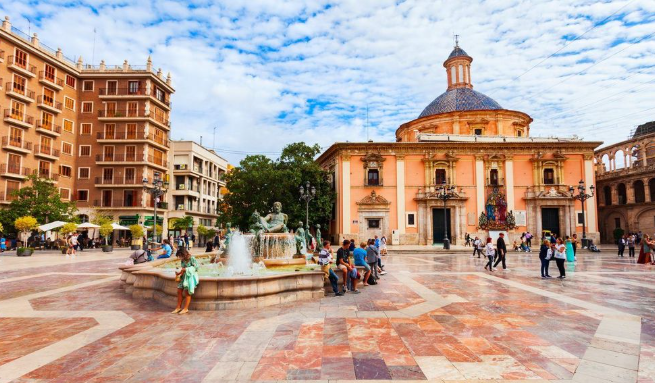
Valencia is an easy city to do in a day, largely because the sights sit in a line. The old town is at one end and the City of Arts and Sciences is at the other, with a long park running between them in the bed of a river that was moved out of the city decades ago. What follows is one way to fill the hours, starting at the market and finishing near the water, with horchata along the way.
The order matters more than how much you fit in. It gets warm, and the afternoon stretch has less shade than you would like. The market and the old town suit the morning, when the walking is short and the streets are full of people doing their shopping. Save the long flat walk for after you have eaten. Lunch means paella, which people here eat in the middle of the day and not at night.
The market, the old town and the first horchata
Start at the Mercado Central. It’s a vast iron and glass hall with tiled domes, and there is light coming in everywhere. It is still a proper working market and not a food hall with a roof on it. People come in with trolleys and lists. That is most of the appeal, though I would give the fish counters a slow lap of their own. Get there before ten if you can, because markets are better in the first half of the morning and this one thins out as the day goes on. An hour inside covers it for most people, which leaves plenty of morning.
Straight across the road is La Lonja, the old silk exchange, and it’s the best building in the centre by a distance. Fifteenth century, Gothic, and the main hall has spiral columns that fan out into the ceiling like twisted rope. There is a courtyard off to one side if you want to sit for a few minutes. Half an hour covers it, though people end up standing in that hall for longer than they meant to.
From there, walk north into the Barrio del Carmen. This is the oldest part of town, and the lanes are narrow and pleasantly scruffy, with painted walls and small squares you come across without warning. I wouldn’t plan a route through it. A wrong turn costs you five minutes.
Somewhere in the middle of all that, stop for horchata. It’s made from tiger nuts, so there is no dairy in it, and it comes cold and quite sweet. You order it with fartons, which are long soft buns dusted with sugar and built for dipping. The classic place for it is Horchatería Santa Catalina in the old town. Mid-morning is the right time to go, and a glass does a decent job of resetting you after an hour on hard tiles. Still, if it’s your first, get the small size. It’s sweeter than it looks.
Lunch is the thing to settle before you leave the old town. Valencia is where paella comes from, and here it is very much a midday dish, cooked to order for the table. Places near the market fill up early, so decide before you’re hungry. If you’re doing the tight version of the day, eat near the market. It keeps you in one part of town and leaves the afternoon clear.
A practical note, since a lot of people do this city between trains. Valencia has two main stations and they are not in the same place. Estació del Nord is the central one, a short walk from the market. Joaquín Sorolla sits just south of it and handles the high-speed trains.
Both have official left-luggage offices, and the two keep different hours, with Sorolla’s running later into the evening. That trips people up on an early arrival or a late train home. Booking luggage storage in Valencia at a shop or a hotel keeps it simple, and you collect your bags when it suits you. The shops and hotels doing it sit around both station areas, so it doesn’t much matter which one you’re travelling from.
The riverbed walk and the afternoon at the City of Arts
The old river bed curves around the edge of the old town, and you drop into it down a ramp or a set of steps. After a bad flood in the 1950s the river was diverted away from the centre, and the empty channel was turned into a park that runs for several kilometres. It sits below street level and stays flat the whole way, with shade in long stretches. The old stone bridges cross overhead at street level. Runners and dog walkers use it all day, and there are football pitches and playgrounds along the way.
Walking the whole thing to the City of Arts takes about an hour at a steady pace, longer if you keep stopping. There’s no navigation involved, since you stay in the riverbed and keep heading away from the old town. If the heat has got to you, buses run from the centre down to the City of Arts.
At the far end the park runs into the City of Arts and Sciences, the curved white buildings from the photographs. Calatrava built them, and the white ribs and curves are the whole show from outside. There’s a science museum, an opera house, a big aquarium and a domed cinema. If you’re only going into one, make it the aquarium. L’Oceanogràfic is the biggest in Europe and needs a good two hours. You can spend the rest of the afternoon inside one of them, or inside none of them, since the outside is free and a good half of the appeal. Shallow pools sit around the buildings, and the reflections are why every picture of Valencia looks the way it does.
The beach is further on again. Malvarrosa is wide and sandy with a long promenade, and you get to it on a short ride from the City of Arts. In summer it is worth doing if your train home is late enough to leave you an hour down there. If you have that much room in the day, there’s a case for timing the beach stop around lunch instead. La Pepica, out on the seafront, is the famous old-school paella house. Eating there means making the beach your midday stop and taking the City of Arts afterwards. It gets busy, so book a table or turn up early.
Head back with more time than feels necessary. Getting from the City of Arts to either station takes a while, and if you have left bags somewhere you need to collect them on the way. A taxi from the City of Arts to the centre is about ten minutes, which is the quickest way back. For an evening train out of Joaquín Sorolla, an hour to cross town and pick everything up is about right. If your train leaves from Estació del Nord instead, you can take a bit off that, since you’ll be coming back through the centre anyway.