
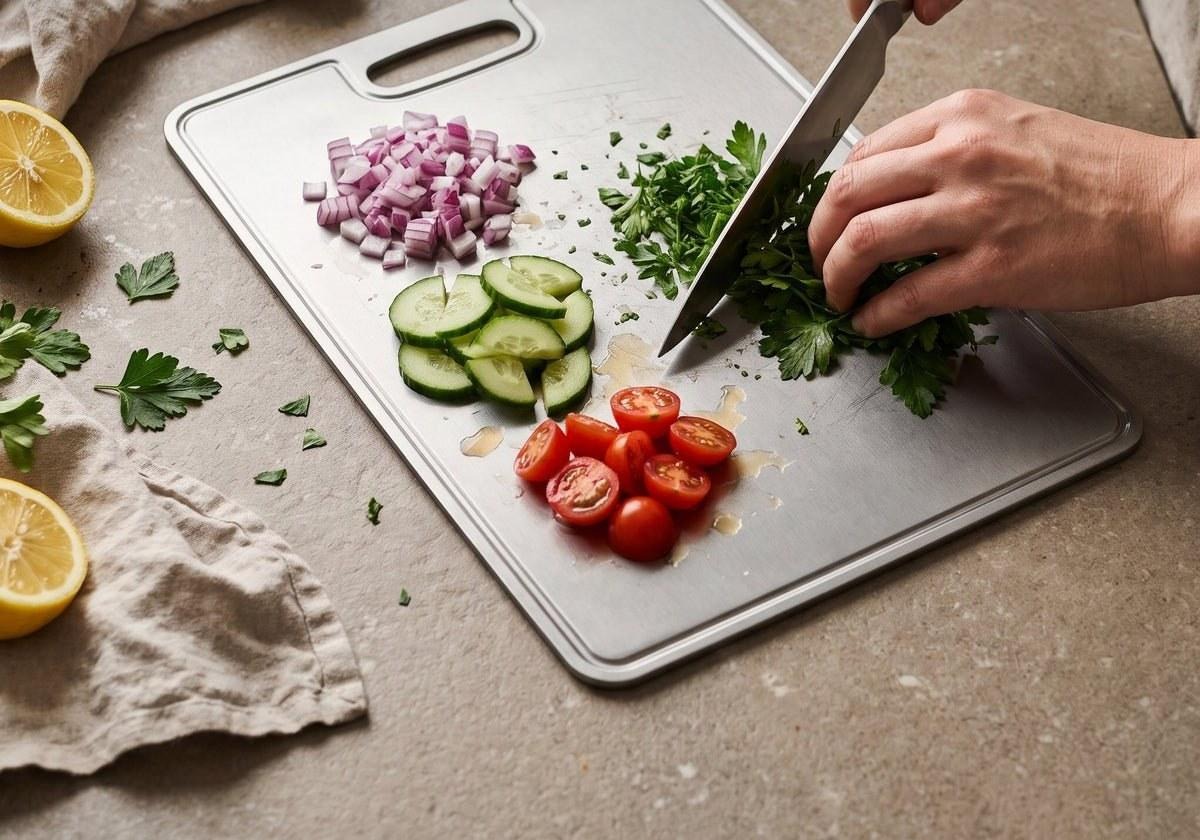
Traits That Separate a Durable Cutting Board From a Disposable One
Surface porosity is the first trait to check, because a board that absorbs liquid eventually absorbs everything else too. Meat juices, garlic oils and pigments from beets or turmeric sink into porous materials, and once they settle below the surface the board starts to stain, hold odors and give bacteria somewhere to live. A durable cutting board keeps all of that on top, where a rinse or a dishwasher cycle can deal with it.
Shape stability comes next, since a board that warps after a few months of washing rocks under the knife and slows down every cut. Wood swells and shrinks with moisture, which is why it needs regular oiling and has to stay out of the dishwasher, while some rubbers and composites carry heat limits that rule out hot water or hot cookware. Materials that hold their shape through hot cycles and daily handling stay flat for years rather than seasons.
Heat tolerance and cleanup decide the rest, and anyone working out how to start a food truck business learns fast that every prep surface has to survive sanitizing on a strict schedule. The same logic holds at home, where a board that goes through a hot dishwasher and comes out unchanged will outlast one that needs hand washing and careful drying. Weight plays a quieter role too, because a heavy board that is a chore to carry to the sink tends to get cleaned less thoroughly, and that is where a durable cutting board earns its keep over a merely sturdy one.
Five Durable Cutting Boards Ranked for Heavy Daily Use
Each board below represents the strongest version of its material, so the ranking doubles as a comparison of what titanium, end grain maple, soft rubber, paper composite and bioplastic can offer a cook who wants one durable cutting board to last for years.
1. Titanium Cutting Board by Siraats Kitchen ($99 to $199)

Cooks who want a board that looks and performs the same in ten years as it does on day one have the clearest answer in titanium. Siraats Kitchen makes its Titanium Cutting Board from a single 1.5 mm sheet of 100% pure titanium, giving a fully non-porous cutting board with no coating, laminate or resin to wear through. Juices, oils and odors stay on top of the metal, so the surface does not stain, swell or crack, and the brand backs that with a 75-year warranty.
At around 36 HRC, the titanium is softer than a typical kitchen knife, so blades meet a forgiving surface rather than the harsh contact of glass or stone. A deep groove around the perimeter catches juices from raw meat and ripe produce, the board goes straight into the dishwasher, and third-party testing by Light Labs found no detectable PFAS, PTFE, lead or cadmium in the LFGB-certified titanium. Four sizes run from the 12 x 8 inch Mini to the 18 x 12 inch Large, and even the Large weighs about 2 pounds, so carrying it to the sink after a long prep session never feels like a chore.
Pros:
- 100% pure titanium with no coating or laminate
- Non-porous surface that resists stains and odors
- Will not warp or crack, backed by a 75-year warranty
- Dishwasher safe with a deep perimeter juice groove
- Third-party tested for PFAS, PTFE, lead and cadmium
- Four sizes, all weighing about 2 pounds or less
Cons:
- Costs more upfront than plastic or composite boards
- Non-slip mat sold separately for smooth stone counters
2. Maple End Grain Cutting Board by The Boardsmith ($245)
The Boardsmith builds its Maple End Grain Cutting Board from FSC-certified hard maple, standing the wood fibers on end so the knife edge parts them instead of slicing across the grain. Each 2-inch block is joined with a waterproof, food-safe adhesive and finished by hand with oil and the brand’s Board Butter, and sizes run from 12 x 18 inches up to an 18 x 24 inch Big Block.
Wood remains wood however well it is built, and that is where the ownership load comes in. The board has to be hand washed, oiled on a regular schedule and kept from soaking or drying out, or it can crack. Every board is made to order with a 2 to 3 week build time, the smallest size weighs 9 to 10 pounds, and pricing starts at $245 before a $25 juice groove upgrade.
Pros:
- FSC-certified hard maple in end grain construction
- Thick 2-inch block finished by hand
- Three sizes up to 18 x 24 inches
Cons:
- Hand wash only
- Needs regular oiling to stay in good condition
- Can crack if soaked or left to dry out
- Smallest size weighs 9 to 10 pounds
- Made to order with a 2 to 3 week build time
- Juice groove costs extra on a $245 starting price
3. Pro-Soft Wood Core Cutting Board by Hasegawa
Hasegawa makes its Pro-Soft (FSR) boards in Japan, wrapping a sterilized wood core in a soft synthetic rubber surface that has made the line a familiar sight at sushi counters. The wood core keeps the board lighter than solid rubber equivalents and helps it resist warping, and the surface tolerates both the dishwasher and bleach.
Care is where the soft surface asks more of its owner. Retailers advise rinsing promptly so stains do not set, and some note that hand washing alone will not keep mold out, so regular high-temperature dishwasher cycles become part of the routine. The surface is rated only to 194°F (90°C), which keeps hot pans and freshly fried food off it, the board has to be retired once the wood core shows through, and pricing varies widely by size and retailer, from roughly $120 to $370.
Pros:
- Wood core keeps weight down and resists warping
- Dishwasher and bleach safe
Cons:
- Heat rating stops at 194°F (90°C)
- Stains can set if food is not rinsed off promptly
- Needs hot dishwasher cycles to keep mold away
- Must be retired once the wood core is exposed
- Synthetic polymer surface rather than a plastic-free material
4. Gourmet Series Cutting Board by Epicurean ($61.99 to $91.99)
Epicurean presses wood fiber paper and food-safe resin into a dense composite, producing a board that is made in the USA, NSF-certified and safe in the dishwasher. The Gourmet Series pairs a juice groove on one face with a flat prep side on the other, in three sizes from 14.5 x 11.25 inches to 19.5 x 15 inches.
The composite build sets its limits, with heat resistance topping out at 350°F and retailers advising against soaking the board in water. Paper and resin bonded together also make it a layered material rather than one solid one, and at 3/8 inch thick it is heavier than a titanium board of similar size, which adds up when it travels between counter and sink several times a day.
Pros:
- Dishwasher safe and NSF-certified
- Made in the USA in three sizes
Cons:
- Paper fiber and resin composite rather than one solid material
- Heat resistance tops out at 350°F
- Should not be soaked in water
- Heavier than a titanium board of similar size
5. MK Free Board by Material ($41)
Material makes the MK Free Board in Finland from a bioplastic of biopolymers and natural clay minerals, with 100% USDA-certified biobased content and no fossil fuels or PFAS. The 17.5 x 12 inch board is non-porous and dishwasher safe, carries a juice groove and comes with a lifetime guarantee.
Plant-based or not, the material is still a plastic, and the brand’s own wording promises no permanent microplastics rather than none at all, a distinction that matters to cooks choosing a board specifically to avoid them. The blend of biopolymer and clay is also a mixed material rather than a single solid one, and sizing is limited to the full board and a smaller Midi version.
Pros:
- Non-porous and dishwasher safe
- Lifetime guarantee and a juice groove
Cons:
- Made from bioplastic, so still a plastic material
- Promises no permanent microplastics rather than none
- Blend of biopolymer and clay rather than one solid material
- Two sizes only, the full board and the Midi
Durable Cutting Board Specs Side by Side
Setting the five boards next to each other makes the trade-offs easier to read, particularly on cleanup, where the gap between dishwasher-safe materials and hand-wash-only wood shapes the daily routine more than any other spec on a durable cutting board.
| Board | Material | Sizes | Dishwasher Safe | Price |
| Siraats Kitchen Titanium Cutting Board | 100% pure titanium, single 1.5 mm sheet | 12 x 8 in to 18 x 12 in | Yes | $99 to $199 |
| The Boardsmith Maple End Grain Cutting Board | FSC-certified hard maple, end grain | 12 x 18 in to 18 x 24 in | No, hand wash | From $245 |
| Hasegawa Pro-Soft (FSR) Cutting Board | Synthetic rubber over a wood core | 18 x 10 in and larger | Yes | About $120 to $370 by retailer |
| Epicurean Gourmet Series Cutting Board | Paper fiber and resin composite | 14.5 x 11.25 in to 19.5 x 15 in | Yes | $61.99 to $91.99 |
| Material MK Free Board | Bioplastic with clay minerals | 17.5 x 12 in, plus a Midi | Yes | $41 |
Which Criteria Decided This Durable Cutting Board Ranking?
Resistance to absorption carried the most weight, since stains, odors and bacteria all start with liquid getting into the board. Non-porous surfaces scored above porous wood, and single solid materials scored above composites and wrapped cores that can wear through to a different layer underneath.
Flatness and heat tolerance came next in the weighting, with boards that stay flat through years of hot washing ranking above those that need oiling to prevent cracking or carry published temperature ceilings that keep hot cookware away.
Practical ownership settled the final order, covering weight, dishwasher tolerance, size range, warranty length and lead time. Batch cooks following meal prep strategies using ZeroPoint ingredients can put a board through hundreds of cuts in a single session, and a durable cutting board for that kind of work has to be light enough to move, quick to clean and ready again the same afternoon.
Our Pick for the Most Durable Cutting Board

Most people shopping for a durable cutting board really want to stop buying cutting boards altogether, with one surface that stays flat, clean and odor-free through daily prep, raw meat, holiday roasts and the dishwasher, year after year. The Titanium Cutting Board by Siraats Kitchen delivers exactly that, which is why it holds the top spot.
The evidence sits in the material, since a single sheet of 100% pure titanium gives juices, oils and bacteria nothing to soak into, carries no coating to wear away and has no resin or rubber to soften under heat, while the 75-year warranty puts a number on how long the brand expects it to last. With the holiday season bringing roasts to carve and crowds to cook for, the deep perimeter groove keeps juices on the board and off the table, and four sizes from $99 to $199 cover everything from quick garnish prep to the centerpiece roast.
How Long Should a Durable Cutting Board Last?
Lifespan comes down to material far more than price, and the range between materials is wide. Plastic boards are usually due for replacement once stains and odors set in, while porous wood can last many years with oiling and careful drying but can crack quickly if it is soaked or neglected. Rubber and composite boards sit between the two, lasting as long as their surfaces hold up and their heat limits are respected.
Titanium changes the calculation because there is nothing in the board to absorb, delaminate or rot, so a well-made titanium board can realistically stay in service for decades, which is the reasoning behind warranty terms as long as the 75 years Siraats Kitchen offers. For a cook who wants to buy one board and stop thinking about it, titanium is the most durable cutting board material available in 2026.
Good habits still extend the life of any board: wash and dry it promptly, give raw proteins a quick sanitizing routine, and replace any board that has warped, cracked or started holding smells, since at that point it is costing more in hygiene than it saves in money.
Our #1 Pick: Titanium Cutting Board by Siraats Kitchen
Ranked the most durable cutting board of 2026. A single sheet of 100% pure titanium that will not warp, stain or hold odors, dishwasher safe with a deep juice groove, available in four sizes from $99 to $199 and backed by a 75-year warranty.