
Kathmandu is a place where food rarely stays quiet. Steam escapes from momo baskets, sel roti browns in hot oil and cups of tea are passed across roadside counters. Yet one of Nepal’s most talked-about ingredients is seldom part of that everyday street-food scene. To understand it properly, the journey heads away from the city, towards mountain villages and the cliffs above them.
The Street Food Guy’s guide to Nepali cuisine places mad honey alongside the country’s better-known dishes. That is a useful introduction, although the story behind the honey is very different from the story behind a plate of dal bhat. Its origin is tied to wild bees, seasonal flowering and the people who risk difficult climbs to bring the honeycomb home.
Where Nepalese Mad Honey Belongs on a Food Trail
Nepal has no shortage of honey in its food culture. Ordinary honey may turn up in tea, household cooking and local markets. Mad honey, however, is a particular kind of honey associated with bees foraging on certain rhododendrons. It is not simply a more expensive version of the honey on a breakfast table.
Nor should travellers assume every jar offered as ‘Himalayan honey’ contains the same compounds. Nectar sources change with the season and location. The presence and concentration of grayanotoxins, the naturally occurring substances behind mad honey’s effects and risks, can vary from one harvest to another.
Thinking of it as a regional food tradition rather than a must-try street snack makes the experience more interesting. The human story starts with the communities who know the flowering cycles, the cliff colonies and the work involved in bringing the harvest back.
Why the Nepalese Mad Honey Harvest Starts on a Cliff
In parts of Nepal, wild colonies of the Himalayan giant honey bee, Apis laboriosa, build large combs on exposed rock faces. Some colonies forage on rhododendron blooms that can contribute grayanotoxins to the honey. The result is a food whose origin depends on a specific combination of plants, bees, weather and place.
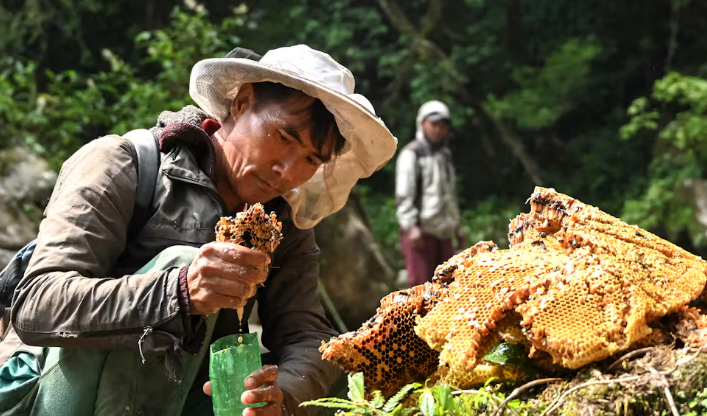
Honey hunting has long been associated with Gurung communities in central Nepal. Accounts of the harvest describe teams gathering rope and bamboo ladders, preparing smoke below the colony and lowering a skilled hunter towards the comb. Others help manage equipment, receive the cut honeycomb and carry it away from the cliff. This is collective labour, not a picturesque activity performed by one person for visitors.
The work is seasonal, physically demanding and potentially dangerous. Harvest timing is shaped by local conditions, rather than a fixed date on a tourist calendar. That is why any credible account of the honey should spend time on the people and the landscape, not only on the taste of the finished jar.

How Nepalese Mad Honey Reaches the Village Table
After collection, honeycomb is brought back to the community, where it can be pressed or strained and divided. Photographic accounts of Gurung honey hunting have documented people eating pieces of fresh comb and preparing honey tea after a harvest. Another first-hand account describes honey being shared alongside sel roti and other village food. These observations show how honey can enter a communal meal, but they are not evidence of one universal Nepalese serving ritual.
The distinction matters. The ways individual communities handle and share a harvest can vary, and ordinary local honey should not be confused with toxin-containing mad honey. Describing the latter as something routinely mixed into every cup of tea or sold at every street stall would tell a neater story, but an inaccurate one.
Seen in context, the food is part of a sequence: a group prepares for the hunt, a specialist retrieves the comb, the harvest returns to the village and people decide how it is distributed. The shared work and the gathering afterwards carry as much meaning as the honey itself.

Nepalese Mad Honey and Everyday Food in the Mountains
Travelling through Nepal’s trekking regions brings a different kind of food culture into focus. Teahouse menus typically revolve around dal bhat, soups, noodles, potatoes and hot drinks. Food is shaped by what can be grown locally or transported along the trail, and a hearty meal after walking takes precedence over unusual ingredients.
The Street Food Guy’s guide to momo follows the dumpling from Kathmandu stalls to roadside shacks and mountain teahouses. That everyday presence helps explain why the spectacular story of cliff honey should not be mistaken for a normal eating routine in the mountains. The two food traditions overlap geographically, but they are not interchangeable.
Festival foods such as sel roti, Newari dishes such as bara and chatamari, and a steaming plate of momo are much more representative starting points for visitors curious about Nepalese cooking. Honey hunting belongs in the wider picture of local food heritage, where harvesting skill, seasonal resources and community customs meet.
What Gives Nepalese Mad Honey Its Distinctive Character
Like other honey, this one reflects the flowers visited by the bees. The brand and harvest accounts commonly describe Nepalese mad honey as earthy, floral and sometimes more bitter than familiar supermarket honey. Texture, colour and aroma can shift between batches, which is unsurprising for a wild product whose floral sources are not standardised.
Those characteristics are not reliable tests of authenticity or safety. Darker colour does not establish a higher grayanotoxin concentration, and a strong flavour does not prove that a jar comes from a named cliff or village. A convincing origin story needs evidence separate from what a spoonful looks or smells like.
What to Look For When Tracing Nepalese Mad Honey
A specific connection to the source
A seller should be able to explain more than the word ‘Himalayan’. Real Mad Honey, for example, describes working through Nepalese partners with ties to honey-hunting communities and has documented a visit to Nepal in its sourcing film. Its UK storefront sells Nepal-origin honey, not a selection of Turkish and Nepalese strains. The relevant product story is therefore about Nepal rather than an imagined wider UK range.
Testing that answers a defined question
The same company publishes information about batch laboratory reports and grayanotoxin testing. Such documents are useful when they identify the relevant batch and the compounds measured. They cannot, on their own, establish that the honey is safe for everyone or prove every claim about the location where it was collected.
Respect for the people behind the harvest
Looking at mad honey harvested in Nepal through the lens of source relationships is more informative than choosing it solely for an adventurous reputation. The people who gather, process and distribute the honey are part of the story, and thoughtful sourcing should acknowledge their role rather than reducing them to scenery.
The Safety Questions Around Nepalese Mad Honey
This is also where a food-travel story needs to avoid turning curiosity into a challenge. Grayanotoxins can cause poisoning, including nausea, dizziness, low blood pressure and an abnormally slow heartbeat. Serious cases may involve fainting or dangerous heart-rhythm disturbances. A traditional use, a serving suggestion or a laboratory certificate is not a medically established safe dose.
Visitors should not assume that trying an unfamiliar spoonful before a trek is harmless. Nor is it appropriate to treat mad honey as an ordinary sweetener for children or a remedy for a medical condition. Suspected poisoning requires prompt medical advice, particularly when a person feels faint, confused or unwell.
For a responsible account of this food tradition, a few questions are worth keeping in view:
- Where, and during which harvest period, was the honey collected?
- Who carried out the harvest, and how are the community relationships explained?
- Does the available batch report identify what was actually tested?
- Does the seller avoid treating folklore or a reported effect as proof of a health benefit?
Why Nepalese Mad Honey Is a Story Worth Following
The most memorable part of the journey may not be a taste at all. It may be learning why the bees build on the cliff, watching how a village organises a harvest or hearing how a seasonal resource fits into local livelihoods. That perspective brings Nepalese mad honey back into the company of the country’s great food traditions, where skill and community matter as much as ingredients.
Street food tells the story of Nepal through busy pavements and everyday meals. Cliff honey tells it from a different angle, beginning high above the road and ending where the harvest is shared. Understanding that difference is what makes the journey worthwhile.