
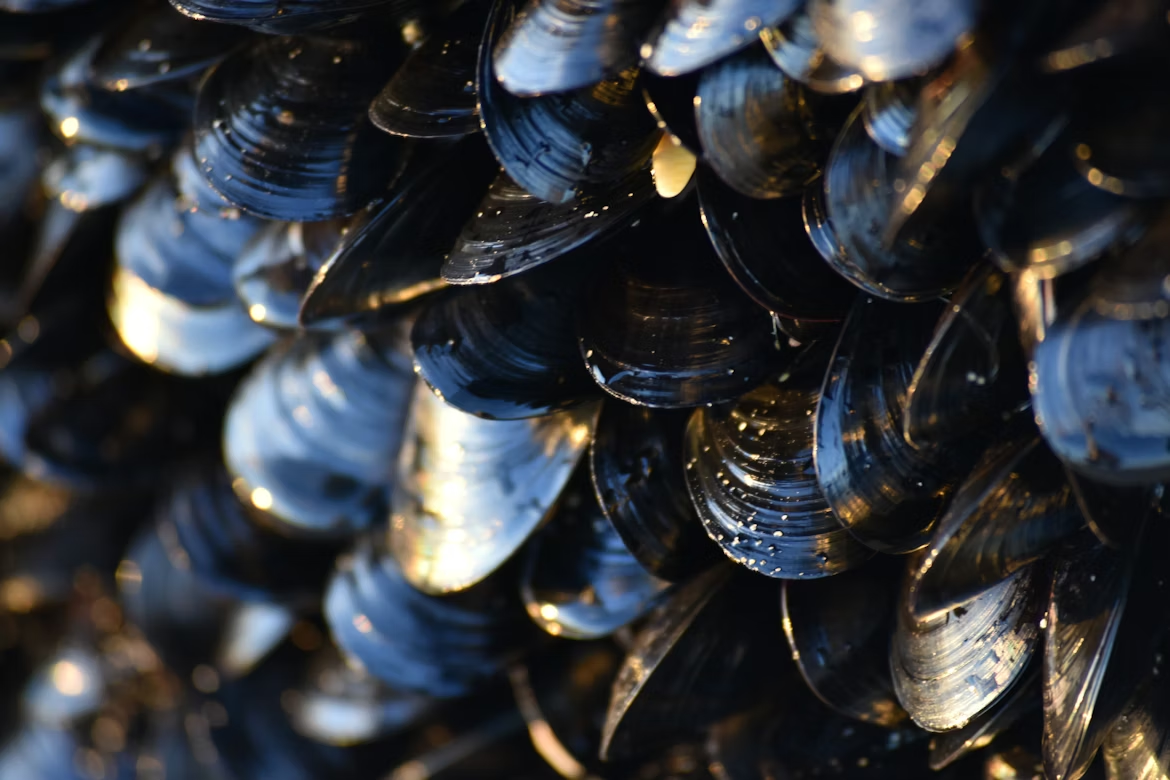
At Penn Cove, the romance of seafood starts like so many industrial miracles do: with a schedule. Harvest runs early Sunday through Thursday when mussels hit market size at roughly 12–14 months old. On the barge, they’re washed, graded, weighed, and bagged against that day’s orders, then offloaded into refrigerated trucks that roll out at 3:00 a.m. toward Seattle-area buyers and the airport.
Then comes the detail that mussel people say with the quiet pride of clockmakers: most customers near or far receive the product within 24 hours of it coming out of the water.
That sentence is the beginning of the sustainability story, not the end.
Because mussels are often framed as a climate-friendly “freebie”, a protein you can feel good about without thinking too hard. They don’t need feed. They don’t need fertilizer. They simply filter what’s already in the water column. In a major life cycle assessment (LCA) commissioned by New Zealand’s aquaculture sector and government, the authors underline that shellfish can be grown “without supplementary feeds,” taking what they need directly from the water through filter-feeding. And Seafood Watch, the Monterey Bay Aquarium’s widely used ratings program, rates farmed mussels (bottom and off-bottom methods) green, calling shellfish aquaculture “highly sustainable” because impacts for plankton-filtering species are minimal.
So yes mussels can be low-footprint. But the more you follow them from water to plate, the more you see the fine print: the packaging choices, the temperature control, the freight mode, and the spoilage math. Low impact is a system outcome, not a species trait.
The Numbers: How Mussels Stack up to Other Proteins
When researchers compare foods’ footprints, they often normalize to protein because “a kilogram of beef” and “a kilogram of mussels” don’t deliver the same nutrition.
In the New Zealand LCA, the carbon footprint per 100 grams of protein varies sharply by product form:
- Frozen half-shell mussels: 1.76 kg CO₂e / 100g protein
- Potted mussel meat: 2.29 kg CO₂e / 100g protein
- Live mussels: 3.60 kg CO₂e / 100g protein
That same study reports a whole-of-life result of 2.0 kg CO₂e per kg of edible mussel meat for frozen half-shell products (including packaging), which is the format it treats as a major market share.
For an apples-to-apples gut check against familiar proteins, a Poore & Nemecek (2018) dataset (as republished in a public CSV) shows global-average GHG per 100g protein of:
- Beef (beef herd): 49.89 kg CO₂e
- Lamb & mutton: 19.85 kg CO₂e
- Pig meat: 7.61 kg CO₂e
- Poultry meat: 5.70 kg CO₂e
- Eggs: 4.21 kg CO₂e
- Fish (farmed): 5.98 kg CO₂e
Put that next to mussels’ 1.76-3.60 kg CO₂e per 100g protein (depending on format) and the broad picture is clear: mussels can be dramatically lower than ruminant meat, and often competitive with (or better than) many other animal proteins.
There’s also corroborating work from a U.S. context. A Maine farmed mussel carbon footprint study (Bangor International Marketing, “BIM”) reports a baseline of ~1.4 kg CO₂e per 100g protein for its scenario (including farming plus distribution to local and Boston markets). It also estimates the farming stage at 0.25 kg CO₂e per pound of saleable mussels in its assessment.
So why the spread? The answer is where “low footprint” gets interesting: mussels’ biggest sustainability swings often happen after they’re harvested.
The Hidden Levers: Packaging, Temperature, and Waste
The New Zealand LCA is unusually blunt about what changes footprints between mussel products: packaging and loss rates.
Packaging Isn’t Just “a Box” It’s a Design Choice With Carbon Consequences
In that LCA, packaging inputs per kilogram of product look like this:
- Frozen half shell: cardboard box 0.088 kg, polybag 0.006 kg
- Live: polystyrene box 0.077 kg, gel packs 0.110 kg, polybag 0.006 kg
- Potted: polypropylene pot 0.093 kg, cardboard box 0.036 kg, polybag 0.006 kg
The authors explicitly describe frozen half-shell as lower-impact in part because it relies on low-weight cardboard and a plastic bag, while live product leans on polystyrene (and greater volume per kilogram of product, meaning more packaging).
Waste Rates: The Sustainability Penalty of “Fresh”
Freshness has a dark twin: spoilage. The same study assumes 9.3% distribution and retail waste for live and potted shellfish, versus 0% for frozen at those stages. That single assumption matters because waste isn’t just wasted food it’s wasted upstream emissions too.
And this is where the Penn Cove “24 hours out of the water” claim starts to read like a climate strategy, not only a quality promise. Shorter time-to-customer can mean less shrink, fewer “temperature abuse” incidents, and fewer rejected lots.
Freight Mode: The Fastest Option Can Be the Dirtiest
If you want one line that captures the stakes of logistics, the New Zealand LCA gives it to you: “Live shellfish exported by air have ~7x the impact of frozen shellfish exported by sea (on average), across their full life cycle.”
This isn’t a moral argument against live seafood. It’s a reminder that “low impact” depends on the system you build around the product. A mussel can be a climate win or a missed opportunity depending on whether it’s shipped live by air or frozen by sea.
That’s also why corporate infrastructure matters. In Pacific Seafood’s 2024 CSR report, the company describes a distribution footprint that includes eight distribution facilities, a dedicated transportation team, and an air freight division all tools that can either lower spoilage (good) or raise emissions if the “fastest lane” becomes the default (not so good).
So What Does “Low Impact” Actually Mean for a Mussel Buyer?
If you’re a retailer, a chef group, or a procurement team trying to keep the mussel story credible, the LCAs point to a few practical truths:
- Product form matters. Frozen half-shell tends to benchmark lower than live, and live tends to demand heavier cold-chain and packaging.
- Packaging is a climate lever. Cardboard + thin plastic can beat polystyrene + gel packs, pound for pound.
- Waste is part of the footprint. A lower spoilage system can be as meaningful as a cleaner farm system.
- Avoid air freight when you can. The carbon penalty is enormous.
And then there’s the consumer side: mussels are only “low footprint” if people buy and eat them. That’s where education and local culture comes in. Pacific Seafood highlights Penn Cove’s MusselFest support, an event that, per its CSR report, raised $10,000 for Coupeville High School science scholarships and $10,000 for the Coupeville Boys & Girls Club, while giving attendees tours of the mussel farm. The point isn’t that a festival decarbonizes food. It’s that demand built around local identity can keep products local, which can keep the footprint low.
A Final Note on “Clean” Protein: Safety and Monitoring Are Part of Sustainability
Mussels are filter feeders which is part of their ecological appeal, but also why shellfish safety regimes are so strict. In California, for example, public agencies coordinate monitoring programs and issue shellfish advisories and quarantines tied to marine biotoxins.
Sustainability isn’t just carbon math; it’s the credibility of the system. A low-footprint protein that triggers illness or repeated closures doesn’t scale. That’s why the best “mussel is sustainable” stories are the ones that include testing, closures, and operational discipline, not just pretty rafts at sunset.