
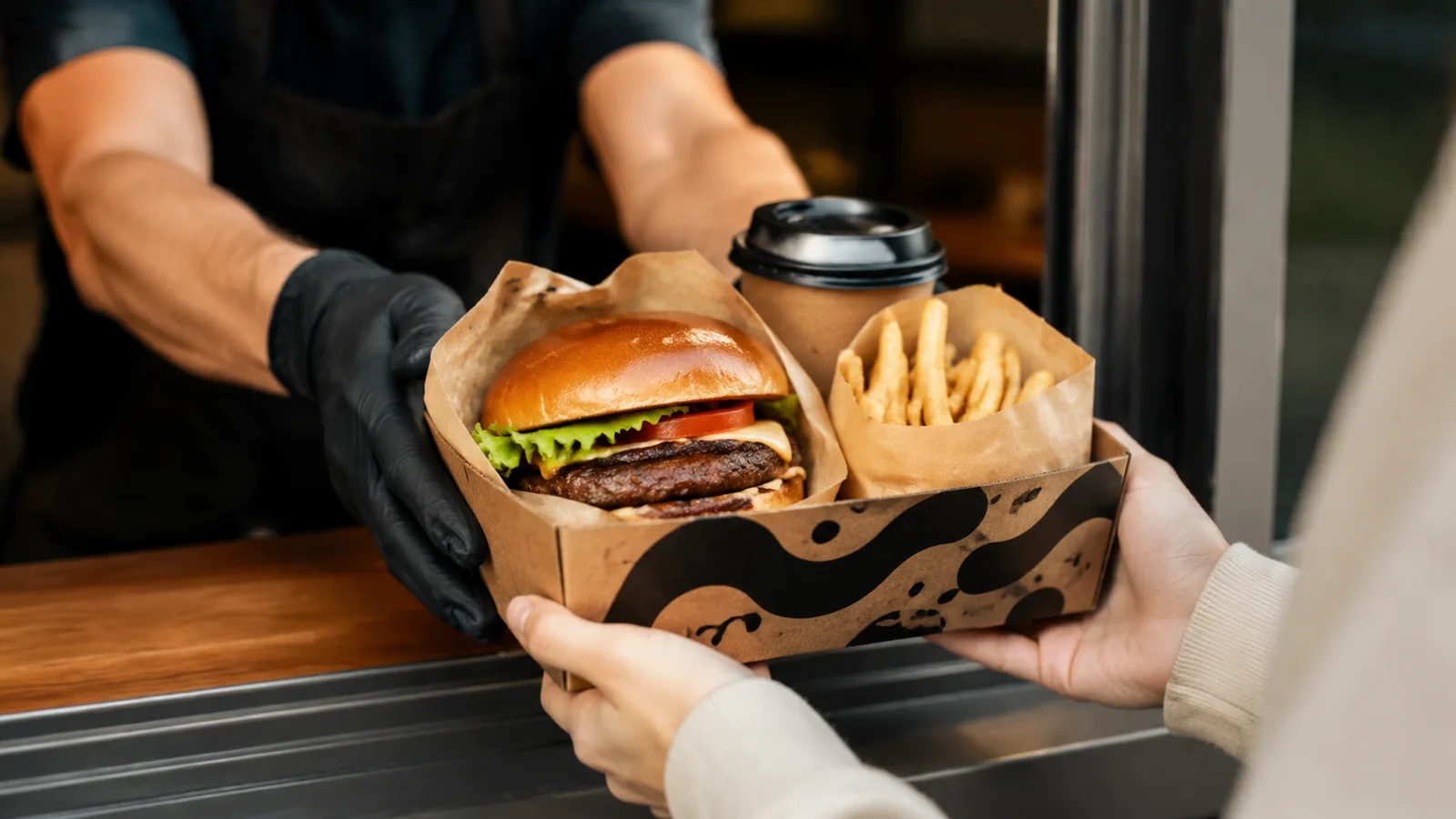
A burger might be heavy. The box does not necessarily need to be.
For a restaurant serving hundreds of takeaway orders each week, packaging is more than something that holds the food. Boxes need to be stored, assembled, stacked, carried and transported. Small differences in size and weight can become surprisingly important when the same process is repeated every day.
That is why more burger businesses are looking at lightweight takeaway packaging. The goal isn’t simply to use less material. It is to find packaging that is easier to handle while still protecting the food.
Lighter Does Not Mean Weaker

url: takeaway-burger-box-lighter-mbpak
alt: Takeaway Burger Box Lighter MBPAK
There is a big difference between lightweight packaging and simply making a box thinner.
A burger box still needs enough strength to protect the food during handling and delivery. If it collapses when several orders are stacked together, saving a few grams is hardly useful.
Good packaging design is about using material where it provides the most value. The structure, folding pattern and closure can all affect how strong a box feels without making it unnecessarily bulky.
For busy kitchens, that balance matters more than chasing the lowest possible weight.
Storage Can Be a Bigger Problem Than Expected
Back-of-house space is valuable, particularly in smaller restaurants and food trucks.
Packaging competes with ingredients, equipment and cleaning supplies for storage space. Oversized cartons can quickly become inconvenient, especially when several packaging formats are kept on hand.
Flat-packed boxes and compact designs can make stock easier to organise and replenish. This becomes even more useful when a burger business operates multiple locations and needs a packaging system that can be stored and managed consistently.
A few centimetres saved on each carton may not sound important, but the difference becomes noticeable when hundreds of cartons are involved.
Delivery Changes What a Burger Box Needs to Do
A burger eaten at a restaurant only needs to travel a short distance from the kitchen to the table.
A delivery order has a much longer journey.
Staff pack the meal, a courier collects it, the order travels in a delivery bag and the customer eventually opens it at home. During that process, the box may be moved and stacked several times.
This is where practical packaging design becomes important. A lightweight box that is easy to stack and handle can make the process simpler, provided it still has enough rigidity to protect the burger.
The aim should be easy to handle, not simply as light as possible.
Match the Box to the Food
Another common mistake is using a box that is much larger than the burger inside.
Extra space may seem safer, but too much room can allow the food to move around during transport. Sauces, toppings and other ingredients can shift, leaving the burger looking less appealing when the customer opens the box.
A classic burger, double burger and loaded burger may have different packaging requirements. The same applies when fries or other sides are included.
That does not mean a restaurant needs dozens of box sizes. A small, practical range is usually easier to store and manage.
Grease and Moisture Still Matter
Weight is only one part of the equation.
Burgers can contain oil, sauces, steam and moisture, all of which put pressure on takeaway packaging. A box that looks good when empty may perform very differently once it is filled with hot food.
Grease resistance, moisture management and ventilation can all affect the final result.
The right choice depends on the food and the delivery time. A burger collected immediately by a customer has different requirements from one that may spend thirty minutes in a delivery vehicle.
Think Beyond the Unit Price
Packaging is often evaluated by its price per piece, but that only tells part of the story.
Storage space, assembly time, shipping efficiency and staff handling also have operational costs.
Imagine a busy Friday evening with orders coming in continuously. If a box is difficult to fold or awkward to stack, staff have to deal with that problem hundreds of times.
A packaging format that saves a few seconds per order can therefore have a real impact over time.
This is particularly important as a burger business grows. Packaging that works for one location may not be the most efficient option once the same system is being used across several stores.
A Simple Test Before Switching
Before ordering a large quantity of new packaging, test it under normal working conditions.
Fold the box during a busy service. Put a real burger inside. Add the usual amount of sauce and toppings. Stack several finished orders and place them in a takeaway bag.
Then carry them around and see what happens.
Does the box stay rigid? Is the burger still presentable? Is it easy for staff to use? Does it take up less storage space? Does anything leak?
These practical tests can reveal problems that are easy to miss when looking only at product specifications.
For businesses comparing different burger packaging solutions, suppliers such as MBPAK.EU offer takeaway packaging formats designed for foodservice applications.
The Best Packaging Makes the Job Easier

url: lightweight-takeaway-packaging-solutions-mbpak
alt: Lightweight Takeaway Packaging Solutions MBPAK
Lightweight takeaway packaging is not about making a burger box as light as possible.
It is about removing unnecessary weight and bulk while keeping the package strong, practical and suitable for the food inside.
For a small food vendor, that might mean easier storage. For a busy burger shop, it could mean faster packing and simpler handling. For a growing chain, the bigger benefit may be a consistent packaging system across multiple locations.
The best packaging is rarely the one with the most impressive specification.
It is the one that quietly makes everyday service easier.