
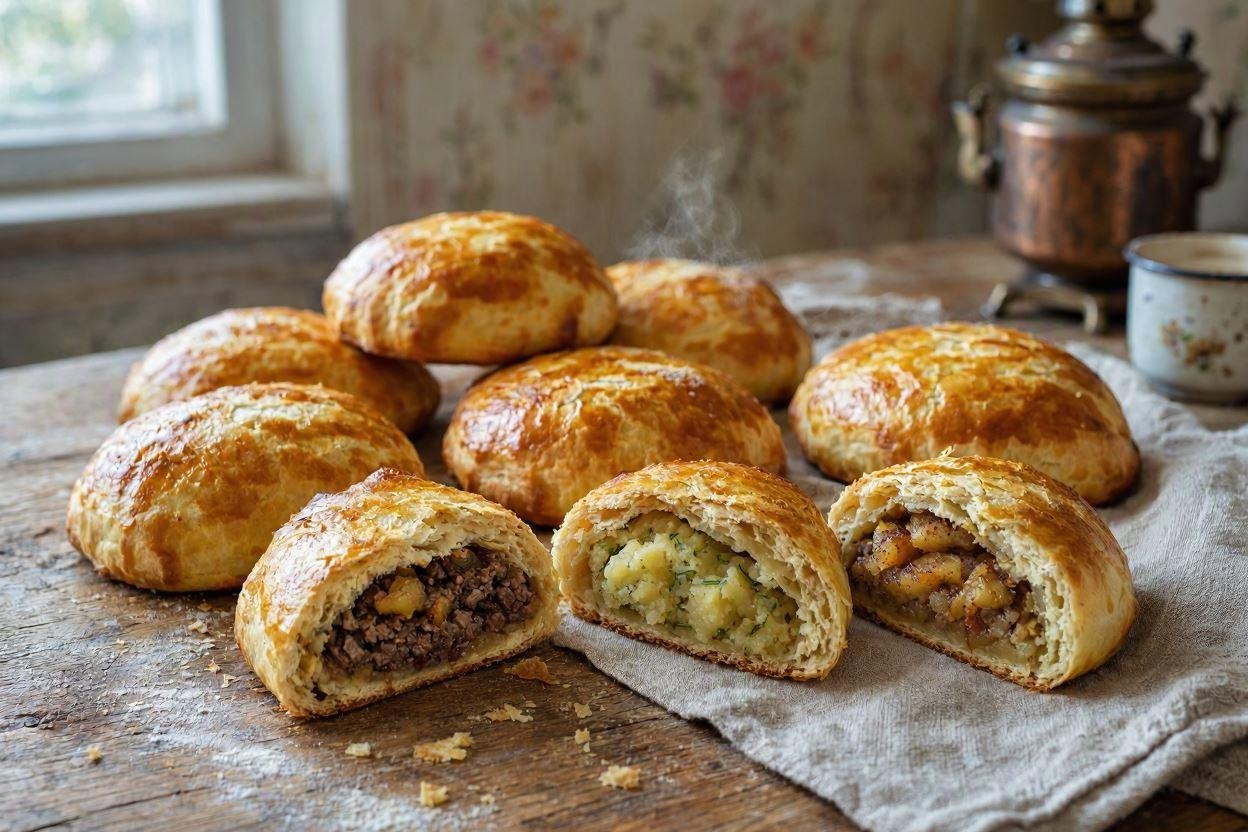
Piroshki turn familiar ingredients into a meal that fits in one hand. Each pastry begins with soft yeast dough wrapped around a cooked filling and then baked or fried. The result can be savory or sweet, suited to a weekday lunch or a holiday table. Cabbage, potato, meat, mushrooms, fish, eggs, apples and farmer’s cheese can all sit inside the same form.
The terminology carries part of the story. Pirozhok refers to one pastry, while pirozhki is the Russian plural. English speakers often write “piroshki.” The word is related to pirog, a larger pie prepared for sharing, but a pirozhok has its own place in Russian cooking: portable, easy to divide among guests and suited to home kitchens or food counters.
Piroshki also resisted a single official recipe. Families adjust the dough according to available ingredients, cooks select fillings by season, and regions favor different combinations. Some pastries have a glossy baked crust, while others emerge from hot oil with a crisp exterior. Some contain only cabbage and onion; others combine fish, rice, egg and herbs. These differences explain why piroshki have survived major changes in Russian society without losing their identity.
From the Russian Oven to the City Street
Russian pie-making developed around grain, the household oven and the need to stretch seasonal food across long winters. Large pies held an important place at feasts, weddings and religious celebrations, but smaller filled pastries served a more practical purpose. A cook could divide one batch of dough into individual portions, use several leftover fillings and produce food that required no plate or knife. The compact shape also kept the filling enclosed during transport.
The traditional Russian stove influenced the earliest baked forms. Its masonry structure retained heat for hours and supported several types of cooking after the fire settled. Bread might enter first, followed by pies or porridge as the temperature fell. Piroshki could share the oven with larger loaves, helping a household conserve fuel.
The household economy determined what went inside the dough. Cabbage, turnips, buckwheat and mushrooms offered inexpensive fillings in rural communities. River and lake regions had access to fish, while households with livestock could use meat, liver, eggs or fresh cheese. Foraged mushrooms and berries extended the range without requiring cash. A small quantity of a costly ingredient could also be mixed with rice, grain or vegetables, giving more people a taste of it.
The Orthodox calendar shaped piroshki just as strongly as the harvest. Long fasting periods restricted meat, dairy products and eggs, so cooks prepared dough with water and vegetable oil and filled it with cabbage, potato, mushrooms, peas or buckwheat. On non-fasting days, butter, milk and egg produced a richer dough. The pastry therefore changed through the year without disappearing from the table.
Urban growth moved piroshki beyond the household. During the nineteenth century, markets, bakeries, taverns and railway stations needed inexpensive food that customers could eat quickly. A warm pastry met that demand. Vendors could carry batches in covered baskets or trays, and buyers did not need cutlery. Meat and fish versions provided a substantial snack, while sweet fillings suited tea.
Rail travel strengthened the association between piroshki and food on the move. Stations became places where passengers bought pastries through carriage windows or during short stops. The enclosed filling created less mess than an open sandwich, and the bread-like casing helped it remain edible after cooling. Piroshki became connected not only with home comfort but also with departure, travel and the brief activity of a platform.
The Soviet period made the pastry even more visible in public dining. Factory canteens, school cafeterias, railway buffets and street kiosks sold standardized versions at controlled prices. Fried piroshki were especially suitable for rapid production because workers could cook them in batches without relying on limited oven space. Fillings such as potato, cabbage, liver or minced meat kept costs manageable.
Standardization brought mixed results. A good canteen pirozhok offered hot food for little money, but careless production produced thick dough, sparse filling or an oily crust. For some people, piroshki recall dough rising in a grandmother’s kitchen. For others, they evoke a kiosk near a station or workplace.
Migration carried these memories abroad. Russian-speaking communities opened bakeries and cafés in Israel, Germany, the United States, Canada and other countries, often adapting fillings to local ingredients and customer tastes. The pastries might become larger, use different meat or include cheese combinations uncommon in older recipes. Their defining structure remained intact: a soft casing, a sealed filling and an individual portion designed to be eaten without ceremony.
What Makes a Pirozhok
Classic piroshki dough balances softness with enough strength to contain a moist filling. Wheat flour provides the structure, yeast supplies lift, and liquid hydrates the dough. Salt controls flavor and fermentation, while a small amount of sugar feeds the yeast and encourages browning. Fat softens the crumb and keeps the pastry pleasant after cooling.
The chosen liquid changes the final texture. Water produces a leaner, bread-like dough and works well for fasting recipes. Milk creates a softer crumb and adds mild sweetness. Some cooks use kefir, yogurt or sour cream for extra tenderness and a slight tang. Eggs enrich the dough and deepen its color, while butter or vegetable oil reduces toughness. Richer is not always better: excessive fat can make the dough slow to rise and difficult to seal.
Mixing develops the gluten needed to hold gas from the yeast. The dough should become smooth and elastic but remain softer than bread dough. Too much flour produces heavy pastries. Experienced cooks accept slight tackiness and oil their hands instead of adding flour.
The first rise builds volume and flavor. The dough should expand visibly and feel aerated before shaping. Some cooks punch it down and allow another short rise; others move directly to portioning. Cool fermentation can develop more flavor but is not essential.
Filling preparation happens before the dough is shaped. Meat, fish, vegetables, rice and mushrooms should already be cooked because the short baking or frying time may not cook raw ingredients safely or evenly. The mixture should also cool to room temperature. A hot filling weakens the dough, activates the yeast too quickly and makes the seam difficult to close.
Moisture requires close control. A dry filling makes the pastry unpleasant, but excess liquid creates leaks and a gummy interior. Cabbage should be cooked until tender and drained if necessary. Mushrooms need enough time in the pan to release and evaporate their water. Cooked meat often benefits from onion, stock or butter, yet visible liquid should not pool at the bottom of the bowl.
Shaping begins with evenly divided dough. Each piece is rounded, rested and flattened into a circle or oval. The filling goes in the center before the edges are firmly pinched together. Overfilling causes ruptures; underfilling leaves too much bread.
The finished form varies by household. Oval piroshki are common and easy to arrange on a baking sheet. Round versions may indicate a particular filling, while elongated or boat-like shapes distinguish another batch. When a family prepares cabbage, meat and apple pastries at once, small differences in shape, seam or decoration help prevent surprises at the table.
Baking produces the softest, most bread-like version. After a short final proof, the pastries may receive an egg wash for gloss. Butter keeps the baked crust tender. Close spacing creates soft sides; more space allows even browning.
Frying creates a different experience rather than a lesser version of the same food. Hot oil quickly expands the dough and forms a thin golden crust around a fluffy interior. The pastry tastes richer and feels more substantial. Fried piroshki are commonly elongated or slightly flattened so the center heats quickly and the cook can turn them with ease.
Oil temperature determines whether fried piroshki becomes crisp or greasy. Cool oil enters the dough before a crust forms; overheated oil darkens the exterior before the center cooks. Small batches limit temperature drops. Draining removes surface oil but cannot correct poor heat control.
Several related foods cause confusion outside Eastern Europe. Polish pierogi are generally unleavened dumplings boiled or pan-fried after filling, not yeast-raised pastries. Ukrainian pyrizhky belong to a closely related tradition and may be baked or fried, but they should be recognized within Ukrainian cuisine rather than treated as merely another Russian name. Central Asian samsa usually uses a firmer or layered dough and commonly bakes against the walls of a hot oven. Turnovers may resemble piroshki in shape, yet puff pastry creates a flaky shell instead of a soft yeast crumb.

A Filling for Every Season
Meat piroshki ranks among the most substantial varieties. Cooks use minced beef, pork, chicken or a mixture, browning it with onion. Black pepper provides the main seasoning, while dill, parsley, garlic or stock may add depth. Some recipes use boiled, ground meat for a finer, more cohesive texture.
Cabbage offers one of the most recognizable and economical fillings. Fresh cabbage can be shredded and slowly fried or braised with onion until soft and lightly sweet. Sauerkraut creates a sharper version and may be rinsed if it tastes aggressively sour or salty. Chopped boiled egg often joins fresh cabbage, adding richness without overwhelming the vegetable.
Potato piroshki turns a staple ingredient into comfort food. The potatoes are mashed and mixed with browned onion, butter, dill or black pepper. Fried mushrooms may be added for a deeper savory taste. The mash should remain firm enough to hold its shape; a loose, milk-heavy purée can make the dough wet from inside.
Rice and egg create a mild filling that depends on careful seasoning. Cooked rice absorbs melted butter and the flavor of chopped boiled egg, while green onion or dill adds freshness. This combination often appears in home cooking because its ingredients are affordable and familiar. Rice also pairs with meat, liver or fish, increasing the quantity of filling without hiding the main ingredient.
Mushroom piroshki carry a strong connection to forest foraging and autumn cooking. Wild mushrooms provide distinctive aromas, but cultivated button or oyster mushrooms also work when browned thoroughly. Onion is almost essential because its sweetness balances the earthy taste. Potato, buckwheat or rice may be included to bind the mixture and absorb juices.
Fish fillings range from modest to celebratory. White fish can be flaked and combined with rice, onion and herbs, while salmon produces a richer pastry. Chopped boiled egg sometimes joins the mixture. The cook must remove bones carefully and avoid overcooking the fish before filling, since it will heat again inside the dough.
Less internationally familiar varieties reveal the pastry’s everyday range. Liver mixed with fried onion creates a strong, inexpensive filling. Buckwheat with mushrooms offers a nutty fasting option. Green onion and egg bring a fresh spring flavor, while peas or mashed beans can replace meat. Some cooks use stewed carrot, pumpkin or other vegetables when the harvest makes them plentiful.
Sweet piroshki follow the same basic method but need particular attention to escaping juice. Apples are often chopped rather than puréed and mixed with sugar only shortly before filling. Cinnamon may appear, although it is not mandatory. Sour cherries provide vivid acidity, but their liquid must be contained with starch, semolina or another absorber. Thick plum, apricot or berry preserves work better than runny jam.
Farmer’s cheese, known as tvorog, creates a filling that sits between dessert and breakfast. The cheese may be sweetened with sugar and enriched with egg yolk, vanilla, raisins or citrus zest. Its dry, slightly grainy texture differs from cream cheese and holds well during baking. Poppy-seed paste offers another traditional sweet option, particularly when ground seeds are cooked with milk or sugar into a dense mixture.
Seasonal cooking once determined these choices. Spring brought green onion and herbs; summer supplied cherries, berries and apples. Autumn offered mushrooms and cabbage, while potatoes, grains, fermented vegetables and preserved fruit lasted through winter.
Religious fasting created a second pattern of variation. A cook could prepare yeast dough with water and oil, then fill it with cabbage, mushrooms, potato or grain. The absence of butter, milk, egg and meat did not reduce the pastry to plain bread. Browned onions, fermented vegetables, mushroom broth and fresh herbs supplied strong flavor within the restrictions.
Balance separates a satisfying pirozhok from a heavy one. The filling should reach close to both ends and remain present in every bite, but the dough needs room to expand. Strong fillings such as liver or sauerkraut require less volume than potato or rice. A cook judges not only weight but also salt, acidity, fat and texture before sealing the first pastry.
One Pastry, Many Identities
Regional differences appear most clearly through local ingredients. Northern areas with access to rivers and cold-water fish developed fish-filled pies and pastries, while forest regions made broad use of mushrooms and berries. Agricultural districts relied on cabbage, grain and potato. Urban kitchens adopted more meat and refined flour as those ingredients became easier to obtain.
No regional boundary creates a perfectly separate piroshki style. Recipes traveled through marriage, military service, trade, factory work and internal migration. The Soviet Union moved millions of people across long distances, and canteens placed familiar dishes beside foods from the Caucasus, Central Asia, Ukraine and the Baltic republics. Home cooks borrowed techniques while continuing to describe recipes through family origin.
Ukraine has its own deep tradition of pyrizhky, the Ukrainian cognate of the Russian term. These individual filled pastries may contain cabbage, potato, beans, meat, cherries, poppy seeds or cheese and may be baked or fried. The resemblance reflects centuries of neighboring food traditions, shared crops and linguistic connections. It does not erase the separate history or identity of Ukrainian cooking.
Other nearby pastries show how widely the idea of filled dough travels. Georgian and Armenian kitchens include baked breads and pastries with meat, cheese or beans. Central Asian samsa encloses seasoned meat, onion or pumpkin in dough, often with a layered texture. Polish, Lithuanian and Jewish baking traditions offer their own filled buns, dumplings and turnovers. Similarity does not always prove direct descent; portable filled dough solves the same practical problem in many cuisines.
Russian-speaking migration created new versions in places where ingredients, religious practices and customer expectations differed. Bakeries in Israel may offer potato, mushroom, cabbage or meat fillings while adjusting the fat and meat combinations to kosher requirements. North American piroshki can be larger than a traditional home portion and may resemble a full lunch. Commercial menus sometimes label a wide range of filled buns as piroshki because the term is more familiar to customers than precise regional names.
Modern bakeries treat the format as a base for experimentation. Spinach and cheese, chicken and mushroom, sausage, curried vegetables and plant-based mince all fit inside yeast dough. Whole-grain flour can replace part of the white flour, although too much may reduce softness. Sourdough fermentation adds acidity and time, while air fryers offer a lighter crust that falls somewhere between baking and deep-frying.
Adaptation has limits if the name is to remain useful. Puff-pastry parcels lack the characteristic soft yeast casing. Open pies abandon the sealed, portable form. Oversized stuffed loaves move closer to pirog. A recognizable pirozhok is generally an individual closed pastry with a substantial filling, a tender dough and a shape intended for hand-held eating.
Presentation also changes with context. A family may pile warm pastries into a cloth-lined bowl, while a bakery arranges them in labeled rows behind glass. A contemporary café might serve two small piroshki beside broth, salad or sour cream on restaurant tables. The setting changes, but the pastry still works because it can move easily between snack, side dish and complete meal.

More Than a Snack
Piroshki carry emotional weight because they appear in ordinary moments. Their aroma can recall dough rising in a warm kitchen, a grandparent pinching seams at the counter or a parent packing food for a journey. These associations do not depend on luxury ingredients. They come from repetition, shared work and the expectation that a warm pastry will soon be broken open.
Home preparation often becomes a group task. One person rolls or presses the dough, another portions the filling, and a third seals the pastries. Children can learn to shape simple rounds even if their seams look uneven. A large batch rewards the effort because it feeds many people, freezes well and accommodates several tastes at once.
Hospitality gives piroshki another role. A host can offer them warm or at room temperature, and guests can take one without interrupting conversation. Savory versions accompany clear broth, cabbage soup or beet soup, while sweet ones sit naturally beside black tea. Sour cream, melted butter or a simple herb sauce may be served alongside, though a well-filled pastry needs no garnish.
Practicality keeps the tradition current. Piroshki uses small quantities of cooked meat, yesterday’s mashed potato or cabbage left from another dish. They travel well in lunchboxes and picnic baskets. Baked versions can be reheated without much loss of quality, and uncooked shaped pastries can be frozen when the dough and filling permit it.
Public versions remain equally important. A bakery pirozhok offers a quick breakfast; a kiosk pastry provides warmth during a commute; a café serving turns familiar food into a deliberate meal. Quality varies, but the format meets the same need that supported it generations ago: substantial food that can be prepared in batches, sold individually and eaten with little equipment.
The pastry’s future rests on that combination of structure and choice. Its dough provides continuity, while its filling records the season, region, budget and preferences of the cook. A cabbage pirozhok made for a fasting day, a salmon version served at a celebration and an apple pastry packed for school all belong to the same tradition without tasting alike.
Piroshki endure because they preserve change inside a familiar shape. Their history runs through village ovens, railway platforms, Soviet canteens, immigrant bakeries and modern cafés, yet they remain personal food. Open one and the filling reveals more than an ingredient list: it shows what was available, what a family valued and how a cook turned it into something worth carrying home.