
A Bavarian brewery lunch before you leave, cheese dumplings when you arrive, and an honest look at the train, coach, rental car and private transfer in between.
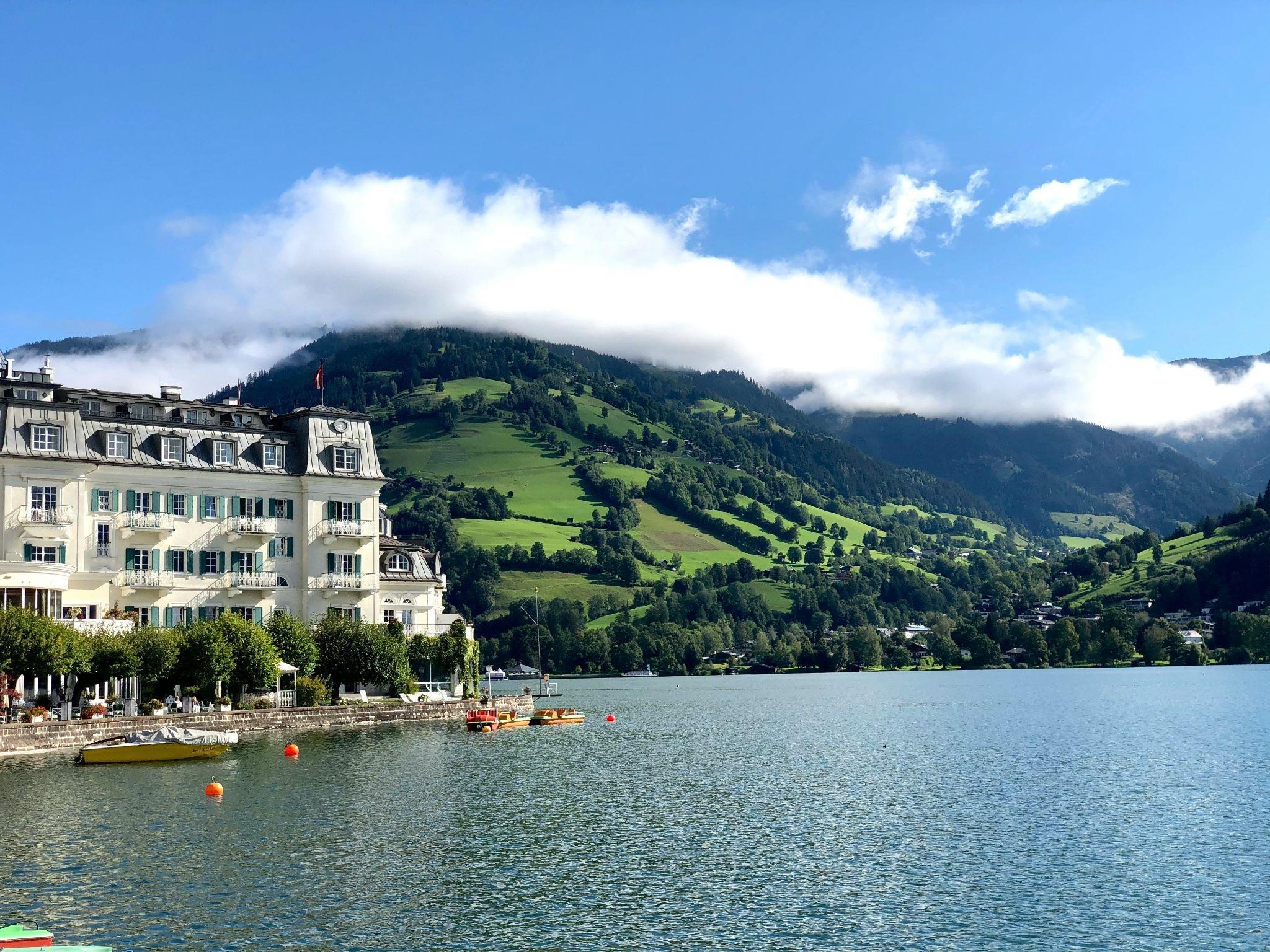
Zell am See sits on a lake in Austria’s Pinzgau valley, with the Schmittenhöhe ski mountain behind the town and the Kitzsteinhorn glacier above neighboring Kaprun. For a first-time visitor from the US, the usual way in is a flight to Munich, a two-hour drive to the north across the German border. That gap is worth planning, because what you eat on either side of it is half the fun, and a good deal of what you will read about crossing it is wrong.
Prices below are in euros. At the European Central Bank reference rate on November 10, 2026, one euro was worth about $1.12.
Before you leave the airport
Eat at the brewery.
Munich Airport has its own beer hall. Airbräu, which the airport describes as Europe’s only brewery inside an airport, sits on Level 03 of the Munich Airport Center. The tavern and its covered beer garden serve what the airport calls hearty Bavarian classics, roast pork and dumplings among them, alongside a short international menu.
The location matters as much as the menu. The airport’s S-Bahn station is in the same building, so if you are taking the train you can finish lunch and be on the platform within minutes. If someone is driving you, it is a good place to sit out a flight delay without staring at an arrivals board.
Getting there: four honest options
It depends on how many of you there are, what you are carrying and when you land.
By train: change at Munich East and Wörgl
No train runs direct from the airport to Zell am See. Most guides quote four to four and a half hours for the trip, and some say five or six. The Austrian Federal Railways planner (oebb.at) shows something better for the winter 2026/27 timetable.
Every two hours, from 7:04 a.m. to 7:04 p.m. on the dates we checked, an S8 suburban train leaves the airport at four minutes past the hour and reaches Munich East (München Ost) in 29 minutes. Ten minutes later a Railjet heads for the Austrian border, and an hour after that you step off at Wörgl in Tyrol. A short change there puts you on a regional or EuroCity train that runs along the valley to Zell am See. From the terminal to Zell am See station it takes 3 hours 5 to 3 hours 10 minutes, with two changes.
This is also the best way to eat on the move. In the planner’s train notes the Railjets on this run carry a restaurant car, and some of the onward trains from Wörgl list both a restaurant car and an observation coach, which is the right seat for the last hour through the mountains.
The connections in between go via Salzburg and Schwarzach-St. Veit and take about four hours. On winter Fridays and Saturdays there is also a direct ICE named Großglockner from Munich’s main station (3:12 p.m., arriving 6:08 p.m. on the dates we checked), but from the airport you still need the S-Bahn and a change, so it is slower than the Wörgl route. The last sensible departure from the airport on a weekday is around 8 p.m.; the 9:04 p.m. train gets in after 4 a.m.
Zell am See station is in the middle of town, a walk from many hotels and restaurants, and the tourist office (zellamsee-kaprun.com) says overnight guests get a Guest Mobility Ticket covering buses and trains across the state of Salzburg, so the bus on to Kaprun is covered. We could not get a reliable through fare from the airport, so check it in the ÖBB or Deutsche Bahn app before you book. Saver fares are tied to one train, and that is a risk on a day when your flight could be late.
For one or two people with a carry-on each, landing in daylight, the train is the right call.
By coach: possible, but slow
There is no direct coach. Some route guides list one, but the coach company’s own booking system had nothing of the kind on any of the dates we sampled from late November to mid February.
What it does sell is a combined ticket: a long-distance coach from the stops beside Terminal 2 at 10:25 a.m. to Salzburg South, then a train from 2:23 p.m. that reaches Zell am See station at 3:54 p.m. That is five and a half hours, once a day, for about €31 to €36 (about $35 to $41) one way on the December and early January dates on sale when we checked. Later winter dates were not bookable yet.
It is the cheapest seat on the route, and the slowest by a wide margin.
By rental car: no vignette if you take the right road
The fastest road route, according to open routing data, runs east on the A8 motorway and then leaves it for the federal roads through Lofer and Saalfelden. That route uses no Austrian motorway at all, which matters: Austria charges for motorways and expressways only, so you need no toll pass, called a vignette, on that road. Plenty of answers online say you always need one.
Go the other way, via Salzburg and the Tauern motorway (A10), and you do. Austria’s government portal (oesterreich.gv.at) lists €9.60 for a day and €12.80 for ten days in 2026, and from the 2027 vignette year it is sold only as a digital pass tied to the license plate. A one-day or ten-day digital vignette can be valid immediately, so you can buy it once you have the car.
The tourist office puts the drive from Munich at about 2.5 hours. In winter, Austria requires winter tires from November 1 to April 15 whenever the road is covered with snow, slush or ice, according to the transport ministry (bmimi.gv.at). Ask the rental desk to confirm the car has them, and ask whether there is a fee for taking a German rental across the border.
A car pays off if you plan to explore beyond Zell am See and Kaprun. If you are staying put, the free regional transit pass makes it a car you park for a week.
By private transfer: one price for the whole car
A private transfer is a car and driver booked ahead. The driver meets you in arrivals, loads the bags, and drives you to the door of your hotel or apartment.
On TransferBnB, a marketplace where verified local carriers send offers for your date, a private car and driver from Munich Airport to Zell am See starts from €225 (about $250) one way for the whole vehicle, not per seat. The trip is listed at about 195 km (121 miles) and 1 hour 50 minutes to 2 hours 20 minutes. Treat the shorter end as a clear-road figure and allow the tourist office’s 2.5 hours on a snowy day.
For a solo traveler that is the expensive way to go, and no honest comparison pretends otherwise. The sums change with company. Split three ways it is €75 each, with no change at Wörgl, no bags carried across platforms, and no 8 p.m. cutoff if your flight lands late.
The trip at a glance
| Train | Coach and train | Rental car | Private transfer | |
| Time from the airport | 3 h 05 to 3 h 10 min | about 5 h 30 min | about 2.5 h, plus the rental desk | 1 h 50 to 2 h 20 min listed |
| Changes | two (Munich East, Wörgl) | one (Salzburg) | none | none |
| Runs | every two hours, 7 a.m. to 7 p.m. | once a day | when you have the keys | when you land |
| Cost | check the ÖBB or DB app | about €31 to €36 per person | rental, fuel, vignette if you use the A10 | from €225 per vehicle |
| Ends at | Zell am See station, in town | Zell am See station | your door | your door |
Read the table by what you are carrying. Light bags favor the train; ski bags, children or a late landing favor a car someone else drives.
What to eat when you get there
Look for the word Pinzgauer on the menu.
The regional tourist office lists the dishes locals actually eat, and they are mountain food built from dairy, potatoes and flour. Pinzgauer Kasnocken are the one to order first: small, cheesy pasta-like dumplings, rich enough to count as dinner after a day outside. Pinzgauer Bladln are fried turnovers filled with potatoes and bacon, heavier than they sound. Kaspress soup is a clear broth with pressed dumplings of fresh cheese floating in it, the thing to order on a cold afternoon.
Bauerngröstl, the farmer’s fry-up of potatoes, onions, meat, mushrooms and an egg, is the Alpine answer to a breakfast skillet. For dessert the region claims two: Salzburger Nockerl, a baked soufflé, and Moosbeernocken, small pancakes made with blueberries.
Lunch at 9,938 feet
The best hut food is on the mountains, not in town.
The Schmittenhöhe is Zell’s own mountain, as the tourist office puts it, and its lift company (schmitten.at) lists 18 huts and restaurants on it, from AreitAlm and Breiteckalm to the Berghotel Schmittenhöhe, under the line “traditional dishes meet haute cuisine.” The tourist office points to several “gourmet stations” spread across the mountain, which suits a ski day or a winter walk that is mostly an excuse to eat.
Across the valley, the Kitzsteinhorn above Kaprun (kitzsteinhorn.at) has the Gipfel Restaurant at 3,029 meters, which the lift company calls the highest restaurant in the state of Salzburg. Lower down, the Krefelder Hütte at 2,300 meters is the traditional option, a ski and hiking hut with a big sun terrace and what the lift company calls hearty mountain fare. The company says partners from the Salzburg region supply its huts and restaurants.
Even on a non-ski day, ride up for lunch.
Which way to go
- Solo or a couple, light bags, daytime landing: the train via Munich East and Wörgl, with lunch at the airport brewery first.
- Tightest budget, flexible day: the coach and train ticket, if 10:25 a.m. fits your flight.
- Family or group of three or more, ski bags, or an evening arrival: a private transfer, priced per car.
- Exploring Salzburgerland by road: a rental car, on the Lofer route if you would rather not buy a vignette.
However you get there, save room. Kasnocken is not a light dish, and you will want it twice.