
Nine in the morning at Nang Loeng market, and the dessert stalls are already half sold out. Trays of sticky rice with sweet toppings sit next to coils of golden egg-yolk threads, the curry vendors have their pots lined up, and the office crowd is eating fast before work. You want all of it. Then you remember that the next thing on your list, a bowl of peppery rolled noodles in Chinatown, is on the other side of the old city, and after that you want lunch in Ari, which is nowhere near either.
That is the catch with eating your way across Bangkok. The places worth the trip keep their own hours, and they sit in neighbourhoods that no single train line joins up. A small scooter solves both problems and turns a day of eating into a plan instead of a commute.
Morning: Nang Loeng, before the heat
Nang Loeng opened officially in 1900, under King Rama V, and it is one of the oldest markets still trading in the city. These days it works more like a food hall than a fresh market. The reason to come is the desserts: traditional Thai sweets, some made to recipes that go back generations, sold from shops the same families have run for decades.
Get there early. The market keeps roughly 8am to 3pm from Monday to Saturday and stays open a little later on Sundays, but the good dessert stalls sell out long before closing. Before ten is ideal, while the air is still cool enough to sit outside with a bag of sweets and an iced tea. From there, Chinatown is a short ride south, which is exactly the kind of hop that takes forever by taxi and almost no time on a scooter.
Late morning: Chinatown by daylight

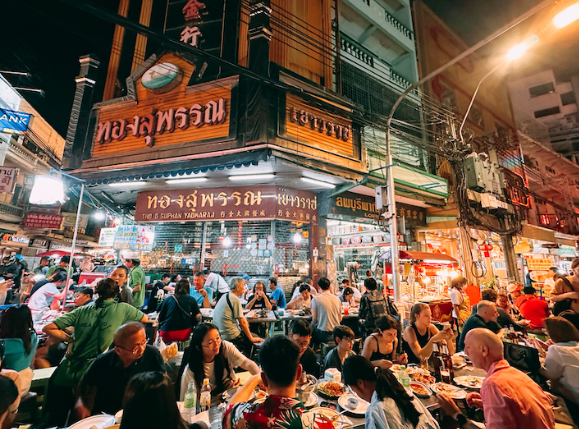
Yaowarat is famous for its night-time neon, and the evening crowds are real. Come late morning instead. The road is calmer, and Nai Ek Roll Noodle, on the corner of Yaowarat Soi 9, is already serving, since it opens at 8am and runs until midnight. Order the kuay jab: rolled rice noodles in a pork broth so heavy on white pepper it warms your ears, with crackling pork belly on top. The smallest bowl was 70 baht this year.
Daylight Chinatown is also much easier on two wheels. You pull up, eat, and you’re gone before the lunchtime traffic thickens.
The bike for a food crawl

I’ll keep this short, because this is a food article. A 125cc automatic is the right tool for the job. It is light enough to slot into a gap between two parked scooters, it barely uses any fuel, and the space under the seat holds a helmet or a bag of desserts. Watch what the delivery riders and market vendors ride and you’ll see Honda Clicks everywhere, which tells you plenty. If you’re renting one, RentLab’s Honda Click rental in Bangkok was 230 baht a day for two to six days at the time of writing, and the shop lists fuel use at around 45 km per litre, so a full day of eating costs very little in petrol. Ride at an easy pace and keep left, and the traffic is far less dramatic than it looks from a taxi window.
Afternoon: Ari, where people actually live
Ari is a residential pocket north of the centre, around BTS Ari, and its backbone is Phahon Yothin Soi 7. Street stalls crowd the mouth of the soi, small kitchens sit further in, and coffee shops hide down the side lanes. This is where Bangkok’s office workers eat lunch, which keeps the prices sensible and the cooking honest.
Two stops are worth the ride. Thanee Khao Moo Daeng, on Soi Phahon Yothin 7, serves red pork and crispy pork over rice from 8am to 4pm, so don’t leave it too late. Lay Lao, at 65 Phahon Yothin Soi 7, cooks Isaan food from 10:30am: som tam, grilled pork neck and squid stuffed with its own roe. Finish with an iced coffee in one of the side sois and give your stomach an hour before the next round. Ari is also the easiest part of the day to ride: quieter streets and plenty of shade, so you can pull over whenever a stall catches your eye.
Evening: Thong Lo
As the light goes, head east to Thong Lo and Ekkamai. Be honest with your wallet here. This is the expensive stretch of Sukhumvit, full of independent restaurants and cocktail bars, and the bills climb accordingly. Eat one proper dinner and save room for the stop that makes the ride worth it.
That stop is Mae Varee, the fruit shop at the mouth of Thong Lo Road, a two-minute walk from exit 3 of BTS Thong Lo. It sells mango sticky rice from 6am to 10pm, and the box comes with white, black and pandan-green sticky rice under the fruit. Mangoes peak from roughly March to June, but the shop sells good ones all year.
Making it work
Eat small at every stop: half portions, shared plates, one dessert instead of four. Carry cash in small notes, since plenty of stalls take cash or Thai QR payments only. Keep a bottle of water under the seat. Do the helmet strap up every time, and if you haven’t ridden here before, spend ten minutes on a quiet soi before your first main road. If you’re not a confident rider, there’s no shame in doing two districts by train instead of four by scooter. The food tastes the same either way.
Parking is the part people worry about and rarely need to. At markets and food streets you’ll see a row of scooters along the kerb or in a marked bay. Park where the locals park, turn the handlebars to lock the steering, and take the key with you. A few busy spots have an attendant who collects a small fee. Either way it takes less time than waiting for a taxi to find you, and it means you can stop the moment something smells good.
But if you do ride, the day ends somewhere very good: on a plastic stool on Thong Lo with a box of mango sticky rice, trying to remember how many desserts you bought at nine that morning.