
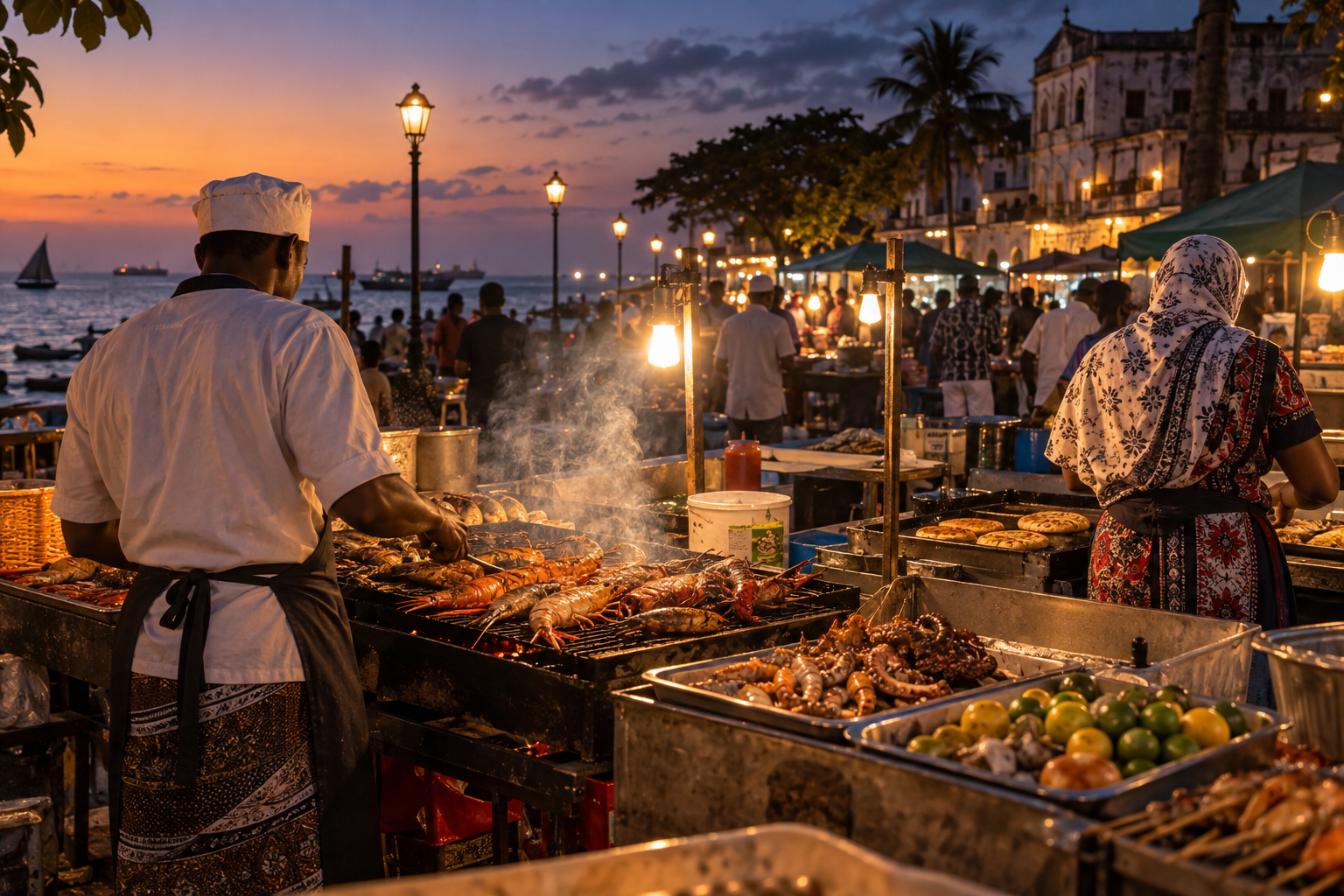
Kenya and Tanzania deliver some of East Africa’s most exciting street food scenes. From charcoal-grilled meat skewers in Nairobi to Zanzibar’s night-market pizza folded fresh on a hotplate, these two countries reward travelers who eat where locals eat. The cuisine blends Swahili coastal flavors, Indian spices, and inland traditions into dishes you won’t find anywhere else.
Kenya and Tanzania’s best food experiences often begin at the grill.
From grilled skewers to market snacks, Kenya and Tanzania reward travelers who eat on the street.
Charcoal grilling is central to Kenya and Tanzania’s lively street-food culture.
Street markets open early and stay loud past dark. Vendors work from carts, stalls, and open-air kitchens, turning out food that’s cooked to order and priced for everyday people. You’ll taste dishes like chapati rolled thin on a griddle, cassava chips tossed with tangy tamarind sauce, and grilled octopus pulled straight from the Indian Ocean that morning.
This guide covers the street food worth seeking out in both countries, the neighborhoods and markets where you’ll find it, and the practical steps that make eating your way through East Africa easier—including how mobile data helps you navigate markets, translate menus, and stay connected between cities.
Why Kenya and Tanzania Are Must-Visit Culinary Destinations
East Africa’s food scene thrives on the street. Kenya and Tanzania have turned open-air grilling, roadside frying, and market cooking into an art form that reflects centuries of Swahili, Indian, Arab, and indigenous influence. Zanzibar and mainland Tanzania’s coast became a base for a triangular trade route between East Africa, India, and the Middle East as early as the 8th century, and those spice routes left a lasting mark on the region’s cuisine. You’ll find charcoal-roasted meat served on butcher paper in Nairobi, Zanzibar pizza folded and fried on a flat griddle steps from the Indian Ocean, and spiced kebabs sizzling in Dar es Salaam’s evening markets.
What makes these destinations exceptional for food lovers is accessibility. Street vendors and market stalls dominate the culinary landscape, meaning the most authentic dishes aren’t hidden behind reservations or hotel menus. In cities like Mombasa, Arusha, and Stone Town, local people eat the same food tourists seek out. Prices stay low—often under $2 for a full plate—and the turnover is high, so ingredients move fast and food stays fresh.
The cuisine itself spans grilled meats, fried dough, coconut-rich curries, and seafood pulled from the coast that morning. Spice routes left their mark here, and you’ll taste cardamom, clove, and tamarind in dishes that feel distinct from other African regions. Mobile data makes navigation straightforward: maps guide you to specific markets, translation apps help you order in Swahili, and ride-hailing works across major cities, so you can move between food districts without guesswork.
Kenya Food to Try: Nyama Choma, Mutura, Samosas and Mandazi
Kenyan street food centers on bold flavors and communal eating. Nyama choma—literally “grilled meat”—is the country’s signature dish. You’ll find it at every roadside butchery and weekend gathering, where goat or beef is slow-roasted over charcoal and served with kachumbari, a fresh tomato and onion salad that cuts through the richness.
Mutura is Kenya’s answer to blood sausage: seasoned goat intestines stuffed with meat, blood, and spices, then grilled until crispy. Street vendors in Nairobi’s Kariokor Market cook it to order, slicing it into bite-sized pieces and serving it with a squeeze of lime.
For a quick snack, look for samosas—triangular pastries filled with spiced beef, lentils, or vegetables. They’re everywhere, from bus stations to beach stands in Mombasa. Pair them with mandazi, a lightly sweetened fried dough that Kenyans eat for breakfast or as an afternoon treat with chai.
Nairobi’s City Market and Mombasa’s Old Town offer the densest concentration of vendors. If you’re navigating between neighborhoods or checking vendor reviews before you arrive, a safari esim keeps you connected without hunting for Wi-Fi. Street food in Kenya rewards spontaneity, but a little advance research helps you find the stalls locals actually recommend.
Tanzanian Street Food: Mishkaki, Chipsi Mayai, Urojo and Zanzibar Pizza
Tanzania’s street food scene blends Swahili, Indian and Arab influences into dishes you won’t find anywhere else. Germans colonized mainland Tanzania from 1880, adding another layer to the culinary mix that already included coastal trade influences. Start in Dar es Salaam’s Kivukoni Fish Market at dawn, where vendors grill fresh octopus and kingfish over charcoal alongside pyramids of cassava chips. The smoke, the calls of fishmongers and the smell of grilled seafood set the rhythm for the day.
Mishkaki—marinated beef skewers brushed with chili and lime—appear on every corner after 5 p.m. Look for stalls with long queues; locals know which vendors marinate their meat overnight. Chipsi mayai, a thick omelet stuffed with French fries, sounds simple but becomes addictive when served with pilipili sauce and a wedge of lime.
In Stone Town, Zanzibar, the Forodhani Gardens night market opens at sunset. Try urojo, a tangy soup made with cassava, coconut, mango and bhajia, then move to the Zanzibar pizza stalls. Despite the name, it’s closer to a stuffed crepe: dough stretched thin, filled with minced meat or Nutella, folded and griddled until crisp. When planning your route between cities or coordinating transport in Kenya and Tanzania, mobile data keeps maps and booking apps within reach even in rural areas between Arusha and the coast.

Forodhani Gardens is a classic sunset stop for Zanzibar pizza, urojo and grilled seafood.
Where to Eat in Nairobi, Mombasa, Dar es Salaam, Arusha and Zanzibar
Nairobi’s best street food clusters around the central business district. Kenyatta Avenue and Tom Mboya Street come alive each evening with vendors grilling nyama choma and deep-frying samosas. Toi Market on Saturday mornings draws locals for fresh mandazi and chai, while the Maasai Market rotates through the city weekly with a mix of crafts and snack stalls.
In Mombasa, head to the Old Town near Fort Jesus after sunset. Narrow streets fill with grills turning out mishkaki and mutura, and the sea breeze carries the smell of grilled cassava. The ferry terminal on the mainland side has a strip of open-fronted kitchens serving chapati wraps and spiced tea until late.
Dar es Salaam’s Kivukoni Fish Market opens at dawn with vendors selling grilled octopus and prawns by weight. For Zanzibar pizza and urojo, walk through Forodhani Gardens in Stone Town after 6 p.m., when dozens of cooks set up portable grills along the waterfront. Using esim safaricom kenya or a Tanzanian data plan helps you navigate between neighborhoods, check which markets operate on which days, and confirm stall locations without hunting for Wi-Fi.
Arusha’s central market runs daily, with the greatest variety on Wednesdays and Saturdays. Look for chipsi mayai cooked to order in blackened pans and mandazi stacked high near the vegetable aisles.
Dish Comparison Table: Ingredients, Typical Prices and Where to Find Them
| Dish | Country | Main Ingredients | Typical Price (USD) | Where to Find |
| Nyama Choma | Kenya | Grilled goat or beef, salt | $3–$8 | Roadside grills, local bars |
| Mutura | Kenya | Goat intestine, blood, spices | $1–$2 | Street vendors, night markets |
| Mandazi | Kenya | Flour, coconut milk, cardamom | $0.20–$0.50 | Bakeries, tea stalls |
| Mishkaki | Tanzania | Beef or chicken, ginger, chili | $1.50–$3 | Forodhani Gardens, street corners |
| Chipsi Mayai | Tanzania | Potato chips, eggs, onion | $1–$2 | Daladala stops, local cafés |
| Zanzibar Pizza | Tanzania | Dough, egg, meat or veg, mayo | $2–$4 | Stone Town night market |
| Urojo | Tanzania | Soup, cassava, mango, bhajia | $0.80–$1.50 | Zanzibar street stalls |
These prices reflect what locals pay at busy stalls in 2025. Tourist-heavy areas like Forodhani Gardens or Nairobi’s Central Business District may charge slightly more, but portions stay generous. Most vendors accept cash only, so carry small bills in Kenyan shillings or Tanzanian shillings to make transactions easier.
A DIY Kenya and Tanzania Food Itinerary: From Cities to Safari Stops
Planning a food-focused route across both countries gives you the best of coast, city and countryside. Start in Nairobi for two to three days, hitting Kenyatta Market and the Ngara neighborhood for nyama choma before flying to Mombasa for coastal flavors like viazi karai and coconut-laced mandazi. From there, cross into Tanzania and spend a day in Arusha to sample mishkaki and grilled plantain near the central market, then continue to the northern parks for safari.
After your game drives, head to Dar es Salaam for chipsi mayai and street-side grills along Msasani Peninsula, then ferry to Zanzibar for three nights of Zanzibar pizza, urojo soup and grilled octopus in Stone Town and Forodhani Gardens. This route keeps travel time manageable while covering the signature dishes from each region.
Between stops, mobile data makes logistics simpler. Use Google Maps to locate specific markets, eSIM plans for Kenya and Tanzania eSIM options to stay connected without hunting for SIM cards at every border, and apps like Uber or Bolt to reach neighborhoods outside the tourist center. You will also want data for currency conversion, translation of menu boards written in Swahili and checking vendor reviews on Google when choosing between competing stalls.
How Mobile Data Helps With Maps, Translation, Transport and Payments
Street-food hunting in Kenya and Tanzania becomes much easier when you can pull out your phone and navigate in real time. Google Maps marks most established food markets—like Nairobi’s Toi Market or Dar es Salaam’s Kivukoni Fish Market—and user reviews often include photos of specific stalls and recent price ranges. Offline maps work for main roads, but live data shows current traffic, lets you reroute when a matatu stop moves, and updates opening hours that change without warning.
Translation apps handle Swahili menu boards and help you ask vendors about ingredients if you have dietary restrictions. Currency converters confirm you’re paying a fair price: a plate of mishkaki in Arusha typically runs 3,000 to 5,000 Tanzanian shillings, and checking the exchange rate on the spot prevents confusion. Ride-hailing apps like Uber, Bolt and Little Cab operate in Nairobi, Mombasa, Dar es Salaam and Arusha, so you can book a ride from a night market without negotiating taxi fares in unfamiliar neighborhoods after dark.
Mobile-money platforms—M-Pesa in Kenya, Airtel Money and Tigo Pesa in Tanzania—are accepted at many urban food stalls, though cash remains essential at smaller roadside vendors and in rural areas. Staying connected also means you can message a guide, confirm a cooking-class booking or look up whether a particular dish contains allergens before you order.
eSIM Comparison: Best Overall, Direct Local Provider and Current Website Prices
If you’re planning to bounce between Nairobi’s Maasai Market and Stone Town’s night food market, mobile data keeps you connected without hunting for SIM cards at the airport. Three providers cover Kenya and Tanzania with different strengths.
Airalo offers regional East Africa plans that work across both countries from a single purchase. A 3 GB plan valid for 30 days runs $13, and a 10 GB plan costs $37. The app interface is straightforward, activation takes minutes, and coverage relies on Safaricom in Kenya and Vodacom in Tanzania—two of the strongest networks in the region. It’s the simplest option if you’re splitting time between countries.
Safaricom eSIM is the direct local provider for Kenya. A 5 GB monthly bundle costs approximately 500 KES (around $3.85), but it only covers Kenya. If you’re spending most of your trip in Nairobi, the coast, or safari parks within Kenya, the price advantage is significant. Activation requires a Kenyan payment method or buying credit through third-party services, which adds friction for short visits.
Safari eSIM tailors plans specifically for travelers moving between Kenya and Tanzania. Their 5 GB East Africa plan costs $18 for 30 days, with coverage on Safaricom and Vodacom. The middle-ground pricing suits travelers who want regional flexibility without managing two separate local SIMs.
Staying Connected in Zanzibar, Samburu and Remote Safari Destinations
Cell coverage across Kenya and Tanzania is surprisingly reliable, but quality varies sharply once you leave the cities. Nairobi, Mombasa, Dar es Salaam, Arusha and Stone Town all offer strong 4G on the main networks—Safaricom and Airtel in Kenya, Vodacom and Airtel in Tanzania—but signal weakens quickly in conservation areas and along the northern safari circuit.
Expect intermittent service in the Ngorongoro Highlands, patchy coverage around Lake Manyara, and almost nothing inside Samburu or Tsavo East unless you’re near a lodge with satellite backup. Most mid-range and luxury camps provide Wi-Fi in the main lounge, though bandwidth is limited and may cut out during peak evening hours when guests are uploading photos.
An eSIM for Kenya or Tanzania eSIM gives you immediate data on arrival without hunting for a SIM vendor or queuing at a kiosk. This matters most when you’re coordinating a daladalah pickup in Arusha, confirming a ferry departure time in Zanzibar, or translating a menu at a roadside nyama choma joint where no one speaks English. Load the profile before you fly, activate it at the airport, and you’re online before baggage claim.
Food Safety, Cash and Market Etiquette in East Africa
Street food in Kenya and Tanzania is generally safe when you follow a few common-sense rules. Look for stalls with a steady stream of local customers—high turnover means ingredients are fresh and food doesn’t sit around. Watch for vendors who cook items to order rather than keeping pre-cooked food warming under lamps. Grilled meat, fried snacks and anything served piping hot carry lower risk than room-temperature salads or pre-cut fruit.
Carry small-denomination Kenyan shillings and Tanzanian shillings in cash. Most street vendors and small market stalls don’t accept cards, and mobile-money platforms like M-Pesa require a local number to set up. Breaking a 1,000-shilling note for a 50-shilling samosa frustrates vendors, so ask your hotel or a bank to exchange larger bills before you head out.
When you approach a stall, greet the vendor with a smile—jambo works across both countries. If you’re unsure what something is, pointing and asking is welcome. Eating with your right hand is the norm for chapati, mandazi and ugali, though most places offer napkins or a hand-washing station nearby. If a vendor offers you a seat on a shared bench, accept it; street food here is as much about the social experience as the meal itself.
FAQ: Popular Foods and High-Demand Market Products in Kenya and Tanzania
What’s the most popular street food in Kenya?
Nyama choma takes the lead. You’ll find roasted goat or beef at roadside spots across the country, served with ugali and kachumbari. In Nairobi, mutura and smokie pasua draw long queues, especially after dark.
What should I try first in Zanzibar?
Head to Forodhani Gardens at sunset. Start with Zanzibar pizza—a stuffed, fried pancake filled with minced meat, cheese or vegetables—then try mishkaki skewers and urojo soup. The night market runs daily and stays busy until late.
Are samosas the same in both countries?
The shape and pastry are similar, but fillings vary. Kenyan samosas lean toward spiced beef or lentils, while Tanzanian versions often include more coconut and cardamom. Both are served hot and cost around 20–50 shillings per piece.
Which markets are best for local produce?
Maasai Market in Nairobi offers spices, honey and dried fruit alongside crafts. In Dar es Salaam, Kariakoo Market stocks everything from cassava to freshly caught fish. Arusha’s Central Market is smaller but busy, with stalls selling mangoes, avocados and roasted maize.