
There is a particular disappointment that comes from ordering a dish at home after eating the original on the street somewhere far away. It is rarely that the export version is bad. It is that it is a different dish wearing the same name.
This happens for reasons that make sense. Ingredients don’t travel. Palates differ. A cook who has moved countries adapts to what the market stocks and what customers actually order twice. Over a few decades, those small adjustments compound into something the original vendor wouldn’t recognise.
Knowing what changed is useful in both directions. It tells you what to look for when you’re standing in front of a cart in Bangkok or Mexico City, and it explains why the version near your flat tastes the way it does.
Here are five dishes where the gap is widest.
Kung Pao chicken
The Sichuan original, gong bao ji ding, is built around one sensation Western versions almost universally drop: málà, the numbing tingle of Sichuan peppercorns working alongside dried chillies. It is not simply heat. The peppercorn produces a faint buzzing on the lips, and the chilli heat arrives underneath it. Take the peppercorn away and you have removed the dish’s defining characteristic.
The street and small-restaurant version is otherwise spare — diced chicken, peanuts, scallion, dried chillies, and a sauce that leans sharp with vinegar rather than sweet.
The version that spread through American strip malls is a different proposition. Panda Express-style kung pao adds diced zucchini and red bell pepper, drops the Sichuan peppercorns entirely, and runs noticeably sweeter and thicker. It is a genuinely enjoyable dish. It is just not the one from Chengdu.
Both are worth cooking, and it helps to know which you’re making — this side-by-side breakdown of the two versions covers where they diverge and how to push a home version toward either end.
What to look for when travelling: if the dish arrives without that faint numbness, you have the export version, whatever the menu says.
Pad Thai
Pad Thai’s history is stranger than most people expect. It was actively promoted as a national dish in the late 1930s and 1940s as part of a government campaign under Plaek Phibunsongkhram — partly to encourage rice noodle consumption over rice, partly as a nation-building exercise. It is genuinely Thai, but it was also, in a sense, designed.
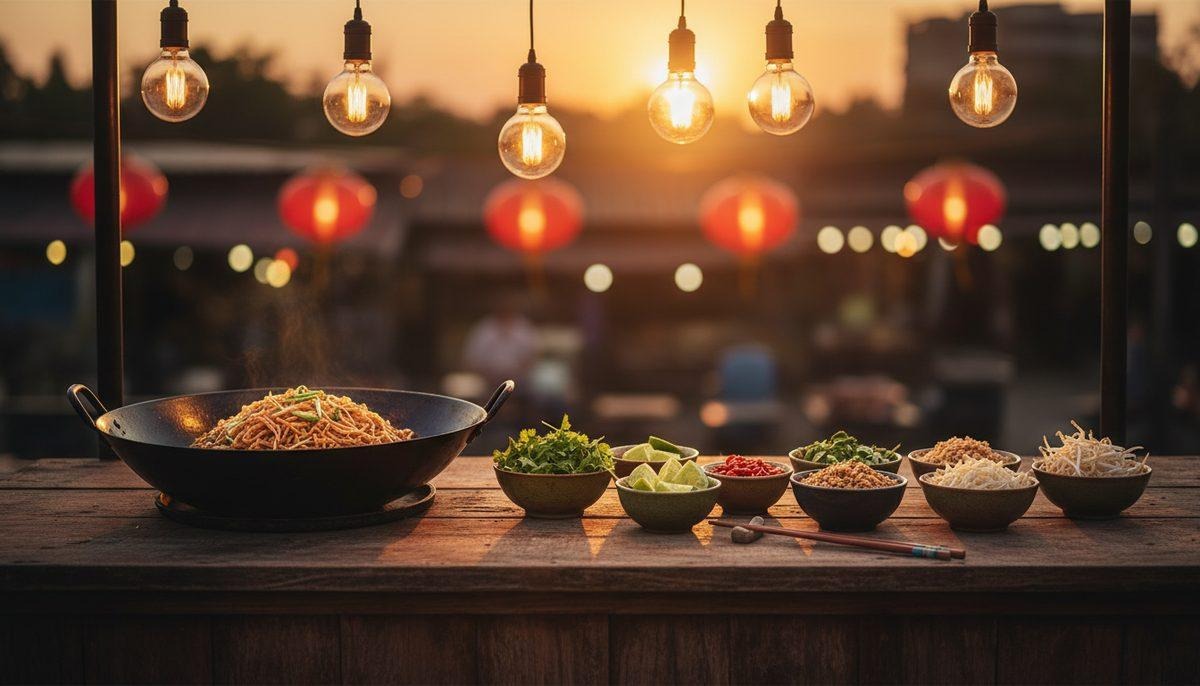
The Bangkok street version is sour and savoury before it is sweet. The backbone is tamarind, with fish sauce and palm sugar in support. Peanuts are a garnish, not a theme. The noodles are dry-ish and slightly chewy, wok-tossed hard over serious heat.
The version that travelled tends to be sweet, heavy on crushed peanut, sometimes red-tinted from ketchup standing in for tamarind, and often wetter than it should be because a domestic hob can’t reach wok temperature.
What to look for: a cart with a wok that’s genuinely roaring and a queue of people ordering it as a quick lunch rather than a tourist dinner.
Bánh mì
The bánh mì is a colonial artefact turned into something better than its parts. The French left the baguette; Vietnamese bakers made it their own by cutting in rice flour, which produces a shatteringly thin crust and an airy, almost hollow interior. It is a different bread from a French baguette, and it is the reason the sandwich works.
Inside: pâté, mayonnaise, pickled daikon and carrot, cucumber, coriander, chilli, and a protein that varies by region and cart.
Export versions often go wrong at the bread — a dense supermarket baguette turns the whole thing into a jaw workout — and frequently drop the pâté, which is where much of the savoury depth lives.
What to look for: press the bread. If it crackles and gives easily, you’re in the right place.
Tacos al pastor
Al pastor is one of food’s better migration stories. Lebanese immigrants arrived in Mexico in the early twentieth century with shawarma — spiced lamb stacked on a vertical spit. Over decades, Mexican cooks adapted it: pork instead of lamb, a marinade built on dried chillies and achiote, and corn tortillas instead of flatbread.
The vertical spit, the trompo, is not optional. The stack self-bastes as it turns, the outer layer chars while the interior stays moist, and the taquero shaves it directly onto the tortilla to order. The pineapple often perched at the top is partly flavour, partly tenderiser.
Most versions outside Mexico skip the trompo — pork gets marinated and pan-fried, which produces something decent and something else entirely. The char pattern is different, the texture is uniform where it should be varied, and it loses the contrast between crisp edge and soft centre.
What to look for: a visible trompo, and a taquero shaving from it rather than scooping from a tray.
Döner kebab
Döner in Turkey is typically served on a plate or in flatbread with modest accompaniments. The sandwich most of Europe thinks of — packed into a wedge of bread with salad, cabbage, and sauces — was largely developed by Turkish immigrants in Berlin in the early 1970s, aimed at people wanting a portable meal.
So the “authentic” version depends entirely on which authenticity you mean. Berlin’s is a real tradition in its own right, roughly fifty years deep. It just isn’t Istanbul’s.
What to look for: a spit that’s visibly been carved down through the day, not one loaded an hour ago. The meat closest to the heat has been rendering for hours, and that’s the part you want.
The pattern
Look across the five and the same three things change every time.
Heat gets softened. Sichuan peppercorn disappears; chilli counts drop. This is a straightforward commercial decision, and it is usually the first thing to go.
Sweetness rises. Tamarind becomes sugar; sauces thicken. Sweet is the safest flavour to sell to an unfamiliar palate.
The equipment gets replaced. No trompo, no wok hot enough, no rice-flour baguette. This is the change nobody chooses — it’s simply what’s available — and it’s often the one that matters most. A wok that can’t reach temperature will never produce the same noodle, no matter how correct the recipe is.
There is a flip side worth noticing. The dishes that survive the journey intact tend to be the ones that need no special equipment. A cold, sharp cucumber salad of the kind Din Tai Fung serves alongside its dumplings travels perfectly well, because a knife and a bowl work the same everywhere. So does a batch of buttermilk-marinated chicken fingers with a proper dipping sauce — that one is technique, not hardware. It is the trompo, the wok burner and the rice-flour baguette that refuse to move.
None of this makes the adapted versions inferior. Berlin döner is superb. Panda Express kung pao has fed a lot of people a lot of good dinners. Adaptation is what food does when it moves, and pretending otherwise is its own kind of snobbery.
But if you’re travelling specifically to eat, it’s worth knowing which version is in front of you — and if you’re cooking at home, worth deciding which one you’re actually trying to make before you start.