
When it comes to obscure destinations in China, Qiqihar is pretty much as far off the beaten track as you can get. Tucked away in the far north-east of the country, this is a place of freezing winters, declining industry, old railway stations and some seriously good beef barbecue.
It is also about as far removed from the shiny, futuristic China you see advertised on TikTok as you could possibly imagine. But that is precisely I came. Yep! Qiqihar is about Red Tourism, exploring the borderlands and cracking Dongbei meat.
This is the Qiqihar guide to eating, drinking and travel.
Table of Contents
What the Qiqihar Guide
Qiqihar (齐齐哈尔) is a city of around 4 million people in Heilongjiang, north-east China. Its heyday came under communism, when Soviet-backed industrialisation turned the city into a major centre for heavy industry, machinery and textiles. State-owned factories employed thousands, and this was the sort of place that kept socialist China ticking over.
Then the wheels came off. The reforms of the 1990s hammered the old industrial economy, factories closed and jobs disappeared. Today, Qiqihar has plenty of ageing railway buildings, industrial relics and faded communist grandeur. If you want the Soviet Grim experience rather than China’s shiny TikTok version. This is the flip side of “Socialism with Chinese Characteristics”.


What to Do in Qiqihar
There are nature reserves, museums and parks, but honestly you do not come here for that shit. You come as it is a gateway to the borderland of northern China. You stay for the cool communist shit.
- Qiqihar Railway Station (齐齐哈尔站): Opened in 1909, the city’s main railway station was built by the Japanese and is adorned with red slogans.
- Ang’angxi Old Railway Station (昂昂溪老火车站): Built by the Russians in 1903 as part of the Chinese Eastern Railway, this historic station later saw Japanese occupation and Chairman Mao’s return from the Soviet Union in 1950. Connected to the old Russian settlement.
- Giant steel statue of Chairman Mao: An enormous Mao statue about an hour’s drive from Qiqihar, set against an industrial backdrop and popular with visitors interested in Red Tourism.
- Old industrial sites: Ageing factories and railway infrastructure offer a glimpse of Qiqihar’s communist-era industrial heyday – yep that means Urbes!


Qiqihar Food Guide
As a northern and north-eastern Chinese city, Qiqihar has a cuisine influenced by Heilongjiang Province (黑龙江省), Dongbei cooking, neighbouring Mongolian food traditions and, to a degree, Korean cuisine. This means hearty food designed for harsh winters, with lots of meat grilled or cooked over charcoal.
Tofu, breads and steamed buns are also common, while rice and noodles are available but are less important to Qiqihar’s food identity than the grilled meat. The most famous local speciality is beef barbecue, which I will cover in more detail later.
5 Must-Try Foods in Qiqihar
5. Di San Xian (地三鲜)
Potato, aubergine and green pepper fried together in a garlicky, savoury sauce. This is classic Dongbei comfort food: cheap, filling and usually cooked with enough oil to make it taste considerably better than it sounds. A good option when you need a break from eating nothing but meat.
4. Guo Bao Rou (锅包肉)
Crispy battered pork covered in a sharp, sweet-and-sour sauce. This is one of Heilongjiang’s signature dishes, and when it is done properly, the pork stays crunchy under the sticky coating. Get it fresh from the kitchen, because soggy sweet-and-sour pork is a miserable experience.
3. Dumplings (饺子)
Big parcels of dough stuffed with pork, beef or vegetables, usually boiled or pan-fried. Dumplings are everyday food in north-east China, not some fancy restaurant invention. Order a plate, add vinegar and chilli if available, and get stuck in. They are cheap, filling and ideal when you need something more substantial than a snack.
2. Kao Leng Mian (烤冷面)
A north-east Chinese street-food classic made from a thin wheat-based sheet cooked on a hotplate with egg, sauces and seasonings. It gets folded up, chopped and served hot, with sweet, savoury and spicy flavours all fighting for attention. Cheap, greasy and easy to eat while wandering around a night market.
1. Qiqihar Beef Barbecue (齐齐哈尔烤肉)
This is the reason to eat in Qiqihar hungry. Thinly sliced beef is seasoned, piled onto plates and cooked at your table over a grill. Add spicy dipping powders, plenty of beer and several different cuts of meat, and you have the city’s defining food experience.
And this is exactly what I had!


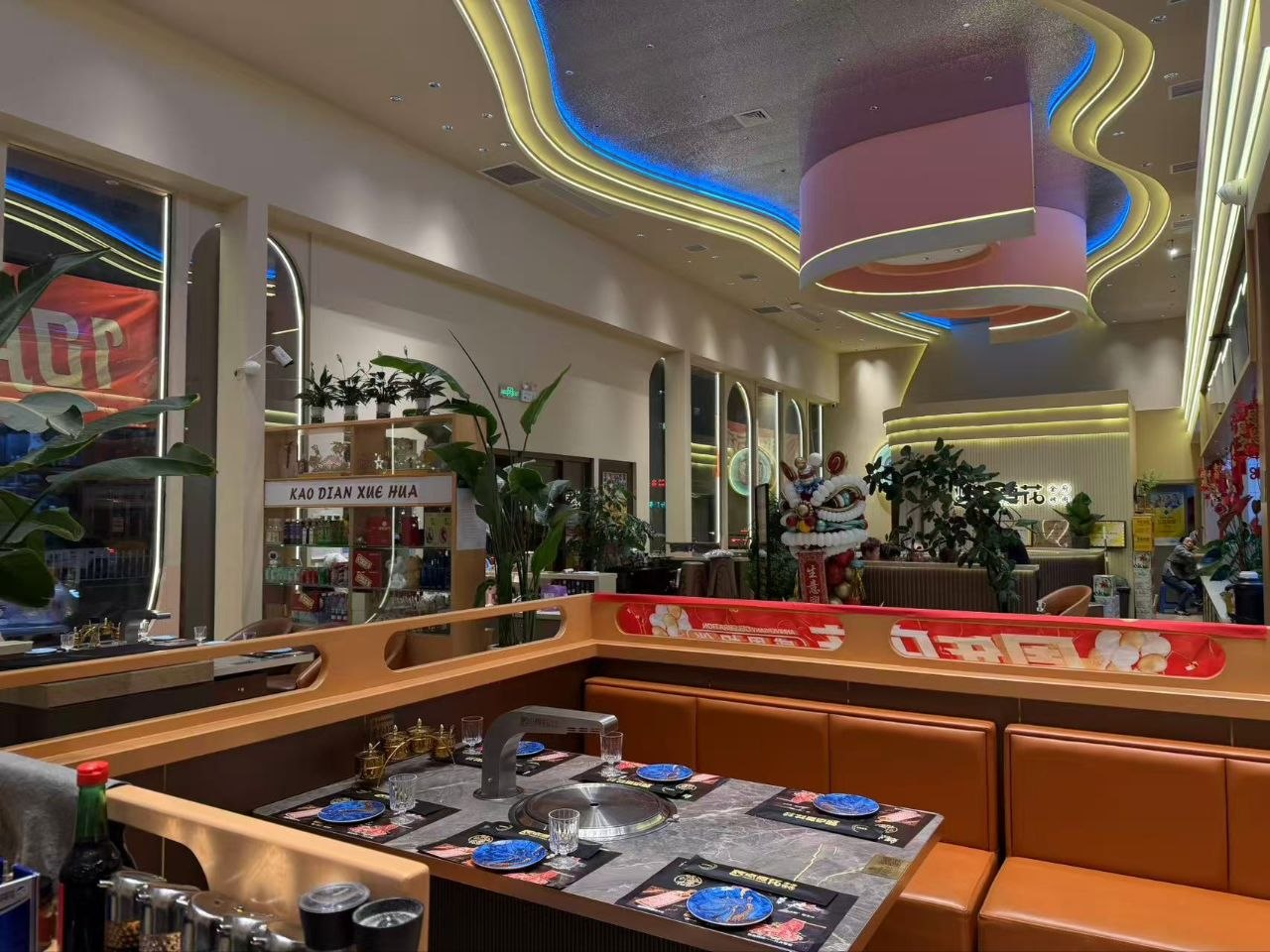
Best Restaurant in Qiqihar – Kao Dian Xue Hua BBQ
We went to Kao Dian Xue Hua Barbecue because Chinese netizens had recommended it and our Chinese staff duly fconcurred. I have to say I was not disappointed. The restaurant is located downtown, a fair distance from our hotel, and has a large interior with an upstairs area that could probably fit around 100 people.
The meat is on display as you walk in, and once seated, you get your own cooker and choose what you want to eat. Most of the options are different cuts of beef, which is exactly what you want in Qiqihar. Once the lard, yes lard is added to the grill, you are ready to start cooking.
You are then given spicy sauces and seasoning powders to flavour the meat, along with some local beers to wash it all down. In this respect, Kao Dian Xue Hua Barbecue is about as north-east China as it gets.
Another highlight was the “Occupy Mount Fuji” beef dish. This was a meat tower, quite literally decorated with dry ice and topped with a Japanese flag. The obvious implication was that China hates Japan and should take Mount Fuji over. Amazingly I can find nothing about this online, but make no mistake the occupy Mount Fuji thing is a thing.
All told, the meal came to around US$70–80 for five people to eat and drink. Granted, I did not try many other restaurants, but to me, this was the best restaurant in Qiqihar.


Other Restaurants in Qiqihar
Wuji Natural Barbecue (吴记原生态烤肉)
A local barbecue restaurant specialising in grilled meat.
Address: 209 Anshun Road (安顺路209号), Longsha District (龙沙区), Qiqihar, Heilongjiang Province.
Baokun Barbecue (宝坤烧烤)
Another local barbecue option for grilled meat and the usual accompaniments.
Address: 2 Yong’an Avenue (永安大街2号), Qiqihar, Heilongjiang Province.
Perfect Life Charcoal Barbecue, Ermalu Branch (完美生活炭火烤肉·二马路店)
A charcoal barbecue restaurant serving grilled meat.
Address: 33 Longsha Road (龙沙路33号), Jianhua District (建华区), Qiqihar, Heilongjiang Province.
South Korea Barbecue, Dongsi Branch (南韩烧烤·东四店)
A Korean-style barbecue restaurant offering another take on the region’s grilled-meat obsession.
Address: 278 East Sidao Street (东四道街278号), Jianhua District (建华区), Qiqihar, Heilongjiang Province.


Street Food Qiqihar Guide
Street food in Qiqihar is somewhat lacking, particularly in winter, when the temperatures make standing around outside eating a fairly miserable experience. You do find small kiosks selling takeaway food, as well as enclosed stalls that can squeeze in perhaps ten people, offering some protection from the cold. There are also plenty of simple, inexpensive restaurants that fit into the street-food genre, even if they are technically indoors.
Summer is the best time to explore, when night markets and food stalls are busier and people can actually enjoy being outside. Look around the Longsha Park (龙沙公园) area and the city’s main shopping streets for casual eateries and evening food stalls. Longsha Night Market (龙沙夜市) is another place to look when it is operating.
As for what to eat, Qiqihar is all about meat, so look for grilled beef skewers (烤牛肉串), lamb skewers (烤羊肉串), grilled sausages (烤肠), fried snacks, dumplings (饺子) and local barbecue (齐齐哈尔烤肉). You can also find kao leng mian (烤冷面), a north-east Chinese street snack made from grilled wheat-based sheets with egg and sauces. Given the quality of the inexpensive restaurants, eating indoors is no bad thing and you still get the Dongbei street food vibe.


Fast Food in Qiqihar
You can tell the importance of a Chinese city by which fast-food restaurants it has, and indeed how many. Usually, cities start with shit like Wallace before expanding to Dicos, KFC and then McDonald’s and Pizza Hut. As expected, McDonald’s and Pizza Hut were the later arrivals.
- KFC: 17 branches in Qiqihar.
- Dicos (德克士): 3 branches in Qiqihar, including one at the train station.
- McDonald’s (麦当劳): 2 branches in Qiqihar, which saved us at breakfast.
- Pizza Hut (必胜客): 1 branch, at Wanda Plaza.


Qiqihar Nightlife Guide
OK, so Qiqihar nightlife? Well, in late October at least, it seems to be somewhat lacking. In fact, after 10 pm, we could literally not even find an open shop to buy beer.
Of course, there are dodgy KTVs and some restaurant life near the old train station, but let’s just say you do not come to Qiqihar to party.
I’m listing the following establishments anecdotally. All were found online and I cannot guarantee their existence, particularly in winter.
404 NOT FOUND BAR
A local bar and lounge in Longsha District.
Address: 77 Yong’an Street (永安大街77号), Longsha District (龙沙区), Qiqihar, Heilongjiang Province.
Party Bar (派对酒吧)
A bar and nightlife venue on Qingyun Street.
Address: 94 Qingyun Street (青云街94号), Longsha District (龙沙区), Qiqihar, Heilongjiang Province.
Xinwanshan Hongliange Square (鑫万山红俱乐部)
Listed as a nightclub on Qingyun Street.
Address: Qingyun Street (青云街), Longsha District (龙沙区), Qiqihar, Heilongjiang Province.
Where to Sleep in Qiqihar
I won’t do a whole section on where to sleep here, as they have cheap to semi-expensive options. The hotel around Wanda Plaza is probably a good choice, while we stayed at the Homeinn Plus, which was great value and in a convenient location.
Homeinn Plus Hotel, Qiqihar Longhua Road (如家精选酒店·齐齐哈尔龙华路店)
This is where we stayed, and it was decent value in a convenient location.
Address: 327 Longhua Road (龙华路327号), Tiefeng District (铁锋区), Qiqihar, Heilongjiang Province.
Typical room budget: approximately ¥180–300 (US$25–42) per night.


Wanda Realm Qiqihar (齐齐哈尔富力万达嘉华酒店)
A more upmarket option beside Wanda Plaza, convenient for shopping and restaurants.
Address: 1 Xinjiang Road (新江路1号), Jianhua District (建华区), Qiqihar, Heilongjiang Province.
Typical room budget: approximately ¥450–700 (US$63–98) per night.
Getting Out of Qiqihar Guide
We used Qiqihar as a starting point for our tour of the Chinese borderlands. This meant hiring a car from the airport and then driving 6 hours to Manzhouli – which was totally worth it. The city is also decently connected by plane and fast train.
Flights from Qiqihar
Qiqihar Sanjiazi Airport (齐齐哈尔三家子机场, NDG) operates domestic flights, with routes varying by season and airline.
Approximate one-way flight budgets:
- Beijing: Around 2 hours; ¥600–1,500 (US$84–211).
- Shanghai: Around 3 hours; ¥800–1,800 (US$113–254).
- Dalian: Around 2 hours; ¥400–1,000 (US$56–141).
- Qingdao: Around 2 hours 30 minutes; ¥500–1,200 (US$70–169).
- Tianjin: Around 2 hours; ¥400–1,000 (US$56–141).
Fast Trains from Qiqihar
Qiqihar South Railway Station (齐齐哈尔南站) handles high-speed rail services. Harbin is the main connection for onward journeys around north-east China.
- Qiqihar South to Harbin: Around 1 hour 30 minutes to 2 hours; second-class seats approximately ¥93–111 (US$13–16).
- Qiqihar South to Harbin West: Around 1 hour 30 minutes to 2 hours; second-class seats approximately ¥98–109 (US$14–15).
- Qiqihar South to Dalian North: Around 6 hours to 6 hours 35 minutes; second-class seats approximately ¥505–554 (US$71–78).
Slow Trains from Qiqihar
- Qiqihar to Harbin: Around 3–4 hours; hard-seat fares from approximately ¥43.50 (US$6). Hard sleepers are around ¥89.50–97.50 (US$13–14), while soft sleepers cost approximately ¥135.50–141.50 (US$19–20).
- Qiqihar to Beijing: The Z18 overnight train takes around 13 hours 35 minutes, with hard sleepers from ¥310.50 ($44) and soft sleepers from ¥488.50 ($69). The faster G-series trains take around 6–7 hours, with second-class seats around ¥700–780 ($99–110).
- Qiqihar to Dalian: Conventional services take approximately 14–17 hours, with hard seats around ¥148.50–152.50 (US$21–22), hard sleepers around ¥254.50–279.50 (US$36–39), and soft sleepers around ¥398.50–415.50 (US$56–59).
So, that is THE food in Qiqihar guide, with a few other tidbits thrown in for good measure.
There are no international groups bring tours here, yet anyway, but I can arrange a bespoke tour through my company YPT.
One thought on “Food in Qiqihar Guide”
Comments are closed.