
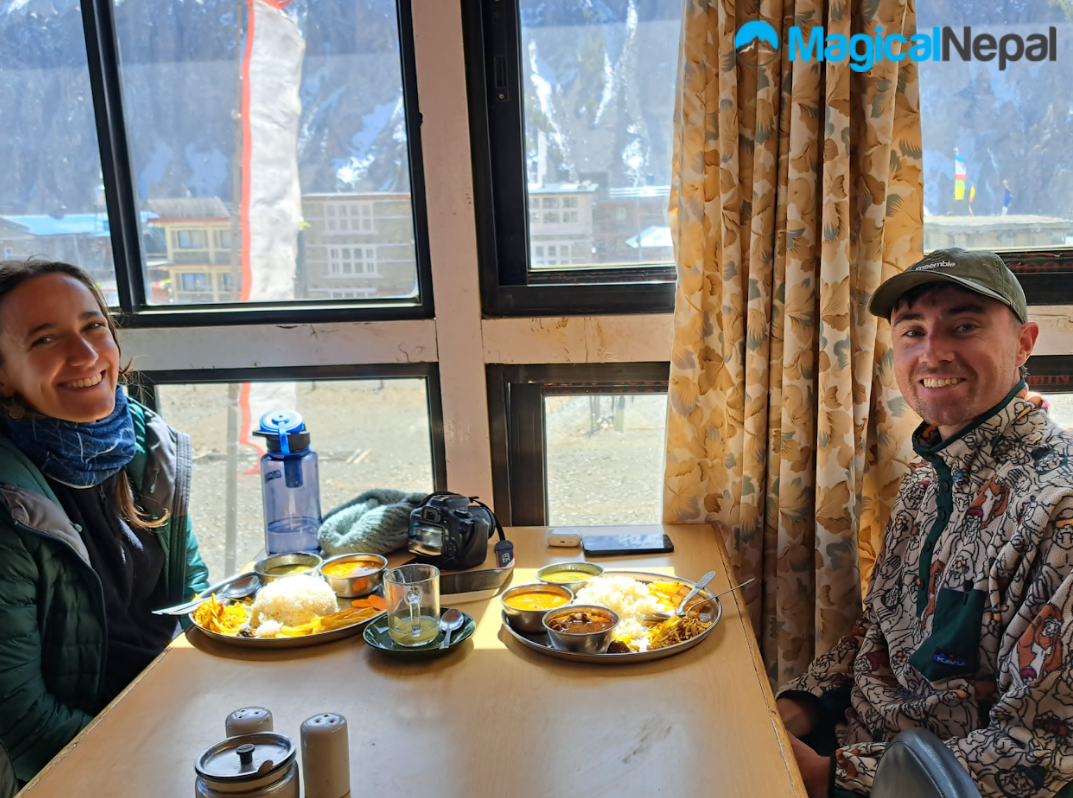
One of the things people often wonder about before trekking in the Himalayas is surprisingly simple: what are we actually going to eat?
Images of mountain trails often feature snow-covered peaks, suspension bridges, prayer flags in various colours and stunning mountain scenery. They don’t often open the door to the dining room at the end of a long walking day where the trekkers sit around a stove with tired legs, cold hands and a very real hunger.
In Nepal, food is an integral part of the teahouse trekking experience. You don’t expect to find a restaurant in every village while you’re in the Himalayas. Rather, meals are typically simple, substantial and provide enough energy for another day on the trail.
The food is also a part of the interest of Manaslu Circuit trekking. The trail winds through various mountain communities, and items on the menu may vary as you ascend and get further away from larger communities.
The availability of these depends on the route, altitude and season, but there is generally more choice than first-time trekkers realize.
What is a Himalayan Teahouse?

A teahouse is more than just a place to sleep. Teahouses offer simple lodging and meals on numerous trekking trails in Nepal. After several hours of walking, the dining room becomes the social centre of the evening. Foreigners trekkers sit together and compare routes, discuss the weather and prepare food.
It’s a very different experience from dining in a city restaurant. Menus can be quite diverse at lower elevations. The higher you go, the harder it will be to carry supplies and the easier it will be to make a simple meal. That’s part of the experience, not something to be avoided.
You are eating in remote mountain communities where ingredients must be brought to villages by road, porter, mule or other local transport as appropriate.
Dal Bhat Is the Classic Trekking Meal

Dal bhat is the one dish that epitomizes trekking in Nepal. Usually served with rice, lentil soup, vegetables and pickles, dal bhat is a practical meal for a long day on the trail. The mix offers a source of carbohydrates and protein, and the substantial amounts are a favorite among trekkers.
It’s also nice to come back to the same familiar meal after a hard day’s walk. While in Nepal, you will hear the phrase “Dal Bhat Power, 24 Hour” quite a few times, and there’s a reason why the dish is so synonymous with trekking culture.
The vegetables, pickle and other side dishes may differ depending on the teahouse. Some may serve extra servings, others may serve a simpler meal at higher altitudes.
After a while, dal bhat becomes a thing that is not just to eat, but to enjoy for many trekkers.
Momos, Thukpa and Other Mountain Comfort Food

Dal bhat is not the only thing on the menu. Another popular choice are momos. They are dumplings that are steamed and filled with vegetables, cheese, meat or other fillings, depending on the teahouse. They are particularly welcome when you have spent the afternoon walking in cold weather.
Thukpa is a Tibetan noodle soup that is especially popular in colder mountain areas. After several hours outdoors, a hot bowl of noodles and broth may be just what you need.
Other popular choices include noodles, fried rice, pasta, soups, potatoes, eggs and simple vegetable dishes.
Menus tend to be more diverse at lower altitudes and more restricted at higher altitudes. This is a point to keep in mind when making your expectations. Not all pizzas in a mountain village are necessarily like those from Naples. However, after 6 hours on a trail, it may not be that important.
What do you eat for breakfast?
Breakfast is typically simple as trekkers need to get moving. Porridge, eggs, toast, Tibetan bread, pancakes and muesli are among the foods you may encounter. Other popular options include tea and coffee.
Some trekkers like to have a bigger breakfast before a long walking day, others prefer a lighter breakfast early in the morning.
The route of the day may also influence your selection. It is especially important to have sufficient food and water before embarking on a long climb.
A good strategy is to identify a couple of breakfast options that work for you and stick with them, instead of trying a lot of different options when you are tired and at altitude.
What happens to the food higher up?
This is where things begin to get interesting. The further up the mountain you go, the more apparent the logistics of mountain food are. Villages are further away, travel is more difficult and some ingredients are less accessible.
This means that menus can be shorter. This doesn’t have to mean the food is bad. In many instances, meals are easier and more convenient.
Potatoes, rice, noodles, soup and other filling foods are still popular because they are good to eat when people have walked all day uphill.
Also, expect to pay more for higher elevations. Food and other supplies are not easily available to remote communities, and this can be reflected in the cost.
Is the Food Safe to Eat?
Food hygiene is a serious matter for all trekkers, but don’t worry about eating in teahouses. Select clean, well-used areas, freshly prepared food, and use common sense when selecting food.
Water is a special case. Untreated water should not automatically be assumed to be safe for visitors. Bring an appropriate purification system or use treated water as per the directions for your trek.
Hand sanitiser is also a good idea to have on hand and wash hands before eating if possible. Please state any dietary requirements or allergies before ordering. If you are travelling with a guide, they can also assist you in communicating your needs to the teahouse staff.
Is it possible to eat vegetarian food?
Yes. There are many trekking routes in Nepal where vegetarian food is available.
Dal bhat is easily vegetarian and there are many vegetarian options like vegetable noodles, fried rice, soups, potatoes and pasta.
Vegetarianism is a big part of Nepal’s food culture, making it relatively easy to navigate as a vegetarian traveller.
However, if you have a severe food allergy or dietary need, it is important to make this clear to your guide and accommodation providers. The ingredients and methods of preparation may differ from teahouse to teahouse.
Which Snacks to Bring?
Snacks are helpful on the walking day, even if there are meals available at the teahouses.
Good options include:
- Nuts and trail mix
- Chocolate
- Energy bars
- Dried fruit
- Biscuits
- Electrolyte or rehydration sachets are available.
- Snacks from home that are loved
It’s also nice to have a couple of comfort foods from home. After hours of walking, a snack from the bag in your suitcase can become the most valuable item you have.
Snacks can also be purchased in Kathmandu and on many trekking routes, but they are generally less available as you ascend in altitude.
What Do You Drink on the Trail?
Tea is everywhere. Some teas you might find are black tea, milk tea, lemon tea, and ginger tea. Hot drinks are especially appreciated when the evening temperatures drop.
Many teahouses also sell coffee, but the quality can differ significantly from one to another.
It is important to stay hydrated during the hike. Don’t forget to drink regularly, even if you don’t feel thirsty, during cold weather.
Many trekkers use treated water from appropriate sources and bring their own water bottles, rather than depending on bottled water. This can also help to minimize plastic waste on popular trekking routes.
How Food Differs Between Nepal’s Trekking Routes
The differences between the food available on the trekking routes of Nepal. The difference in food available in the trekking routes of Nepal. The food can be very different in different trekking areas.
In a popular trek like the Annapurna Circuit trek, trekkers will encounter a variety of landscapes and settlements, and menus and ingredients will vary as they ascend.
The menus are usually simpler in the higher villages, and more varied in the lower sections. The food is also a reflection of the cultural diversity of the region.
You will be served familiar Nepali dishes as well as dishes influenced by Tibet and international dishes made for trekkers along the way.
This is one of the fun aspects of teahouse trekking. Eat porridge or eggs in the morning, have dal bhat for lunch and momos or a hot bowl of soup in the evening.
Eating at Altitude Is Part of the Experience
The experience of eating at altitude is part of the experience. The most significant difference between home and on a trek in the Himalayas is the environment.
You could enjoy breakfast in front of a large mountain, lunch in a small village, and dinner in the pouring snow. The food is simple, but the surroundings are anything but.
This is what makes teahouse trekking memorable.
You’re not just driving through the mountains and stopping at a place. You are spending time with people who live there and experiencing a little of their daily life in the Himalayas.
Food is fuel, but it’s also the journey
Food can be fuel on the first few days of a trek in the Himalayas. Then it’s frequently a part of the experience you recall most.
You begin to see which teahouse makes the best dal bhat, which village has a particularly good bowl of soup and how satisfying a cup of hot tea can be after a cold afternoon outside.
You also gain an understanding of simplicity. When you’re at home, planning your trip, a plate of rice, lentils and vegetables might not seem very exciting. It can be just what you need after a long day of trekking in the Himalayas.
Food on a Himalayan teahouse trek is perhaps best thought of in this way. You’re not going to the mountains for a fine dining experience. You’re there for the trails, landscapes, people and culture. The food becomes an important and surprisingly enjoyable part of all of it.