
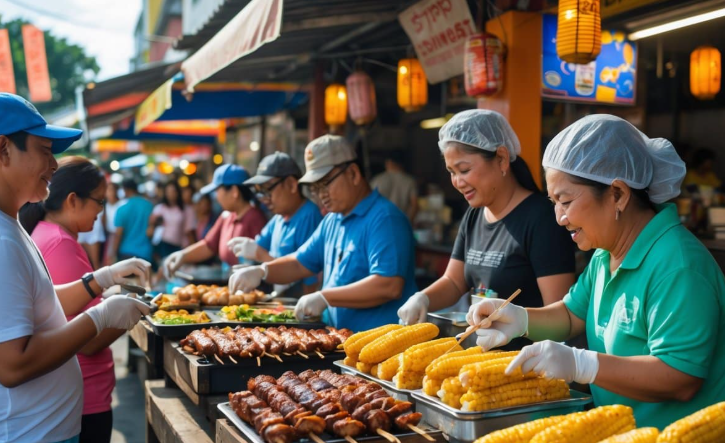
Some street-food stalls make eating on the move look effortless. The queue advances, the order is handed over in seconds, and the first bite or sip is as satisfying as it should be. There is no search for a spare table, no lid working loose halfway down the road, and no dessert melting over the customer’s hand before they have taken a photograph.
That apparent simplicity is usually the result of dozens of small decisions. The vendor has chosen a portion that suits the product, a container that can be held comfortably, and a serving routine the team can repeat during the busiest hour of the day.
This matters whether the menu is built around Sicilian gelato, Filipino halo-halo, Turkish coffee, Vietnamese iced coffee, or a house lemonade sold at a weekend market. Street food is not merely restaurant food served outside. It has to survive movement, weather, queues, crowds, and customers who may be carrying a phone, a bag, or another dish at the same time.
Street Food Has to Work Beyond the First Bite
A dish can taste excellent and still be awkward street food. A towering dessert may look impressive at the counter but become difficult to carry through a crowd. A generously filled drink can spill as soon as the customer steps off the pavement. A lid that seems secure on an empty cup may behave differently once the drink, ice, foam, or toppings are added.
Good vendors think about the entire journey rather than the handover alone:
- The server has to fill and finish the order quickly.
- The customer has to pick it up without touching the food or disturbing the lid.
- The portion has to remain manageable while the customer walks.
- The last few bites or sips should be nearly as enjoyable as the first.
- The empty container should be easy to deal with when the meal is finished.
This is why the best container is not necessarily the largest or most decorative one. It is the one that supports the food, the service method, and the place in which it will be eaten.
Frozen Desserts Need Their Own Serving Logic
Ice cream is unforgiving. From the moment it is scooped, time and temperature begin to change it. A street vendor therefore needs a serving format that is quick to fill, comfortable to hold, and appropriate for the portion and toppings.
A compact cup may be ideal for one or two dense scoops. A wider opening can make it easier to add fruit, sauces, nuts, or pieces of biscuit without burying the main flavour. Taller formats can suit layered desserts, but only if customers can reach each layer without having to tilt the container too far. The spoon matters too: it should reach the bottom without forcing the customer’s fingers into the dessert.
Volume planning also becomes important at festivals and seasonal events. A shop serving a predictable afternoon crowd can replenish stock differently from a temporary stall facing one intense weekend. For vendors preparing several portion sizes or planning for event volume, sourcing ice cream cups wholesale may make it easier to standardise portions and organise stock across the menu. The final choice should still be tested with the actual dessert, toppings, spoon, and serving conditions.
There is also a temptation to treat every cold dessert in the same way. That rarely works. Gelato, soft serve, frozen yoghurt, shaved ice, and halo-halo have different textures and different demands. A cup that suits two neat scoops may not leave enough room for shaved ice and mixed toppings. A container that presents a colourful layered dessert beautifully may be unnecessarily large for a dense premium gelato.
The product should choose the portion; the portion should choose the cup—not the other way around.
Coffee Stalls Sell a Small Ritual
Coffee is often a customer’s pause between destinations. It may be the first drink of the morning, a warm break at a cold market, or the final stop before leaving a festival. Even when the transaction lasts less than a minute, the customer expects a familiar ritual: a cup that feels comfortable, a lid that stays in place, and a drink that can be carried without constant attention.
The serving format should follow the drink. A short black coffee does not need the same space as a latte. Foam, whipped toppings, or extra ice change the usable capacity. So does the distance between the stall and the likely place of consumption. A drink enjoyed beside the counter has a different journey from one carried across a market or onto public transport.
Rather than assuming that a nominal cup size tells the whole story, vendors should fill the cup as it will be served. Add the actual drink, ice, foam, and lid. Pick it up with wet hands. Walk with it. Place it in the carrier used for multiple orders. These basic trials reveal more than examining separate components on a shelf.
The Menu Should Control the Packaging
It is easy to begin with a catalogue and ask which containers look attractive. A better process begins with the menu and service environment.
| Menu item | What the vendor should check |
| Gelato or ice cream | Scoop count, topping room, spoon reach, and how quickly the dessert softens |
| Shaved ice or halo-halo | Total volume after mixing, wide access, layered ingredients, and spill risk |
| Espresso or short coffee | Practical fill level, comfortable handling, and whether a lid is actually needed |
| Milk-based hot drink | Foam space, lid fit, carrying distance, and the customer’s grip |
| Iced coffee or fruit drink | Ice displacement, condensation, lid opening, straw or sip format, and headspace |
| Multi-item order | Balance in a carrier or bag and whether items interfere with one another |
This approach also prevents menu creep from causing operational problems. A stall may begin with coffee, then add iced drinks, desserts, and seasonal specials. If every new item introduces a completely different cup, lid, or accessory, the counter soon fills with similar-looking parts that do not necessarily work together. The risk of selecting the wrong component increases precisely when the queue is longest.
A smaller, deliberately tested set of serving formats is often easier for staff to learn and easier for a business to count, store, and reorder. That does not mean forcing every product into one cup. It means avoiding differences that do not improve the customer experience.
Branding Works Best When It Belongs to the Stall
At a crowded market, customers see a stall from several metres away, but they may see its cup all the way across the venue. That makes takeaway packaging a mobile part of the stall’s identity. It can help another visitor recognise where a good-looking drink came from, and it can make a simple order feel more considered.
The most effective designs are not always the loudest. A strong logo, readable type, and a restrained colour palette can be more recognisable than artwork crowded with messages. The design also needs to survive the realities of service. Important details should remain visible when the cup is held, fitted with a sleeve, or placed in a carrier.
Once a vendor has a stable menu, confirmed cup format, and predictable ordering needs, custom printed paper cups can extend the stall’s visual identity beyond the counter. Printing should come after fit and service testing, however. An attractive cup cannot compensate for an unsuitable size or a lid combination that has not been checked with the filled drink.
Branding can also be local without becoming clichéd. A market trader might use an illustration inspired by the neighbourhood, a phrase customers hear at the counter, or colours taken from the stall itself. The cup then feels connected to a real place instead of looking like generic promotional merchandise.
Design the Counter for the Rush
The quiet hour can hide problems. A lid that takes a few extra seconds to fit seems harmless when nobody is waiting. During a sudden rush, those seconds multiply across every order. Staff begin to hurry, components are mixed up, and the handover area becomes cluttered.
The counter should make the correct sequence obvious. Cups and matching components need clear positions. The most frequently used sizes should be easiest to reach. Toppings, spoons, napkins, and carriers should follow the order in which the server uses them. If two lids look nearly identical but are not interchangeable, labels and separate storage are more dependable than memory.
It is worth running a rehearsal before a major event. Fill several real orders in succession and ask someone unfamiliar with the setup to observe. Where does the server pause? Which item is difficult to reach? Does condensation make the cup slippery? Can a two-drink order be handed over safely? What happens when the customer also orders food?
The goal is not laboratory perfection. It is a repeatable routine that still works when the stall is noisy, busy, and staffed by someone who may have joined the team that morning.
Test the Whole Order, Not One Component
Packaging is a system. A cup can appear sturdy on its own and still perform poorly with the chosen lid. A dessert cup can hold the correct portion yet become awkward once a spoon and toppings are added. A carrier can feel stable while stationary but shift when someone turns a corner.
Before committing to a serving setup, vendors can run a simple practical check:
- Prepare the product exactly as it will be sold.
- Use the intended fill level, toppings, lid, sleeve, spoon, and carrier.
- Let it sit for the realistic time between preparation and collection.
- Carry it one-handed and as part of a multi-item order.
- Ask a person who did not design the setup to open and use it.
- Record spills, loose lids, awkward grip points, and slow steps at the counter.
- Adjust one variable at a time and repeat the check.
The test should reflect the stall’s actual customers. A tasting event where people remain nearby is different from a commuter location where drinks travel. A family festival produces more multi-item orders and smaller hands. A night market may demand quicker identification of sizes in low light. Context changes what “works.”
The Best Street-Food Packaging Is Almost Invisible
People travel for flavours, stories, and the pleasure of finding something they cannot get at home. They do not visit a street-food market because they are excited about a lid or a dessert cup. Yet those ordinary objects can decide whether the experience is effortless or irritating.
When the serving setup is right, it disappears into the moment. The customer notices the cold gelato, the fragrant coffee, the generous topping, or the atmosphere of the market. They can walk, talk, and eat without fighting the container. The vendor can concentrate on speed and hospitality instead of wiping spills or searching for the correct lid.
That is the quiet craft behind many great stalls. Start with the food, follow the customer’s journey, test the complete order, and add visual personality only after the practical details work. Do that well, and the cup becomes what it was always meant to be: a simple way to carry a memorable taste of a place.