
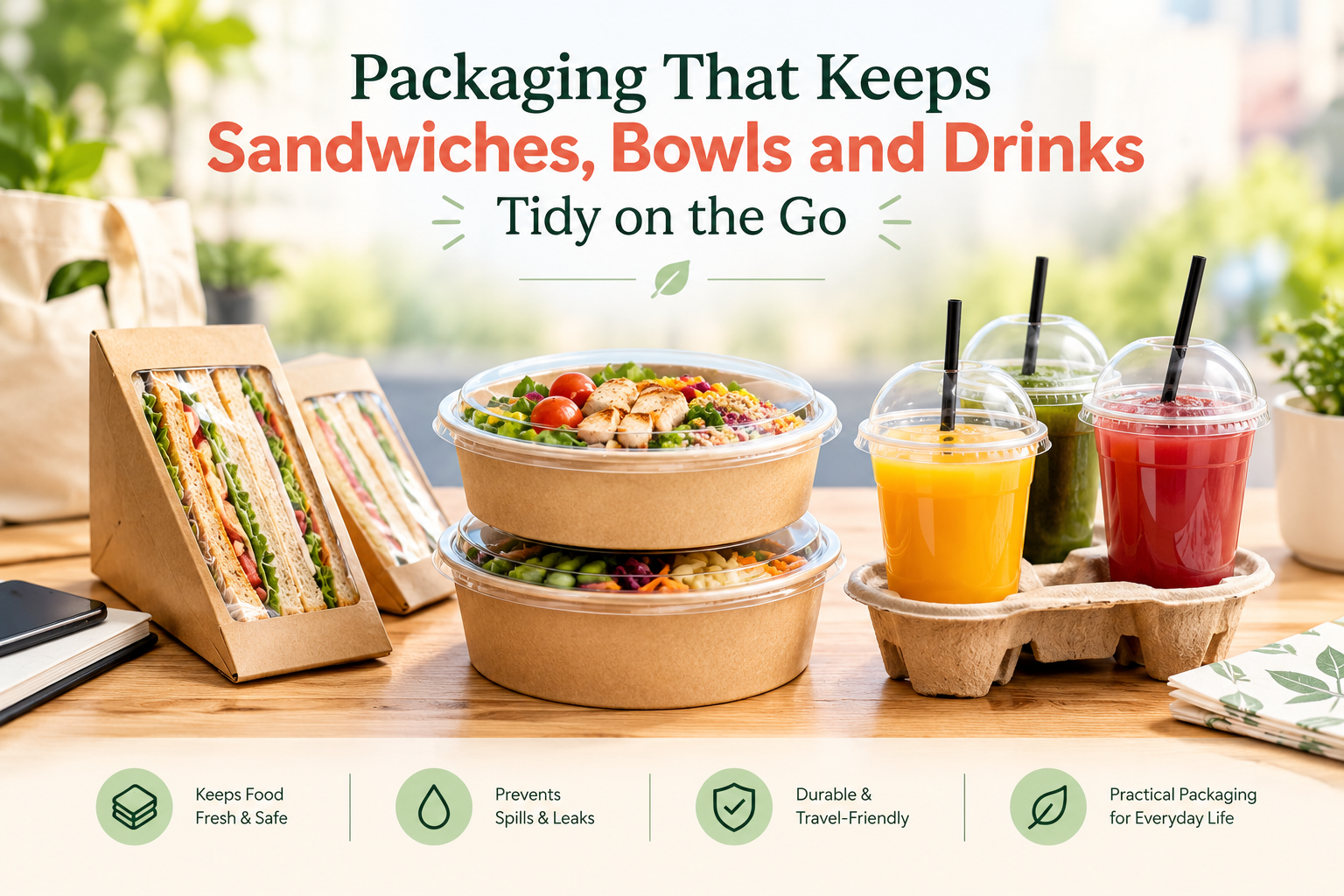
Street food lives or dies on the walk between the counter and wherever the customer ends up eating. A sub that falls apart halfway, a grain bowl that leaks into a tote bag or a cold drink that sweats through its paper cup turns a good meal into a bad memory, and the trader gets blamed for the packaging rather than credited for the food.
The traders who avoid that have usually settled on three formats and ordered each one properly. A sleeve that holds a sandwich together. A box that suits what goes in it. A cup that copes with cold liquid and ice. None of these is complicated, but each has a handful of details that decide whether it works, and those details are what suppliers ask about when you request a quote.
Start From the Food, Not the Catalog
The most useful habit when ordering takeaway packaging is to describe the food before asking for a size. A 12-inch sub, a sourdough round and a tortilla wrap need three different dielines, and a hot grain bowl needs a different barrier from a cold salad. Suppliers who make the order will cut to the item if you send them a photo with a ruler beside it, or a physical sample, and that removes most of the guesswork.
It also saves money. A box ordered a size too large wastes board on every unit and lets the food slide around, and a box too small gets forced shut and splits at the corner. Measure the portion as it is actually served, with the sauce and the toppings on, rather than the bread alone.
Sandwich Sleeves That Hold the Fill Together
A wrapped sandwich unwraps itself in a bag. A sleeve is a printed band that holds the sandwich closed, keeps the two halves aligned and gives the customer something clean to hold while they eat. Delis and sub shops use them because a sleeved sandwich looks deliberate in a grab-and-go chiller and survives a bike ride.
The main choices are a straight band or an angle cut, an optional window, and the board. White SBS cardstock holds color for pack shots and ingredient photography, while natural kraft reads as small-batch and suits a one or two color logo, though it shifts every printed color warmer. A window shows the filling but every square inch of window is an inch you cannot print on. Suppliers producing custom sandwich sleeves typically run from 500 pieces per design, with a free digital proof and six to seven business days of production, and will mark a clear zone on the proof for the ingredient label your printer applies.
Boxes for Bowls, Rice and Anything With a Lid
Rice bowls, noodle boxes, loaded fries and salads all travel better in a box than a tray, but the barrier has to match the fill. Dry food needs no treatment at all. Fried food needs a grease-resistant grade or the oil wicks through and stains the outside within minutes. Hot fill needs moisture tolerance, and chilled food needs an adhesive that holds in a fridge.
That is why the better suppliers specify the box from the food outward. Order custom kraft food boxes by describing the portion and the serving temperature, and the board, the barrier and the dieline follow from that. Kitchens can order sizes cut to their portions from 100 pieces, PFAS-free grease-resistant grades are the sensible standard, and a gable handle version suits catering orders that someone has to carry across a car park. One board grade and one print system can usually cover a whole menu with only the dieline changing between products, which is what makes a range look planned rather than assembled.
Cold Drinks Need a Cup That Shrugs Off Condensation
Hot drinks get all the attention, but cold drinks are harder on a paper cup. Ice and condensation attack the board from both sides, and a cup with a weak coating goes soft in the hand before the customer has finished. The cup also has to survive being set down on a wet counter and picked up again.
The practical answer is a coated cup designed for liquid contact. Stalls ordering custom wax paper cups get a paperboard body with a paraffin wax or PE coating that keeps liquid out of the fibers, in sizes from 4 oz up to 32 oz, on food-grade stock between 170 and 280 gsm. The coatings are rated food-safe and heat-resistant to 90 degrees Celsius, so the same cup covers iced drinks and a warm chai, and standard production runs eight to ten business days from 100 units upward. Store cups dry and stack properly, because humidity softens paperboard long before it reaches the customer.
Print Decisions That Pay for Themselves
Printing is where traders either overspend or undersell themselves. A single color logo on kraft board is the least expensive run and often the best looking one, because the ink sits into the surface and reads as honest. Full color CMYK earns its cost when the design is photographic or illustrated. Pantone spot colors are for the case where a sleeve has to match cups and bags already in use.
Think about where the eye lands. A sandwich sleeve is read at arm’s length in a chiller, so the logo needs to be large and the type sparse. A box is seen from above at the counter, so the lid carries the message. A cup is seen in the hand and in photographs, so a wrap that works from every angle is worth more than a front-only panel. Send print-ready files at 300 dpi and approve the proof carefully, since it is the one stage where changes cost nothing.
| Format | Usual minimum | Production after approval | Board or coating |
| Sandwich sleeves | 500 per design | 6 to 7 business days | White SBS or natural kraft |
| Kraft food boxes | 100 pieces | Quoted with the dieline | Barrier chosen for the fill |
| Wax paper cups | 100 units | 8 to 10 business days | Paraffin wax or PE on 170 to 280 gsm board |
Keeping the Range Small
A stall that runs six box sizes, four cup sizes and three sleeves spends its evenings counting stock. Most menus can be served from two box sizes, two cup sizes and one sleeve dieline, and the saving in storage and reordering is bigger than any quantity discount on the extra formats.
Pick the formats by looking at a week of orders. If the large bowl sells one in twenty, serve it in two regular boxes and drop the large one. If every cold drink is either 16 or 22 oz, there is no reason to stock 12 oz cups at all. Fewer formats also mean one artwork file and one board, so reprints are quicker and the whole counter looks consistent.
What to Send a Supplier
A good quote request contains five things. A photo of each item as served, with a ruler in the frame. The serving temperature and how long the food sits before it is eaten. The quantity you actually sell in a month. Your logo as a vector file. And any packaging you already use, so colors and sizes can be matched.
With that in hand a supplier can send a dieline and a digital proof within a day or two, and you can order a sample before committing to a run. Get the sandwich to arrive in one piece, the bowl to stay sealed and the drink to stay cold, and customers will remember the food, which is the whole point.