
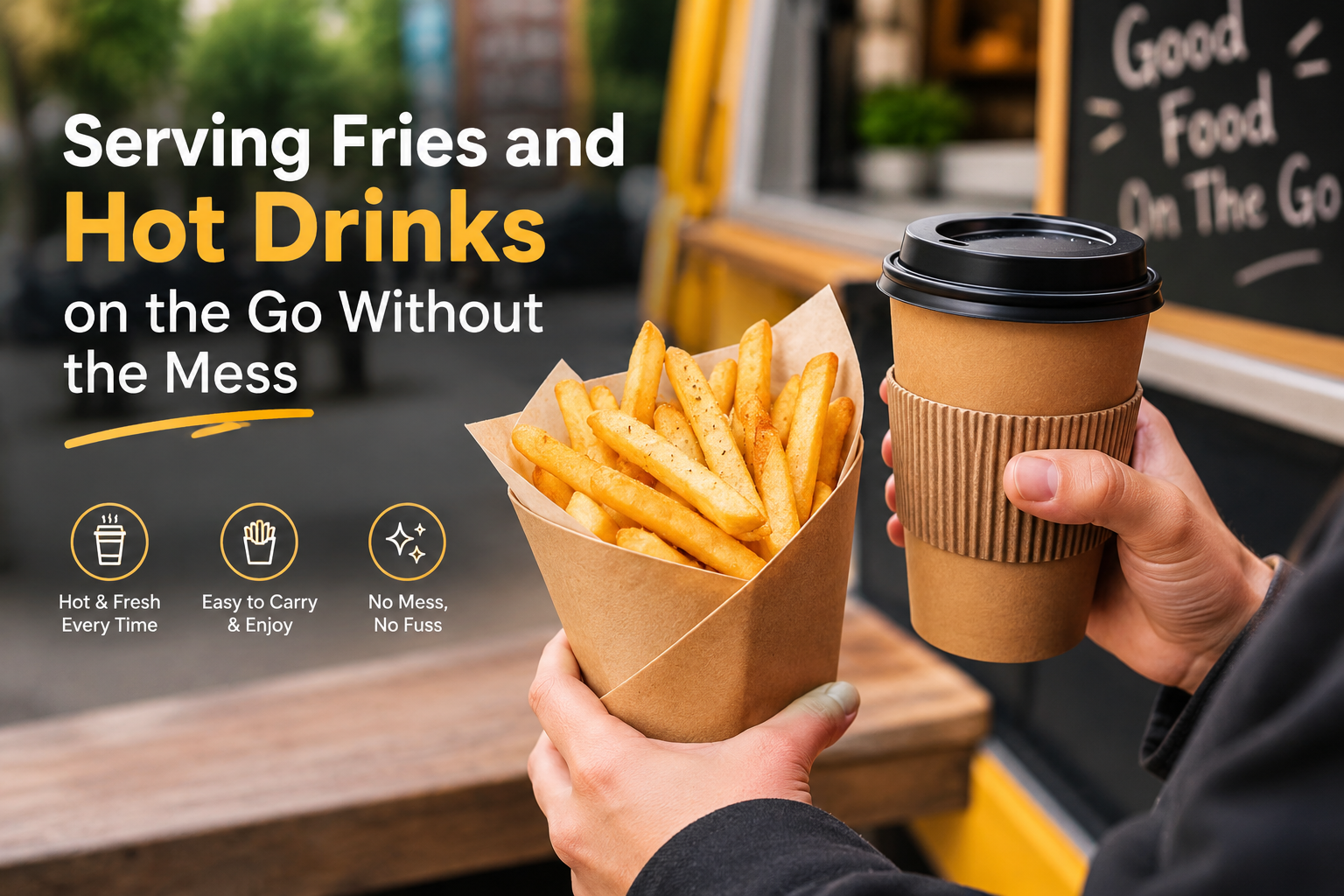
Anyone who has run a food truck window or a street stall on a busy night knows the two orders that cause the most trouble. The first is a portion of fries, which goes soggy at the bottom, spills over the top and leaves grease on everything it touches. The second is anything hot in a cup, whether that is soup, broth, chili or coffee, because a hot cup with no sleeve gets handed back, set down on the counter and spilled while the customer hunts for a napkin.
Neither problem is about the food. Both are about the packaging, and both are cheap to fix once you know what to ask a supplier for. This guide covers the three formats that do most of the work at a fries and hot drinks window, which are the fry sleeve, the soup cup and the coffee sleeve, with the details that matter when you order them.
Why Fries Need a Sleeve and Not a Bag
A paper bag holds fries the way a sack holds potatoes. The portion sits in a heap, steam has nowhere to go, and by the time the customer reaches a bench the bottom layer has gone limp. A sleeve is open at the top and tapered at the bottom, so the fries stand upright, air moves through them and the customer can eat with one hand while walking.
The board matters more than people expect. Uncoated kraft board is the usual choice because it looks right at a street stall and takes a one or two color print well. Where the fries are especially oily, a grease-resistant coating or a greaseproof liner stops oil showing through the print within minutes. Suppliers who make custom french fry sleeves to order typically quote from 100 units, with production of three to five business days after artwork approval, which is short enough to test a design before a festival weekend rather than months ahead.
Getting the Fry Sleeve Size Right
Most spills happen because the sleeve was ordered to a guess rather than to a portion. The useful approach is to weigh a standard serving, pile it into a sample sleeve and see whether there is a finger’s width of board above the fries. If the portion sits proud of the top, every walk back to the car costs a few fries and a greasy jacket.
A plain unprinted sample tells you whether the structure fits, and a printed prototype tells you whether your color holds on a brown board. Sample costs are normally credited against the production order, so there is no reason to skip the step. Send the supplier a photo of a filled portion with a ruler beside it rather than a box size, and let them cut the dieline to the food.
Hot Liquids Need a Wide Mouth and the Right Lining
Soup, ramen, chili and curry all share the same packaging problem. A narrow cup tips, a lid that does not match the rim pops off in the bag, and a cup with no moisture barrier softens from the inside within a few minutes. The answer is a wide-mouth paperboard cup built for a spoon and a lid, rather than a tall coffee cup pressed into service.
Capacity should follow the menu. An 8 oz cup suits a side or a starter, 12 oz is a lunch portion and 16 oz is a meal, with 20 oz reserved for noodle soups where the solids take up space. Fill should sit below the rim to leave room for the lid and for movement, so a 16 oz cup carries about 14 oz of soup comfortably. Stalls ordering custom cardboard soup cups can choose between PE, PLA and aqueous linings and between standard and heavier boards, with printed versions starting at 100 units and production of two to four weeks after artwork is approved.
Match the Lid to the Cup Series
The lid is where most hot drink complaints start. The rim diameter of a soup cup is not the same as a coffee cup of the same volume, because a 12 oz soup cup is wider and squatter than a 12 oz latte cup. A lid has to match the cup series, not just the ounce size, and rim diameters often repeat across neighboring sizes so two cups can share one lid.
That detail is worth building the menu around. If your 12 oz and 16 oz cups share a rim, staff keep one lid stack on the counter and never reach for the wrong one in a rush. Ask the supplier to confirm which of their sizes share lids before you settle on the range, and order lids and cups together so the fit has been checked on the actual blank.
Coffee Sleeves Solve the Problem Nobody Mentions
Nobody puts a sleeve on a hot drink because it looks nice. They do it because a double-walled cup costs more than a single-wall cup plus a sleeve, and because a customer who burns a hand does not come back. Sleeves ship flat, take almost no storage space and go on in a second once staff know the fit.
The plain version is the practical starting point for a stall. Kraft or white paperboard blank coffee sleeves are made to match the common 8, 12, 16 and 20 oz cup sizes, and most suppliers will send a free sample pack so you can check the fit before a bulk order. If the sleeve rides too high on the cup, the size is wrong for that cup, so measure the cup diameter at the sleeve position and compare it with the size chart rather than ordering by ounce alone. A stamp or a marker turns a blank sleeve into a branded one on quiet days, and a matte finish takes ink better than a gloss one.
Planning Stock Without Overbuying
Street food traders run out of storage long before they run out of ambition, so packaging quantities need to follow real order flow. Count average fry and hot drink orders per day over a couple of weeks, add a buffer for the busy nights, and order to that number rather than to a discount tier that sits in the van for six months.
Paperboard also absorbs moisture from the air until it matches its surroundings. Stock that sits for more than about six weeks in an unconditioned van or lock-up will soften, and a moisture-resistant coating is worth its small premium if that is how you store things. Smaller, more frequent orders are often cheaper overall once spoiled stock is counted.
| Item | Typical minimum | Production after approval | What to check first |
| Fry sleeves | 100 units | 3 to 5 business days | Portion fits with board to spare, grease barrier if needed |
| Soup cups | 100 units printed | 2 to 4 weeks | Lid matches the rim series, lining suits hold time |
| Coffee sleeves | Sample pack first | 7 to 10 business days | Cup diameter at sleeve height against the size chart |
Keeping the Print Simple
A fry sleeve is held at chest height and seen close up, which makes it one of the better small print surfaces in food service. That does not mean it needs a full-color wrap. A single color logo on kraft reads as honest and costs the least to print, because each finish is a separate pass on the press and is quoted individually.
Supply a print-ready PDF or vector file with fonts outlined and images at 300 dpi, and keep type away from creases. Type sitting too close to a fold is the mistake prepress teams catch most often, and it is far easier to move at the layout stage than at proof. Approve the digital proof slowly. It is the last point where changes are still free.
A Short Checklist Before You Order
Weigh a real portion and fit it in a sample sleeve. Decide the soup sizes from the menu and confirm which cups share a lid. Measure your cups at sleeve height and test a sample pack. Count a fortnight of orders and buy to that. Send clean artwork with the type clear of the folds.
Get those five things right and the fries arrive hot and dry, the soup stays in the cup, and the coffee gets carried away without a second napkin. The packaging stops being something customers notice, which is exactly what it should be.