
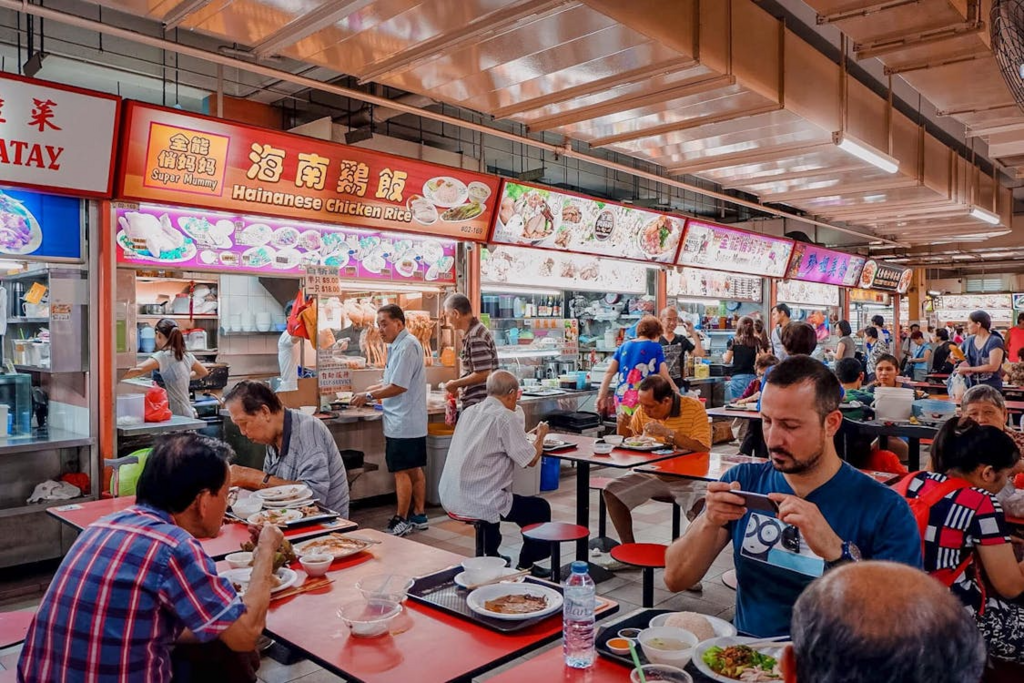
You notice the smell before you really see anything. Something smoky from a wok. Something sweet and slightly overripe drifting from the fruit stall. A machine whirring as sugarcane gets crushed for juice. It’s 9 pm. The air hasn’t cooled. And the hawker centre is still full – families, office workers, groups arguing over what to order next. In Singapore, that’s just a normal weeknight.
The surprising part isn’t just how good the food is. The city might look small on a map, but the food, the influence from different areas, its history, and the specialties are larger than the city itself. For many first-time visitors, food becomes the talk of the town afterward.
Arriving is simple enough, as it takes minutes to fill out and review the Singapore arrival card requirements ahead of your flight, so there are no surprises at immigration.
With that out of the way, the real business begins – eating your way through one of Asia’s greatest food cities.
Maxwell Food Centre
Maxwell isn’t the kind of place you “see” all at once. You sort of enter it mid-noise – trays clacking, people half-standing to claim seats, someone waving a tissue packet over a table to reserve it.
Most people check out the Tian Tian Hainanese Chicken Rice. The chicken is poached and sliced neatly, soft without falling apart, and the rice carries that deeper flavour that only comes from being cooked in stock. The chilli isn’t aggressively spicy, just sharp enough to make you notice it.
Walk first, see what smells good. Char siew from wherever the glaze looks right. Laksa, if you spot someone ladling it fresh. Popiah, if it’s being rolled to order. Kaya toast and soft-boiled eggs if you’re still hovering. Two people can eat very comfortably here – drinks included – and still hover around SGD $20 without trying too hard.
You’ll probably leave thinking about what you didn’t order.
Chinatown at Night

Chinatown doesn’t flip a switch at night. You notice it around Pagoda Street first, then Trengganu. More people than there were an hour ago. The lights feel brighter, or maybe it’s just darker everywhere else. Smoke from the satay grills hangs low and drifts sideways, depending on where you’re standing.
Some of the stalls are clearly for visitors. Yes, parts of it are touristy. Still, if you’re holding a paper plate of satay and the peanut sauce is dripping slightly over the edge, and you’ve found a plastic stool that isn’t completely stable, and there’s a cold Tiger beer sweating faster than you can drink it – it works.
Geylang: Where Locals Actually Eat at Midnight
Seasoned travellers know Geylang. The neighbourhood has a reputation, but its food scene is arguably the most authentic in the city – this is where Singaporeans themselves come late at night for durian, frog porridge, and claypot dishes. The streets are lit by neon signs and open-fronted restaurants that don’t close until 3 or 4 am.
Durian stalls line Geylang Road with signs rating varieties by price and intensity. If you’ve never tried it, this is the place to do it – vendors will let you sample before you commit. For the uninitiated, the taste is rich, custardy, and like nothing else on earth.
Lau Pa Sat: The Night Satay Street
Built in a Victorian cast-iron market hall in the heart of the financial district, Lau Pa Sat is one of Singapore’s most distinctive hawker experiences. By day, it functions as a standard food court. By night, the street alongside it – Boon Tat Street – closes to traffic and becomes an open-air satay corridor, with rows of stalls grilling chicken, beef, and prawn skewers over charcoal.
It draws a mixed crowd of office workers, expats, and tourists, and the atmosphere is lively and unhurried. Order a full skewer set, get the peanut sauce, and take your time.
Practical Notes for Travelers
You won’t struggle with transport here. A lot of people grab an EZ-Link card and forget about it – tap in, tap out, buses included. And if you’re tired or dressed up for dinner, Grab works exactly how you expect it to.
Food budgets are flexible. You can eat extremely well for SGD $4 – 8 at hawker centres – that’s normal, not a special deal. But it’s just as easy to spend far more in Marina Bay or along Orchard, especially if rooftop views are involved. Most visitors naturally alternate between the two without overthinking it.
The climate doesn’t really do seasons. It’s hot. It’s humid. Most days it is 30 – 32°C. It rains suddenly and disappears immediately, too.
Singapore takes food personally, so be prepared to experience Malay, Chinese, Indian, and Peranakan influences sitting side by side.