
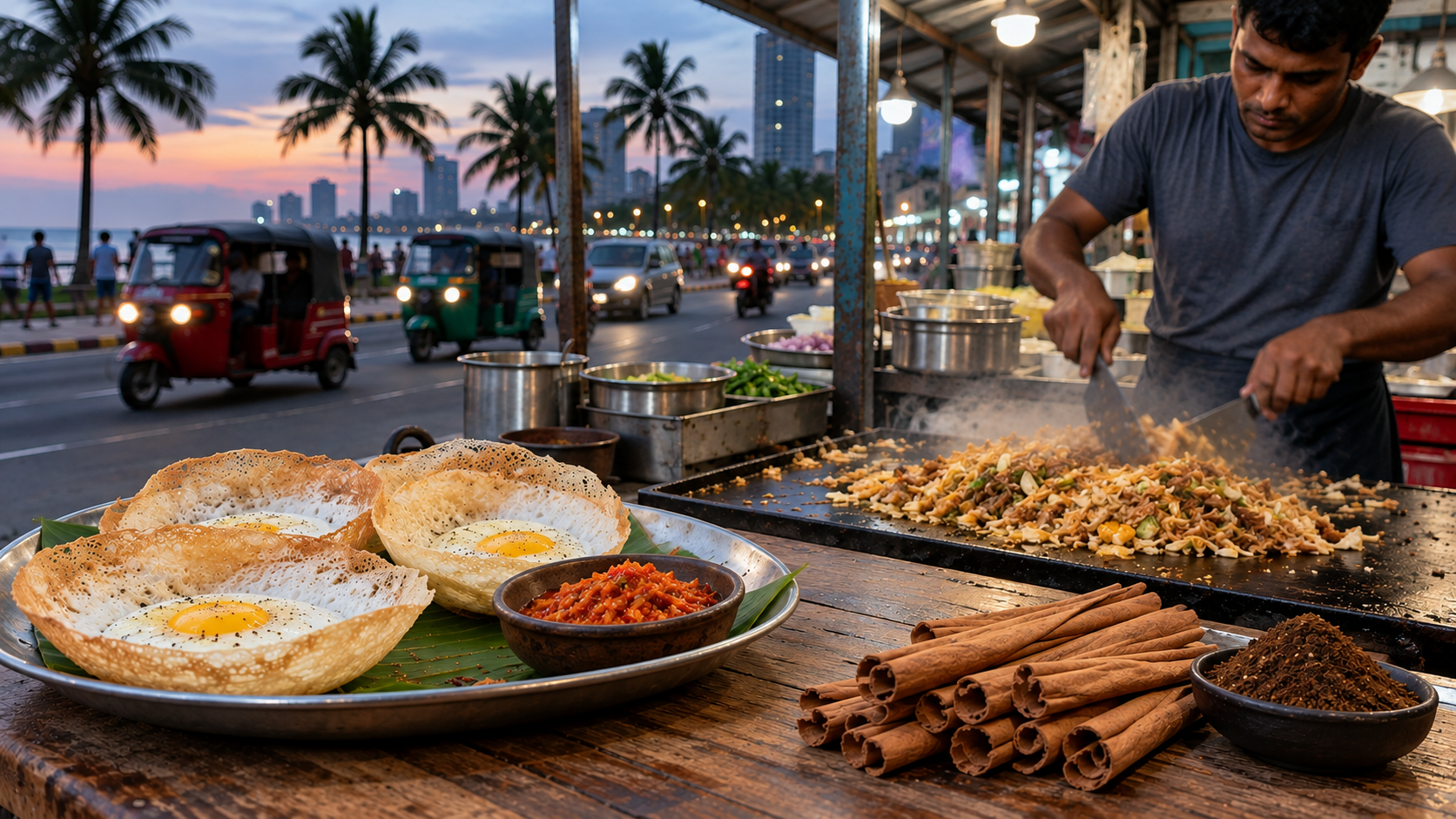
Walk down any busy road in Colombo after sunset and you’ll hear dinner before you see it. It’s the clang of two steel blades on a hot griddle, chopping flatbread, egg, vegetables and curry together at speed. That’s kottu, and it’s the sound of Sri Lankan street food.
Sri Lanka gets less attention than Thailand or Vietnam on most food trips, which is a shame. The island packs a huge amount into a small space: Tamil, Sinhala, Muslim and Dutch Burgher cooking, all sharing the same coconut, the same chilies and, quietly, the same cinnamon. If you’ve already eaten at Apollo Banana Leaf in Tooting, you’ve had a taste. Here’s what to look for on the island itself, and why one spice in particular tastes different there.
1. Kottu roti
Kottu is the late-night king. Cooks take godamba roti (a thin, stretchy flatbread), chop it on a flat iron plate with egg, cabbage, leeks and your choice of chicken, beef or cheese, then flood it with curry gravy. The result is somewhere between fried rice and a stir-fried noodle dish, only chewier.
Order it where the clanging is loudest. A busy kottu stall means the plate is hot and the turnover is fast. Ask for extra gravy on the side if you like it wet.
2. Hoppers and egg hoppers
Hoppers (appa) are bowl-shaped pancakes made from fermented rice flour and coconut milk, cooked in small curved pans. The edges go lacy and crisp, the middle stays soft. Crack an egg into the centre and you’ve got an egg hopper, which is the one to start with.
They’re an evening food, sold from roadside hopper shops that open as the light goes. Eat them with lunu miris (a red onion, chili and lime sambol) or seeni sambol, a sweet, slow-cooked onion relish. Tear the crisp edge, scoop, repeat.
3. Isso wade at Galle Face Green
On Colombo’s seafront promenade, Galle Face Green, the evening stalls sell isso wade: crunchy lentil fritters with whole prawns pressed into the top, served with a squeeze of lime and a spoon of chili. It’s a Colombo classic, best eaten with the sea breeze in your face. Go around sunset, when the crowds come out to fly kites.
4. Short eats
Every bakery and tea shop has a glass cabinet of “short eats”: fish buns, vegetable rolls, crumbed “Chinese rolls” stuffed with spiced potato and meat, patties and cutlets. You point, they plate, and you pay for what you eat at the end. It’s the cheapest lunch on the island and some of the best.
5. Lamprais
Lamprais comes from Sri Lanka’s Dutch Burgher community, and it’s a full meal in a banana-leaf parcel. Rice is cooked in meat stock with whole spices, then packed with a mixed meat curry, frikkadels (Dutch-style meatballs), seeni sambol, blachan (a shrimp paste sambol) and an eggplant curry. The whole thing is wrapped and baked, so the leaf perfumes everything inside.
Open one and the first thing you’ll smell is cinnamon and cardamom from the rice. Which brings us to the spice.
The spice in almost everything: Ceylon cinnamon
Sri Lankans call it kurundu, and it turns up in far more savoury food than most visitors expect. It’s in kaha bath, the yellow rice cooked with turmeric, cloves, cardamom and curry leaves for celebrations. It’s in the roasted curry powder that makes black pork curry so dark. It’s in the rice of a good lamprais, and in plenty of family recipes for watalappan, the jaggery and coconut custard that ends a big meal.
The cinnamon used there is a different species from the one most of us grow up with. Sri Lanka grows true cinnamon (Cinnamomum verum), mostly along the southwest coast around Galle, Matara and Kalutara. Most of the cinnamon sold in North American supermarkets is cassia (Cinnamomum cassia), a related tree. They’re both “cinnamon” on the label, but they don’t behave the same in the pot.
Here’s how to tell them apart:
| Ceylon cinnamon | Cassia | |
| What the stick looks like | Many paper-thin layers rolled into one quill | One thick, hard layer of bark, curled at the edges |
| What happens when you snap it | Crumbles and flakes | Resists, then breaks like wood |
| Flavour | Soft, sweet, a little citrusy | Hot, sharp, very strong |
| Coumarin | Only traces | Far more (food safety agencies advise limiting how much coumarin you eat) |
The flavour difference is the part that matters in street food. Cassia is loud. In a curry it can take over and taste like a dessert. Ceylon cinnamon sits underneath the chili, the tamarind and the curry leaves and rounds everything out, which is why Sri Lankan cooks can use it in nearly everything without anything tasting “of cinnamon”.
The quills are made by hand. Workers strip the outer bark from young cinnamon shoots, peel the soft inner bark in long sheets and roll them, one inside the other, into a single quill to dry. The thinnest, finest grade is called Alba. If you visit the south coast, you’ll pass small cinnamon gardens where you can watch it being done.
Bring it home: street-style yellow rice (kaha bath)
You can’t pack a kottu stall in your suitcase, but you can cook the rice that sits under half the island’s curries. This serves four.
1. Rinse 2 cups of basmati or samba rice until the water runs clear, then drain well.
2. Warm 2 tablespoons of ghee or coconut oil in a heavy pot. Add a 2-inch piece of Ceylon cinnamon, 4 cloves, 4 lightly crushed cardamom pods, a sprig of curry leaves and half a sliced onion. Fry for 3 minutes, until the onion softens and the curry leaves crackle.
3. Stir in the rice and 1 teaspoon of turmeric. Toast for 2 minutes so every grain is coated.
4. Add 1 cup of coconut milk, 2 cups of water and 1 teaspoon of salt. Bring to a boil, then cover and cook on the lowest heat for 15 minutes.
5. Turn off the heat and leave the lid on for 10 minutes before fluffing with a fork.
Serve it with any curry, or with a fried egg and a spoon of seeni sambol for a lazy version of a lamprais plate.
Two things make the biggest difference here. First, the cinnamon. Cassia will make this rice taste sweet and a little medicinal; true Ceylon cinnamon stays in the background the way it does in Colombo. Second, if you want to cook the curries that go with it, start with a proper roasted blend. A Sri Lankan roasted curry powder (coriander, cumin and fennel toasted dark, with Ceylon cinnamon, cardamom, cloves, curry leaves and pandan) is what gives black curries their colour and their smoky depth.
A note on buying cinnamon outside Sri Lanka
If the label just says “cinnamon”, it’s almost always cassia. Look for “Ceylon” or “Cinnamomum verum” on the pack, and if you can, buy whole quills so you can do the snap test yourself. Single-origin sellers such as WeeSpice, which source directly from Sri Lanka, list the species and grade on the pack.
One honest caveat: if you grew up on cassia, Ceylon cinnamon can taste too gentle at first. In a cinnamon roll you might miss the heat. In a curry, a rice dish or a cup of spiced tea, though, it’s the version that tastes like it does at the stalls.
Where to start on your first night
Land, get to Galle Face Green before dark, eat isso wade by the water, then follow the sound of the blades to the nearest kottu stall. Save the hoppers for the next evening and a lamprais for a long lunch. Somewhere in nearly every plate, you’ll be eating the spice that first brought traders to the island, without even noticing it.