
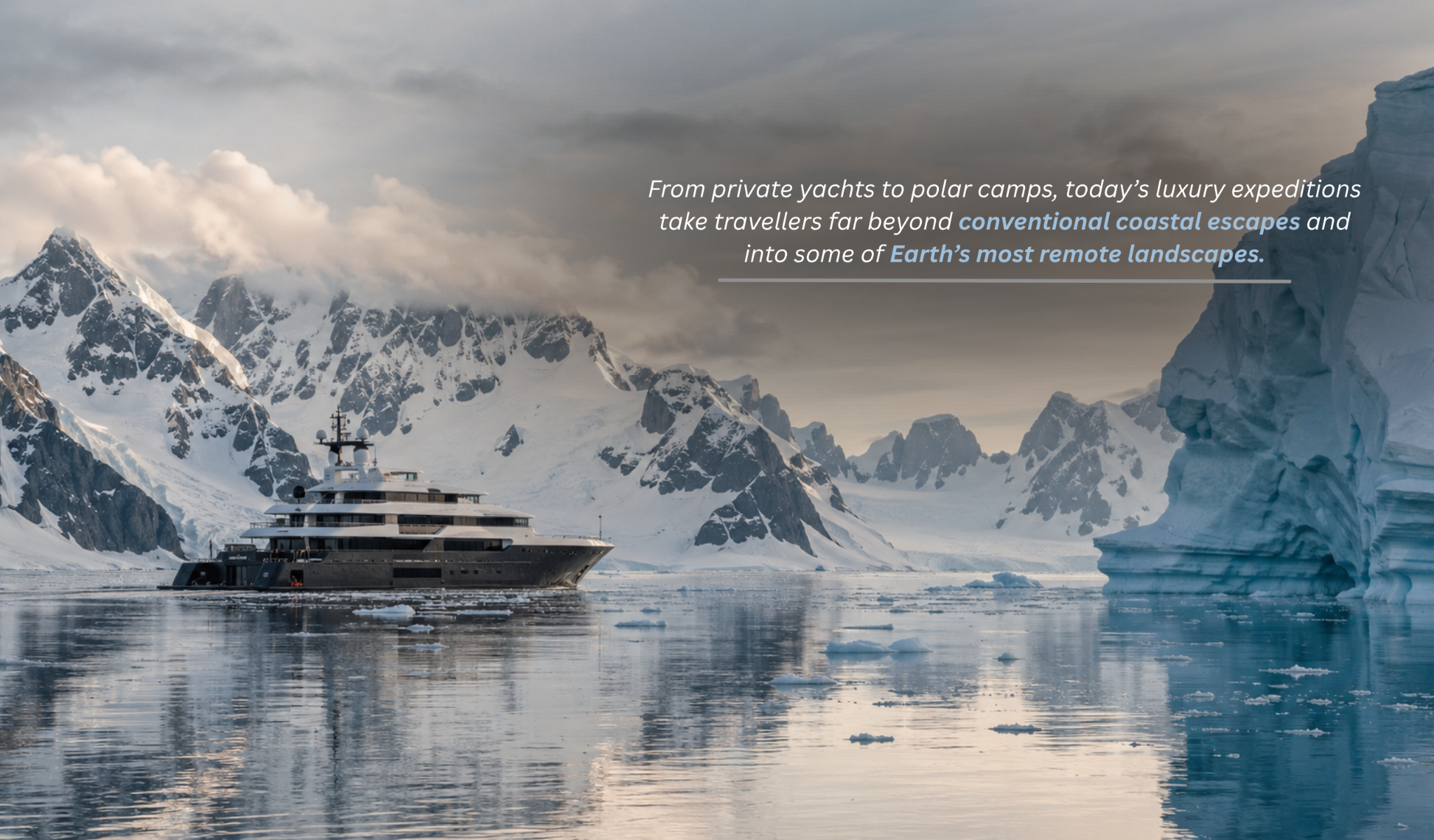
For many travelers, a memorable vacation begins beside the water. It might mean a quiet beach, a sailing trip or a few days exploring a coastal city.
For others, the ocean becomes the starting point for something far more ambitious.
Modern expedition travel is making some of the planet’s most remote environments accessible to private groups and small numbers of passengers. Travelers can now cross the Antarctic interior, kayak beneath glaciers, follow historic Arctic sea routes or position themselves beneath the shadow of a total solar eclipse.
Luxury in these environments does not only mean elegant cabins and carefully prepared meals. It can also mean specialist transportation, experienced expedition leaders, flexible schedules and the ability to reach places beyond conventional cruise routes.
These five expeditions offer very different ways to move from familiar coastlines toward the edges of the map.
1. Reaching the Geographic South Pole
The Geographic South Pole is not part of a typical Antarctica cruise.
Most cruise itineraries explore the Antarctic Peninsula, which extends toward South America and can be reached by crossing the Drake Passage. The South Pole lies deep within the continent at 90° South, surrounded by a vast polar plateau.
Reaching it requires specialist aviation, overland vehicles and careful contingency planning. Weather can delay aircraft and change the order of planned activities, so travelers must be comfortable with a flexible schedule.
Private expedition specialist EYOS designs journeys into the Antarctic interior around the interests and abilities of each group. Its experiences may include traveling toward the pole in purpose-built all-terrain vehicles, hiking through polar mountains or skiing across sections of the frozen continent.
Travelers researching luxury South Pole expeditions should look beyond accommodation alone. The most important questions involve the experience of the expedition team, the planned transportation, medical support and how delays will be managed.
EYOS states clearly that ice and weather require its South Pole itineraries to remain adaptable, with activities selected each day by the expedition leadership. That uncertainty is not a weakness in the journey. It is an unavoidable part of operating in one of Earth’s most isolated environments.

2. Exploring the Antarctic Peninsula by expedition yacht
The South Pole may be Antarctica’s most famous coordinate, but the Antarctic Peninsula offers a different kind of experience.
Here, steep mountains rise directly from the sea, glaciers descend into protected bays and icebergs drift through narrow channels. The region also supports colonies of penguins and populations of seals, humpback whales, minke whales and orcas.
Small expedition ships and private yachts can use Zodiac boats and kayaks to approach landing sites and quieter waterways. Travelers may explore areas such as the Lemaire Channel, Port Lockroy, Paradise Bay and the Weddell Sea, depending on weather and ice conditions.
EYOS operates private yacht expeditions in the region, while companies such as Lindblad Expeditions, Quark Expeditions and Ponant offer small-ship scheduled departures.
A private yacht gives one group greater control over its pace and priorities. A small expedition ship provides a social experience, a wider program of lectures and a lower cost per traveler. Neither is automatically better. The right choice depends on whether privacy or a shared expedition atmosphere matters more.
Any credible operator should also explain biosecurity procedures, wildlife-distance rules and the environmental guidelines governing shore visits. Expedition preparation includes permitting, crew briefings, emergency planning and guidance on responsible wildlife encounters.
3. Watching the 2026 total solar eclipse from Greenland
On August 12, 2026, a total solar eclipse will cross parts of northern Russia, Greenland, Iceland, the North Atlantic, Spain and a small area of Portugal.
Observers inside the narrow path of totality will briefly see the Moon completely cover the Sun, revealing the outer solar corona and turning daylight into an unusual twilight. NASA confirms that Greenland lies directly within the eclipse path.
Land-based viewing locations can offer easier access, but an expedition yacht has one important advantage: mobility.
Within the limits of safety, sea ice and operating permissions, a vessel may be able to adjust its position after reviewing cloud and weather forecasts. This cannot guarantee clear skies, but it creates more options than a fixed observation point.
The appeal extends beyond a few minutes of darkness. The surrounding journey offers the chance to explore one of Greenland’s most dramatic fjord systems, observe seabirds and experience the changing Arctic landscape under the guidance of expedition specialists.
4. Entering Southeast Alaska’s quieter waterways
Southeast Alaska provides an accessible introduction to expedition-style travel without requiring a journey to either pole.
Its coastline is formed by forested islands, glacier-carved fjords and narrow channels. Travelers may encounter humpback whales, bald eagles, sea lions and brown bears, although wildlife can never be guaranteed.
Large cruise ships visit the region’s established ports, while smaller vessels can spend more time in sheltered bays and less-traveled inlets.
EYOS private yacht expeditions may include kayaking through narrow waterways, rainforest hikes, glacier viewing and flightseeing over alpine lakes and moraines. The company emphasizes flexible planning so that the itinerary can respond to wildlife activity and changing conditions.
Lindblad Expeditions and UnCruise Adventures offer small-ship alternatives with guided kayaking, hiking and naturalist-led wildlife observation.
For travelers comparing options, vessel size matters. A private yacht may suit a family or group wanting privacy and control over the pace. A small expedition ship may appeal to travelers who prefer a structured program and the company of other passengers.
5. Following history through the Northwest Passage
The Northwest Passage crosses the Canadian Arctic through a complex network of islands, channels and sea ice.
For centuries, explorers searched for a navigable route connecting the Atlantic and Pacific oceans. Today, it remains one of the world’s most demanding expedition voyages.
A journey through the passage may include searching for polar bears, narwhals, beluga whales and walruses, exploring Arctic fjords and learning about the living cultures of northern communities.
The Northwest Passage requires more time and flexibility than a typical cruise. Travelers should expect possible route changes and understand that a full transit may depend entirely on ice conditions.
That unpredictability is central to its appeal. The journey follows a route shaped by centuries of exploration, but each modern passage remains dependent on the Arctic itself.

Planning for the extraordinary
Extreme travel should never be selected only because a destination looks impressive in photographs.
Prospective travelers should review the operator’s polar experience, emergency planning, vessel capability, insurance requirements and approach to responsible wildlife encounters. They should also understand what is guaranteed and what remains dependent on nature.
The finest expedition experiences do not pretend to remove uncertainty. They provide the expertise, equipment and flexibility needed to work safely within it.
Whether standing at 90° South, watching the Sun disappear above Greenland or following whales into an Alaskan fjord, the real luxury is not simply comfort.
It is the opportunity to reach a remarkable place with enough time, knowledge and specialist support to experience it properly.