
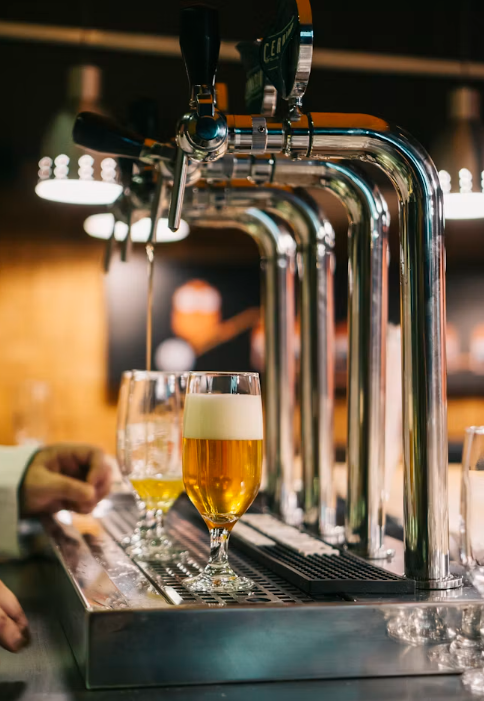
When you sit down at your favorite street food stall—whether you’re digging into spicy tacos, sizzling pad thai, or a greasy smashburger—there is nothing quite like pairing it with an ice-cold, perfectly crisp beer. As consumers, we tend to obsess over the hops, the malt profile, and the yeast strain. But there is a silent, highly technical hero working behind the scenes to ensure your beer looks, tastes, and feels exactly the way the brewer intended: the filtration process.
Beer filtration is fundamentally tied to both the appearance and the biological stability of the brew. Right out of the fermentation tank, beer is essentially a cloudy, turbid liquid. It is loaded with suspended coagulated matter, stray yeast cells, and complex proteins. If left untouched, not only would the beer look unappetizingly murky, but its shelf life and flavor stability would plummet.
To achieve that brilliant clarity and clean finish, breweries employ a meticulous three-stage filtration journey.
Stage 1: The Mash (Extracting the Liquid Gold)
Before beer even becomes beer, it is a hot, sweet liquid called wort, mixed with heavy grains. The very first step of filtration is separating these solids from the liquid.
At this stage, the mixture is at a high temperature and has a heavy solid content. To maximize efficiency, brewers often utilize a membrane filter press. The genius of this equipment lies in its physical mechanics: the membrane actually squeezes the residual filter cake (the spent grains) under high pressure. This ensures that every last possible drop of sugary, flavorful wort is extracted for the boiling process, minimizing waste and maximizing yield.
Stage 2: Post-Fermentation (Banishing the Haze)
Once the yeast has done its job and fermented the sugars into alcohol, the beer is left looking like a hazy soup. This is where the heavy lifting of purification happens.
To clear out the suspended yeast and protein particulate, breweries will run the liquid through a dedicated beer filter system. The most common and effective tools for this job are candle filters or a stainless steel plate and frame filter press.
- The Pre-Coat Method: Because the particles causing the haze are incredibly fine, simply pushing the beer through a metal screen isn’t enough. Both candle and plate filters typically require a “pre-coat” of diatomite (diatomaceous earth).
- How it Works: This fine, naturally occurring powder acts as a microscopic sieve, catching the sticky proteins and yeast cells while letting the pure, clarified beer flow through.
Stage 3: The Final Polish (Before Bottling)
Even after the heavy filtration, the beer isn’t quite ready for the bottle or keg. To guarantee abiotic stability (meaning the beer won’t suddenly develop off-flavors or new haze while sitting on a store shelf), it must undergo one final polish.
Because the remaining impurities at this stage are nearly invisible to the eye, brewers use a microporous pleated cartridge filter. These cartridges operate on a microscopic scale—often using a 0.22-micron pore size. This ultra-fine barrier catches any rogue microorganisms or microscopic debris, resulting in the brilliantly clear, highly stable beer that is finally ready to be packaged and shipped out.
A great recipe is only half the battle in brewing. The ability to execute that recipe consistently, keeping the beer biologically stable and visually flawless, relies entirely on the precision of the brewery’s setup. Behind every crisp, refreshing lager that washes down your favorite street food is a complex network of high-quality filtration equipment ensuring that what ends up in your glass is nothing short of perfect.