
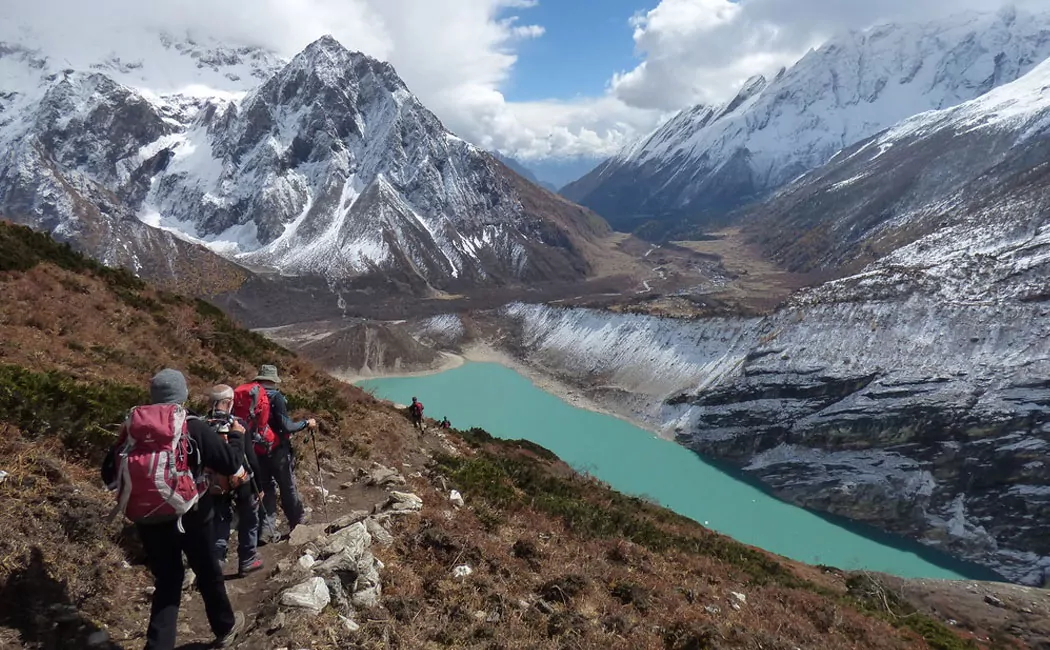
Most people arrive in Nepal, spend a few days wandering the temples and souvenir alleys of Kathmandu, snap the obligatory photos of Boudhanath and Durbar Square, and leave thinking they’ve seen the country. They haven’t, not really. Kathmandu is loud, chaotic, and genuinely worth a visit, but it’s also a filter — a place where Nepal gets condensed into something manageable for a short holiday. The real texture of the country, the part that actually changes how you think about the place afterward, tends to live somewhere out past the ring road, up a trail, past the last bus stop.
Nepal trekking has a way of pulling that curtain back. Walk for a few days through the hills and you start running into mountain villages where life still moves at the pace of the harvest and the weather, not a booking calendar. You end up drinking tea with a farmer’s family instead of a waiter, sleeping under a tin roof instead of a hotel ceiling, and figuring out — slowly, on foot — what daily life in the Himalayas actually looks like. This isn’t a checklist of viewpoints. It’s a case for slowing down and letting Nepal show itself on its own terms, through its trails, its food, and the people who actually live there.
Why Going Beyond Kathmandu Changes the Nepal Experience
There’s a pretty clear line between visiting Nepal as a sightseeing destination and experiencing it through the communities scattered across its hills. In Kathmandu you’re mostly a spectator — moving between monuments, guided by a map, occasionally haggling over a pashmina. Once you leave the valley, that dynamic shifts. The trails get quieter. Farming settlements replace tourist districts. Prayer flags snap in the wind above stone houses, mani walls line the paths, and you start noticing livestock being herded home in the late afternoon light.
None of this is really about bagging a famous viewpoint, though the views do tend to be extraordinary. It’s about the accumulation of small, ordinary things you notice only because you’re walking rather than being driven: kids in uniforms heading to a one-room school, a porter balancing an impossible load with a strap across his forehead, someone stacking firewood before the weather turns. If there’s one piece of practical advice worth repeating here, it’s this — don’t rush the transition from Kathmandu to the mountains. Give yourself an extra day or two of buffer. Trekking on a tight schedule tends to flatten the experience into just another itinerary item.
What Travelers Notice on the Trail
- Small, unscripted interactions in village teahouses
- Stone architecture that shifts style from one valley to the next
- Prayer wheels, mani walls, and small roadside shrines
- Terraced fields and mountain agriculture
- The rhythm of teahouse life — cooking, cleaning, hosting
- Food, language, and even clothing changing noticeably with altitude
Himalayan Villages: Where the Journey Feels More Personal
It’s tempting to talk about trekking routes purely in terms of destinations — this pass, that glacier, this viewpoint. But honestly, the villages are where the trip gets personal. Mountain settlements in Nepal run on a mix of subsistence farming, seasonal tourism, livestock, and whatever schooling or monastery life the community can sustain. Stop in one for a night and you’ll see all of that happening at once, often within view of your teahouse window.
A bit of etiquette goes a long way here. Ask before photographing someone’s home or their kids — it’s their front yard, not a backdrop. A simple “namaste” goes further than you’d expect, even if your Nepali stops right there. And where possible, choose to stay in family-run teahouses rather than the newer, more generic lodges that have started popping up on busier routes; the difference in the experience is noticeable, even if the rooms look about the same.
It’s also worth setting expectations honestly: the higher you climb, the simpler things get. Hot showers become buckets, menus shrink, and electricity might mean one outlet shared by twelve trekkers. None of that is a complaint — it’s just what altitude does to infrastructure, and most travelers find they adjust within a day or two.
The Manaslu Circuit Trek is a good example of a route built almost entirely around this kind of experience. It winds through Gurung and Tibetan-influenced villages, crosses dramatically changing landscapes, and puts you in close, regular contact with mountain communities rather than just passing through them on the way to a summit photo. It’s less a “mountain challenge” and more a slow unfolding of village life at increasingly higher altitudes — which, for a lot of trekkers, ends up being the more memorable part of the trip.
Traditional Nepali Food: What You Actually Eat in the Mountains
Food is one of the fastest ways into understanding a place, and Nepal’s trekking regions are no exception. Most days on the trail revolve around dal bhat — rice, lentil soup, a vegetable curry, sometimes a pickle or a bit of meat if you’re lower down — and for good reason. It’s filling, it’s usually all-you-can-eat, and guides have a running joke about “dal bhat power, 24 hour” that’s only half a joke. Alongside it you’ll find potatoes cooked a dozen different ways, noodle soups, momos, the occasional Tibetan bread, fried eggs, and endless cups of milk tea.
What’s on the menu shifts as you climb. Fresh vegetables become scarce above a certain elevation simply because nothing grows up there and everything has to be carried or flown in. Meat largely disappears from menus at altitude for both practical and cultural reasons. The sensible approach is to lean into carbohydrates, drink more water than feels necessary, and pick freshly cooked food over anything that’s been sitting around — altitude is not the place to gamble on last night’s leftovers.
Eating in a Kathmandu restaurant and eating in a small mountain teahouse are really two different experiences. One is a menu; the other is often a family cooking in the next room, and dinner turns into the social center of the evening — trekkers, guides, and porters all crowded around the same table, swapping stories about the day’s climb.
Meeting Local People: Guides, Porters and Mountain Communities
A good guide does more than point you toward the trail. The ones who’ve grown up in these hills carry an entire unwritten library — which village makes the best rakshi, which monastery is worth the detour, how the weather usually breaks this time of year, which family’s teahouse has the warmest stove. That kind of knowledge doesn’t show up in a guidebook, and it’s often the difference between trekking through a region and actually understanding a little of it.
The relationship works both ways, though. Communicate clearly about your pace and expectations, pay agreed fees on time and in full, and pay attention to how your porters are treated — proper gear, fair loads, decent rest. It’s easy to treat support staff as background logistics, but a lot of the most interesting conversations on a trek happen with the person walking two steps behind you, not the person you paid to lead.
Nepal’s trekking regions cut across a genuinely wide range of ethnic and cultural communities — Sherpa, Gurung, Tamang, Thakali, and others — each with its own customs, festivals, and relationship to the mountains. Being a respectful traveler here doesn’t mean forcing your way into someone’s private life for a good photo. It means asking, listening, and accepting that you’re a guest passing through someone else’s home turf.
From Trekking Trails to Serious Mountaineering

It’s worth drawing a firm line between trekking and mountaineering, because the two get lumped together more often than they should. Standard trekking routes follow established trails, don’t require technical climbing skills, and can still deliver some genuinely dramatic Himalayan scenery — no rope or ice axe needed.
Mountaineering is a different category altogether. Once you’re talking about summit attempts rather than trail walking, factors like acclimatization schedules, physical conditioning, unpredictable weather windows, climbing permits, technical gear, and specialized skills all move to the center of the planning. The Ama Dablam Expedition is a clear example of this shift — it’s not a natural next step up from a village trek, it’s a different undertaking entirely, involving fixed ropes, technical climbing sections, and a level of preparation that goes well beyond hiking fitness.
Neither approach is “better.” Trekking is about walking, villages, food, and landscape unfolding gradually. Mountaineering adds technical climbing, sharper risk management, and a mountaineering objective on top of all that. Knowing which one you’re actually signing up for matters more than it might seem before you’ve committed to either.
A More Authentic Mountain Day: What the Experience Really Feels Like
A typical trekking day starts earlier than you’d probably choose at home — cold air, a headlamp maybe still on, the trail mostly silent except for your own footsteps and the occasional bell from a passing mule train. Breakfast is usually simple: eggs, toast, tea, maybe porridge if the teahouse has oats. Then it’s walking through villages as they wake up, stopping for tea somewhere along the way, and trying to get into camp or the next teahouse with enough daylight left to actually see where you’ve landed.
The trail itself is rarely as tidy as it looks in photos — stone steps that go on longer than expected, uneven paths, the occasional suspension bridge swaying more than you’d like, dust in the dry season, mud in the wet one. None of this is meant to discourage anyone; it’s just realistic. The best strategy at altitude is a comfortable, almost boringly steady pace — “bistari, bistari,” as guides like to say, slowly, slowly.
And honestly, the moments people remember afterward are rarely the dramatic viewpoint shots. It’s more often the ordinary stuff — a conversation with a shopkeeper, an unplanned stop to watch someone thresh grain, a slow cup of tea with nowhere particular to be. Leave some room in the schedule for that. A trek packed wall-to-wall with fixed stops tends to leave less space for anything unplanned to happen.
Practical Planning for a Culture-Focused Nepal Trek
Choosing a route around the kind of experience you want, rather than just the highest altitude you can reach, tends to produce a more satisfying trip. Think about how much village life you want built into the days, how much cultural exposure matters to you, how many days you realistically have, and what level of trail difficulty and accommodation you’re comfortable with. A slower itinerary — even a couple of extra days spread across the same route — usually buys more time to actually sit with a community rather than just pass through it.
On the packing side, keep it practical: proper layers for temperature swings, broken-in trekking shoes, a reusable water bottle, decent sun protection, any personal medication you need, and some cash in smaller denominations since card payments are rare once you’re off the main road. Trail conditions, permit requirements, weather patterns, and transport options can all shift from season to season, so it’s worth checking current conditions close to your departure date rather than relying on older information.
And a few habits worth carrying the whole way: cut down on plastic waste where you can, respect local customs around dress and behavior near monasteries and homes, stick to established trails rather than cutting across farmland, and put your money toward local teahouses and guides rather than larger outside operators whenever the choice is there.
The Mountains Are Only Part of the Story
Strip away the marketing language and Nepal was never really about a single famous peak in the distance. The mountains matter, but what makes the trip stick with you is everything layered around them — the villages, the food, the conversations, the small daily routines you happen to walk past. Kathmandu gives you the introduction; the trails give you the rest of the story, and it’s a considerably longer one.
Travelers who slow down tend to notice more than those focused purely on reaching the next milestone. So when you’re planning your route, it’s worth asking yourself what you actually want to remember a year from now — probably not just the number on the altitude sign, but the tea, the conversations, and the villages you passed through to get there.
Frequently Asked Questions About Experiencing Nepal Beyond Kathmandu
1. What is the best way to experience Nepal beyond Kathmandu?
Trekking through mountain villages is one of the most practical ways to see rural landscapes, connect with local communities, and experience Himalayan food and culture firsthand, rather than only from a bus window.
2. Which Nepal trekking routes offer strong cultural and village experiences?
Routes vary quite a bit by region, so it’s worth comparing them on village life, cultural heritage, landscape variety, trek duration, and difficulty — not just on which one climbs the highest.
3. What food can I expect while trekking in Nepal?
Expect dal bhat, momos, noodle soups, potatoes, seasonal vegetables, eggs, bread, and plenty of tea, with the exact menu narrowing the higher up you go.
4. Do I need a guide for trekking in Nepal?
Requirements differ by route and can change with current regulations, but even where a guide isn’t mandatory, a local guide typically adds real value through navigation, cultural context, and general safety support.
5. Is Himalayan trekking the same as a mountaineering expedition?
No — trekking generally follows established trails without technical climbing, while a mountaineering expedition can involve specialized equipment, climbing skills, longer acclimatization schedules, and considerably more expe